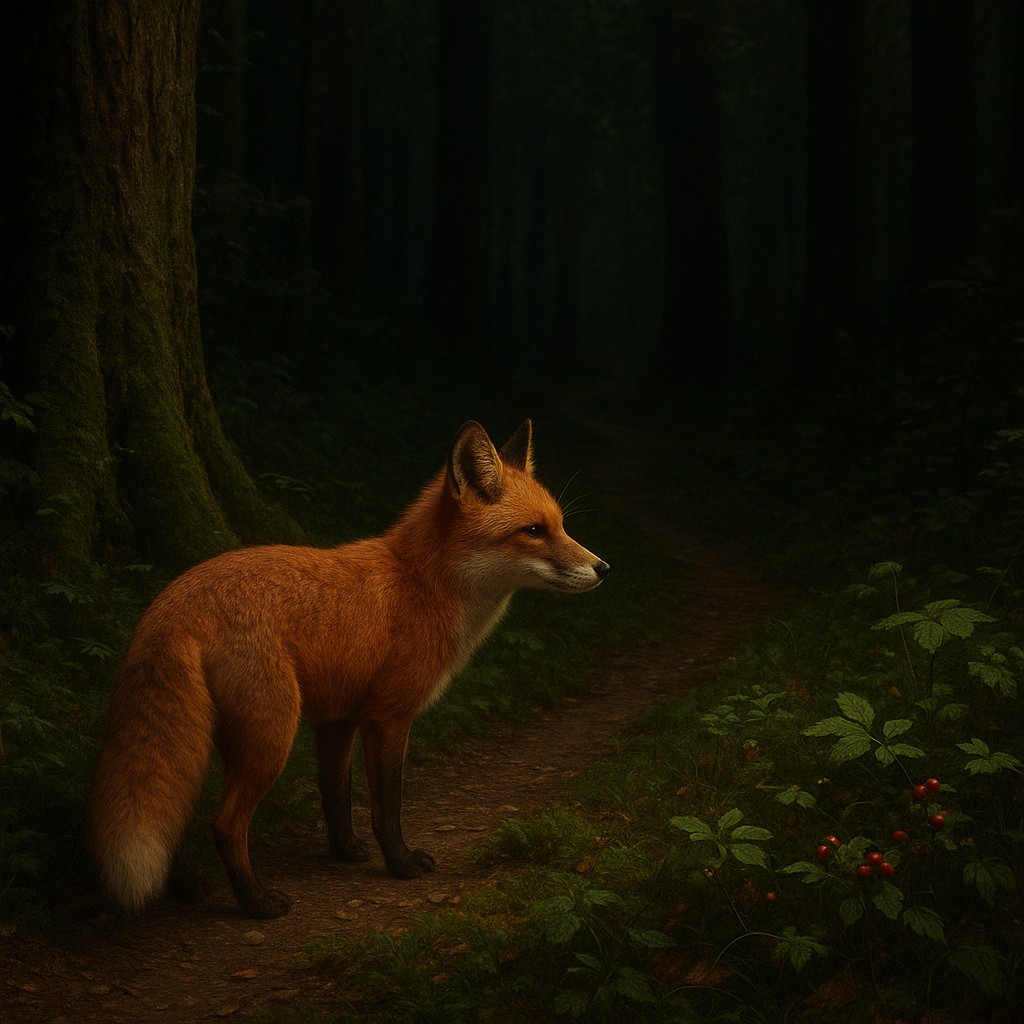
Imagine you are a fox standing at the edge of a thick, dark forest. Your stomach is growling, and your survival depends on finding a meal without wasting precious energy. You sniff the air, scanning for the faint trail of a rabbit or the sweet smell of wild berries. You have to make a split-second choice: is it worth chasing a scent that might lead to nothing, or should you head toward a different part of the woods? Every move you make is a high-stakes gamble where the "cost" is your physical stamina and the "benefit" is a full belly. If a scent grows weak, you do not stick around out of politeness to the forest; you pivot and find a more promising path.
Now, picture yourself on your sofa, scrolling through Google results or navigating a complex news site. While you aren't literally hunting rabbits, your brain is firing in almost exactly the same way as that hungry fox. You scan blue links and bold text, looking for a "scent" that promises the answer to your question. You are solving a silent math problem in your head, weighing the effort of clicking and waiting for a page to load against the chance that the page actually has what you need. This is not just a metaphor. It is the foundation of Information Foraging Theory, a framework that explains our online behavior by looking at our ancient, evolutionary roots.
The Evolutionary Blueprint of Your Browser Tab
To understand why bad website menus are so frustrating, we have to look back at our ancestors. For millions of years, humans and their predecessors survived by being efficient foragers. If you spent more calories digging for a root than the root provided in nutrition, you died. This biological necessity created a "cognitive miser" mentality. We are naturally designed to seek the most information (or energy) for the least amount of effort. When you land on a webpage, your brain treats that site as a "patch" of land. If the patch looks lush and full of keywords that match what you crave, you stay. If it looks barren, cluttered, or confusing, your primal instincts scream at you to move to a greener pasture, which in the modern world means hitting the "back" button.
Researchers Peter Pirolli and Stuart Card formally studied this behavior at Xerox PARC in the 1990s. They noticed that web users did not read pages from start to finish like a book; instead, they scanned them like predators. They coined the term "Information Foraging" to describe this. The theory suggests that humans follow the same "Optimal Foraging Theory" found in biology. In nature, an animal stays in a patch of food as long as the rate of finding snacks is higher than the average rate of finding food elsewhere, minus the "travel time" to get to a new spot. On the internet, your travel time is the few seconds it takes to type a new URL or click a different link. Because travel time online is so short, our threshold for staying is also incredibly low. We are the most impatient hunters in history.
Tracking the Scent of Information
A central concept of this theory is the "Scent of Information." This is the trail of cues, such as labels, icons, and link descriptions, that suggest where the "prey" (the information) might be hiding. Imagine you are looking for a lemon cake recipe on a massive cooking website. You see a menu item labeled "Desserts," another labeled "Baking," and a search bar. Your brain immediately calculates which one has the strongest scent. "Baking" is good, but "Desserts" might be more specific to your goal. If you click "Desserts" and see a section for "Cakes," the scent gets stronger. You feel a hit of dopamine because you are closing in on the kill.
If the scent is strong, users are willing to click through multiple pages. However, if the scent is weak or vague, a user’s confidence drops. A menu label like "Resources" or "Miscellaneous" has a very weak scent because it could contain anything from a manual to a corporate blog post. In the world of design, clarity beats cleverness every time. A witty button that says "Let’s Get Cooking!" has a much weaker information scent than a boring, literal button that says "View Recipes." Your inner fox does not want to solve a riddle; it wants to know exactly where the berries are.
The Mental Balance of the Click
When we forage, we constantly evaluate the "Information Utility" of our actions. This is like a simple equation: Value divided by Cost. The "Value" is how much the information helps us reach our goal, and the "Cost" is the time, mental effort, and physical clicking required to get it. This is why long articles often use subheadings like the ones you are reading now. A heading acts as a "mini-scent" that lets you skip parts of the patch that do not interest you, reducing your cost while keeping the value high.
| Foraging Element |
Animal Context (Forest) |
User Context (Web) |
| The Patch |
A specific bush full of berries |
A single website or search result page |
| The Prey |
A rabbit or a nut |
The specific answer, fact, or file needed |
| The Scent |
The smell of prey or tracks in the dirt |
Link text, icons, and page titles |
| Travel Time |
Running from one clearing to another |
Loading a new page or switching tabs |
| Cost-Benefit |
Calories spent vs. calories gained |
Time spent clicking vs. usefulness of content |
This table shows how the biology of survival maps directly onto the psychology of browsing. Notice how "Travel Time" in the digital world has shrunk to almost zero. In the physical world, if a fox leaves a patch of berries, it might take ten minutes to find another one. On the web, if you leave a site, you are back at Google in less than a second. This low travel time is exactly why modern users have such high expectations. We are pushed away from bad patches much faster than animals are, simply because the cost of leaving is so low. If we do not find a strong scent immediately, we migrate.
When the Scent Leads to a Trap
One of the most dangerous things a designer can do is create a "False Scent." This happens when a link or a headline promises exactly what you are looking for, but the destination page does not deliver. On the internet, we call this clickbait. You see a headline like "How to fix your leaky faucet in three minutes," which provides a strong, irresistible scent. You click it, giving up your energy to load the page, only to find a long introduction about the history of plumbing and a video that does not work.
This creates a "negative scent" for the future. Just as an animal learns to avoid a part of the forest where the food is always rotten, users learn to distrust certain types of links or specific websites. When the scent is strong but the reward is low, the perceived cost of all future visits to that site goes up. This is why relevance is the gold standard of the web. It is not enough to get someone to click; you must satisfy the hunt. If the hunter reaches the end of the trail and finds no prey, they will not come back. The information scent must be maintained from the first glance at a search result all the way to the last sentence of the article.
Reducing the Effort of Digestion
Once a user decides to "eat" the information on your page, the next hurdle is the cost of consumption. An animal does not just find food; it has to chew and digest it. Similarly, once you find the right page, you have to read it. If the text is a massive "wall of words" with no breaks, your brain sees it as a high metabolic cost. It looks like too much work. To keep the forage successful, writers and designers use "Information Enrichment" techniques to make the content easier to swallow:
- Bullet points and lists: These act as bite-sized morsels that are easy to process quickly.
- Bolded keywords: These serve as visual beacons, allowing the forager to scan for the most nutritious parts of the paragraph.
- High-contrast visuals: Images and diagrams provide a lot of information with very little mental effort.
- Progress bars: These show the forager exactly how much more energy they need to spend to finish the patch.
By reducing the "Interaction Cost," you make the patch more profitable for the user. A well-organized, long article can actually feel shorter than a messy short one because it takes less mental effort to navigate. Your goal is to make the user feel as if they are gliding through the information, picking up facts as easily as a bird picking seeds off a sidewalk, rather than a mole digging through heavy clay.
Designing for the Digital Predator
Understanding Information Foraging lets us see the internet through a more empathetic lens. We aren't just "users" or "traffic stats"; we are biological beings trying to find our way in a world overflowing with data. When we design websites, write emails, or organize digital files, we should ask: "If a hungry animal were looking at this, would they stay or would they run?" By providing clear markers and honest promises, we respect the ancient, efficient machinery of the human brain.
As you navigate the digital wilderness, keep an eye on your own "inner hunter." Notice the small thrill you feel when a link looks perfect, and watch for that moment of irritation when a page takes too long to load or fails to provide the scent you were promised. You have inherited a magnificent system for sorting through chaos. By mastering the art of the scent, you can learn to forage more effectively, and more importantly, you can create digital spaces that truly nourish everyone who wanders into your patch of the forest. Leave a clear trail, make the honey easy to reach, and never lead your fellow foragers into a dead end.