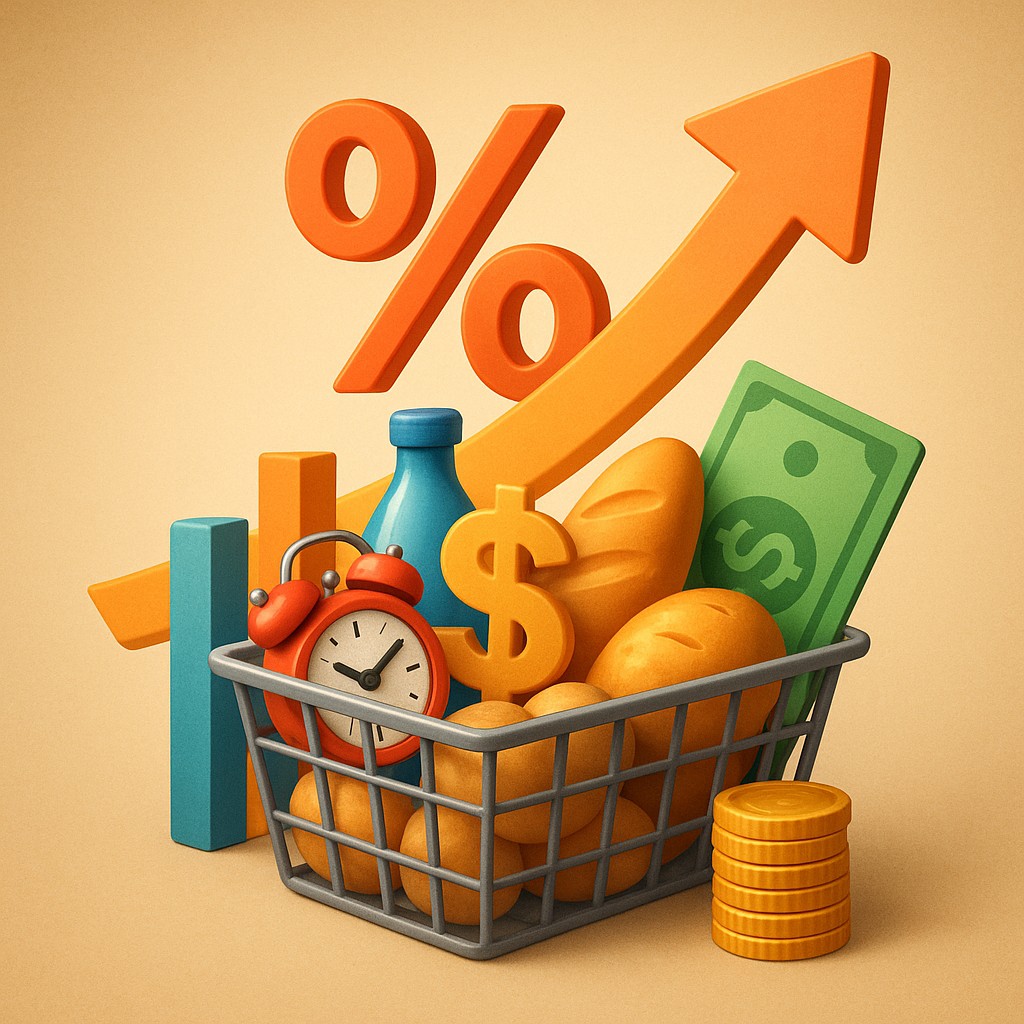
Imagine you walk into your favorite snack shop with $5. Last week, $5 got you a big bag of chips and a drink. Today, the same $5 only gets you the chips, and the drink costs extra. You did not suddenly forget how to shop. Something else changed: prices went up.
Now picture that happening to lots of things, not just snacks. Bus tickets, video games, school supplies, pizza, even haircuts. When many prices rise across the whole economy, slowly or sometimes fast, that is called inflation. It is basically the “prices are climbing” effect, and it matters because it changes what your money can do.
Inflation sounds like a grown-up word, but the idea is simple. Money is like a coupon you trade for stuff. Inflation is what happens when that coupon gets a little less powerful over time, so you need more coupons (more dollars) to get the same things.
Money is a “buying-power token,” and inflation is when it buys less
The simplest explanation of inflation a 12-year-old can understand is this: inflation means money loses some of its buying power. If something cost $10 and later costs $11, your money did not change, but what it can do changed. You now need more money to buy the same thing.
One easy way to picture it is to think of money like points in a game. If a sword used to cost 100 points and now costs 120 points, your points are not “fake,” but they do not go as far. Inflation is like the game store quietly bumping up prices.
This is also why adults sometimes say, “Everything is so expensive now!” They are noticing inflation. Not every single price goes up at the exact same moment, but when lots of prices rise on average, inflation is happening.
A kid-sized story: the cafeteria cookie economy
Let’s build a tiny economy with something that matters: cookies. Suppose your school cafeteria sells cookies for $1 each. Most kids usually bring $2, so they buy two cookies. Everything feels normal, and the cookie price seems “fair” because it fits what people can pay.
Now imagine a kind aunt gives money to every student, and suddenly most kids bring $4 instead of $2. The cafeteria still bakes the same number of cookies each day. So what happens when more money shows up but the cookie supply stays the same? More kids try to buy more cookies than there are cookies.
The cafeteria has a choice: sell out right away and disappoint half the line, or raise the price. If they raise cookies from $1 to $2, fewer cookies get snapped up by the first ten kids, and more cookies are left for everyone else. That price jump is inflation in a small, clear example: more money chasing the same amount of stuff.
Real economies are bigger and messier than cookies, but the basic idea still holds. Inflation is often tied to a mismatch between how much people are ready to spend and how many goods and services are available.
Two main engines that push prices up
Inflation can happen for different reasons, but most explanations fit into two big buckets. Think of them as two ways prices get pushed upward.
When demand runs ahead of supply
This is often called “demand-pull” inflation, but you do not need the fancy name. Here is the plain version: people want to buy more than the economy can easily make right now. If everyone suddenly wants bicycles and bike factories cannot make enough fast, bike prices rise.
This can happen when people get extra money (raises, new jobs, government payments), or when everyone feels confident and ready to spend. Prices rise because sellers see that customers will still buy even if the price is higher.
When it becomes more expensive to make things
The other big engine is this: it costs more to produce stuff, so businesses raise prices so they do not lose money. If the price of wheat rises, bread may cost more. If electricity costs more, running a factory costs more. If shipping is disrupted, moving goods costs more.
This is often called “cost-push” inflation. Again, you do not need to memorize the label, just the idea: when ingredients and labor cost more, the final product often does too.
Inflation can come from either engine, or both at the same time, which is when it can feel like prices are climbing everywhere.
The “invisible average”: not every price changes equally
One tricky part of inflation is that it is usually measured as an average. That means some prices might rise a lot, some rise a little, and some might even fall. Technology is well known for getting better and cheaper over time. A phone today can be more powerful than an older one while costing the same, or even less.
But if food, housing, and transportation rise, you feel it more because those are things people buy all the time. This is why two people can argue about inflation and both feel right. One might say, “Prices are out of control!” (because groceries went up), while another says, “I got a great deal on a TV.” Both can be true.
To make this clearer, here is a simple table that separates a few related ideas people often mix up:
| Idea |
What it means |
Quick example |
| Inflation |
Prices rise on average, money buys less |
A basket of everyday items costs $100, later $105 |
| Deflation |
Prices fall on average, money buys more |
That same basket drops from $100 to $95 |
| Price increase (one item) |
One product gets more expensive, not necessarily everything |
Only concert tickets rise because the band got popular |
| Purchasing power |
How much stuff your money can buy |
$20 buys 4 sandwiches, later only 3 |
Common myths that make inflation sound scary (and what is actually true)
Inflation often gets talked about like a monster under the bed, so let’s shine a light on a few myths.
Myth 1: “Inflation means companies are just being greedy”
Sometimes companies do raise prices to boost profit, and competition often limits how far they can go. But inflation across the whole economy is bigger than one bad guy twirling a mustache. It can come from supply problems, higher costs, lots of spending, or changes in money and credit. Blaming only “greed” is like blaming only the oven when cookies burn, you are ignoring the recipe, the timer, and the temperature.
Myth 2: “Inflation means everything doubles overnight”
Most inflation is gradual, like a slow leak in a bike tire. A little air escapes each month, not all at once. When inflation gets extremely high extremely fast, that is a special and rarer case called hyperinflation. It is dramatic, but it is not the usual day-to-day kind.
Myth 3: “If prices go up, that means we are all poorer”
Not always. If your allowance, wages, or family income rises at about the same speed as prices, you may not feel worse off. The real problem is when prices rise faster than income, then people can afford less. Inflation is like a moving sidewalk: if you walk at the same speed, you keep up, but if you stand still, it carries you backward.
Myth 4: “Inflation is always bad”
High inflation can cause real problems, but a small amount of inflation is normal in many countries. Economies change, people get raises, and businesses invest. Many central banks aim for low, steady inflation because it often goes along with stable growth. The goal is not “zero change forever,” the goal is “prices are steady enough that people can plan.”
How countries track inflation without counting a million price tags
No one measures inflation by racing through every store with a clipboard. Instead, economists use something like a “basket” of common items and services people buy, like groceries, rent, clothes, transportation, and medical care. Then they track how the cost of that basket changes over time.
If the basket cost $200 last year and $210 this year, inflation is about 5 percent for that basket. Notice the key word: basket. Your personal basket might be different. If your family drives a lot, gas prices matter more. If your family rents, rent matters more. Inflation is a national average, but your own experience can feel higher or lower.
The role of central banks: turning the “money temperature” up or down
A big player in the inflation story is the central bank, like the Federal Reserve in the United States. Central banks do not set the price of pizza directly, sadly (imagine that job interview). What they do influence is how easy it is to borrow money, and how much money flows through the economy.
When borrowing is cheap, people and businesses take more loans. That often means more spending on houses, cars, and projects, which can push demand up. When borrowing gets more expensive, people usually slow down spending and businesses may pause expansion plans.
Central banks often raise interest rates to cool inflation and lower them to support the economy when it is weak. It is like adjusting a thermostat. If the room is overheating (prices rising too fast), you turn the heat down. If it is too cold (people not spending, businesses not hiring), you turn the heat up.
This does not work instantly. It can take months for interest rate changes to spread through jobs, spending, and prices. That delay is why managing inflation is hard. It is more like steering a big ship than riding a scooter.
Why inflation can feel unfair, even when it is “just math”
Inflation hits different people in different ways. If you have savings sitting in cash, inflation slowly takes a bite out of it. If you owe money with a fixed interest rate, inflation can actually make that debt feel smaller over time because you pay it back later with “less powerful” dollars.
Here are a few ways inflation shows up in real life:
- Savers may feel annoyed because money saved buys less later if it does not earn interest.
- Workers may feel squeezed if wages do not rise as fast as prices.
- Borrowers with fixed-rate loans may feel some relief, because what they owe stays the same while wages might rise over time.
- People on fixed incomes can struggle because their income stays the same while prices climb.
This is why people argue about inflation so much. It is not just an economic number, it is something you live through.
A simple memory tool: the three S’s of inflation
If you want a quick way to remember what usually drives inflation, try the three S’s:
1) Stuff (supply)
If there is not enough stuff (or services) to go around, prices tend to rise. Shortages push prices up because people compete for limited goods.
2) Spending (demand)
If everyone is spending more, businesses can raise prices because buyers keep buying. Demand grows faster than supply, and price tags creep upward.
3) Squeeze (costs)
If it costs more to make and move things, businesses often pass those costs along through higher prices. Costs squeeze companies, and that squeeze can reach your wallet.
If you can explain “stuff, spending, squeeze” to a friend, you already understand the basics better than many adults at a dinner table.
Putting it all together with one clear example
Say a big storm damages farms (less stuff), and at the same time lots of people buy extra food because they are worried (more spending), and fuel prices rise, making delivery more expensive (more squeeze). Food prices can jump quickly even if nothing “mysterious” is going on. Inflation is often several normal causes stacking up at once.
And if the farms recover, people calm down, and fuel prices drop, food prices might level off. Inflation is not a permanent curse. It is a pattern that shifts as the world changes.
Ending with confidence: you can understand grown-up money topics
Inflation is not a secret code for economists. It is simply the idea that money’s buying power can shrink when average prices rise, usually because demand, supply, and costs are out of balance. Once you see it that way, the news starts to sound less like noise and more like a story you can follow.
Next time you hear someone say, “Prices are going up,” you can ask the smart follow-up: “Is it because people are buying more than we can make, because it costs more to produce things, or both?” That one question turns inflation from a scary word into a puzzle you can actually solve. And when you can turn big words into clear ideas, you are already doing what real economists do: noticing patterns, asking good questions, and staying curious.