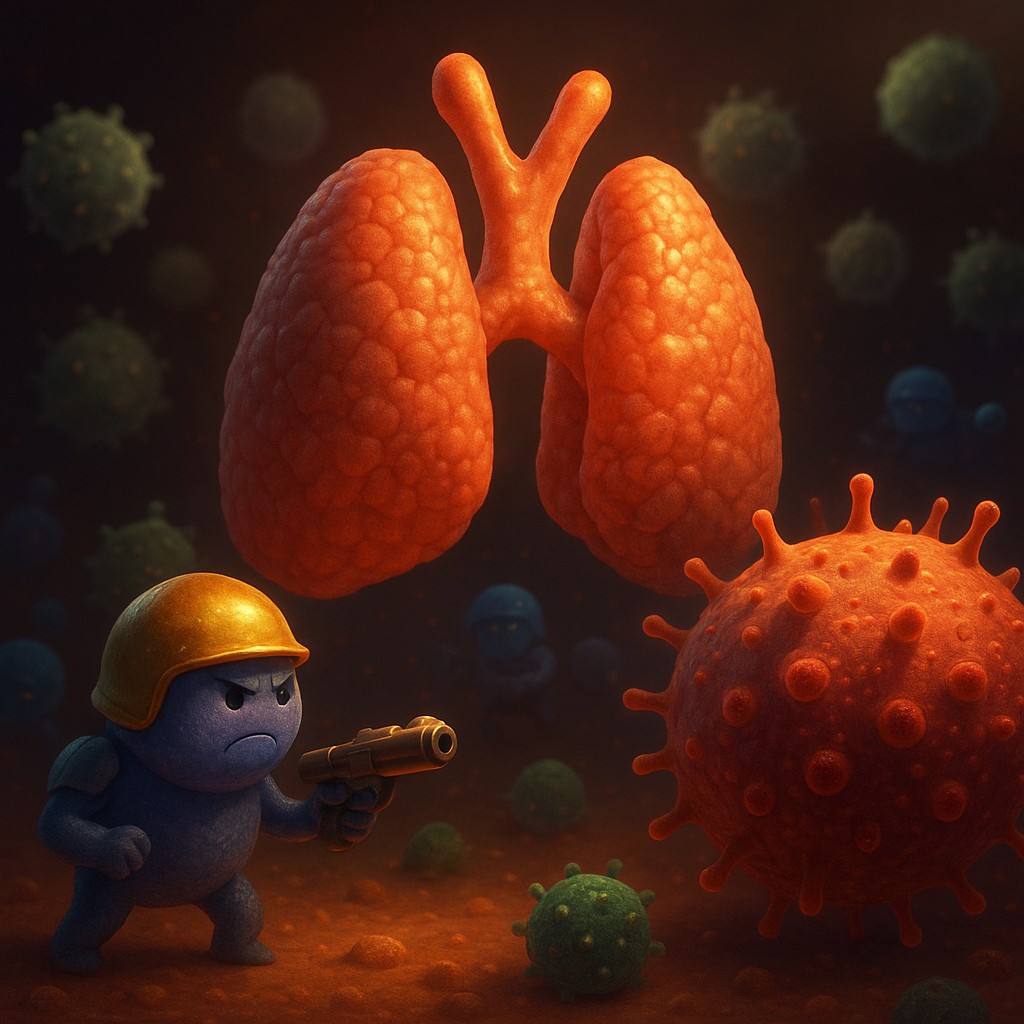
Imagine for a moment that your body houses one of the most sophisticated security forces ever conceived. This force, the immune system, is made up of billions of specialized cells that patrol your arteries, organs, and tissues with the precision of an elite commando unit. Their job is to find and destroy invaders like bacteria, viruses, and parasites that try to turn your body into a luxury hotel. However, this level of power comes with a terrifying risk. Because these cells are designed to destroy biological tissue, they must be able to tell the difference between a foreign invader and your own healthy cells with perfect accuracy. If they lose that focus, the very army meant to protect you begins to tear the house down from the inside.
To prevent this internal catastrophe, your body has developed a rigorous, almost brutal training academy located in a small, often overlooked organ called the thymus. Nestled just behind your breastbone and in front of your heart, the thymus serves as the ultimate quality control center for developing cells. It is here that new T-cells, the specialized infantry of the immune system, must pass a series of life-or-death exams before they are allowed to enter the bloodstream. This process, known as Negative Selection, is the biological equivalent of a background check so intense that only the most disciplined survive. It is the reason you can typically fight off a flu without your immune system accidentally deciding that your thyroid or your joints are the enemy.
The Secret Academy Behind Your Breastbone
The thymus is a fascinating organ because, unlike your heart or lungs, it does not stay in its prime forever. It is largest and most active during childhood, serving as a high-intensity boot camp for the immune system while you are most vulnerable to new germs. By the time you reach adulthood, the thymus begins to shrink and "involute," which means it is gradually replaced by fat. However, the elite graduates it produced in your youth continue to patrol your body for decades. Inside this organ, immature T-cells, called thymocytes, are born from stem cells and must navigate a complex physical maze to prove their worth. This isn’t just about learning how to fight; it is about learning what not to fight.
The curriculum of this academy is divided into two major phases: Positive Selection and Negative Selection. In Positive Selection, the thymus checks to see if the young T-cell can actually recognize and plug into the "docking stations" on other cells, known as Major Histocompatibility Complex (MHC) molecules. If a T-cell cannot bind to these at all, it is useless, like a soldier who cannot see. These cells are quietly dismissed. However, the real drama happens in the next stage. Once a T-cell proves it can see, the thymus must ensure the cell isn't "trigger-happy" toward the body’s own proteins. This second checkpoint is the high-stakes world of Negative Selection, where the body intentionally shows the T-cell its own "ID cards" to see how it reacts.
Running the Gauntlet of Self-Recognition
During Negative Selection, the environment of the thymus transforms into a massive gallery of the body’s internal components. Special cells in the thymus, known as medullary thymic epithelial cells (mTECs), perform a feat of biological magic. They use a specific gene called AIRE (Autoimmune Regulator) to produce proteins that are normally only found in specific, distant parts of the body. In this one small organ, the T-cell might be shown a tiny sample of insulin usually found in the pancreas, a protein from the brain, or a specific enzyme from the liver. It is a complete reproduction of your entire body’s molecular signature, packed into a single training ground.
As the trainee T-cell moves through this gallery, it encounters these "self-proteins." If the T-cell ignores them or reacts very weakly, it passes the test. This confirms that the cell is safe to be released because it won't be provoked by your own tissues. However, if the T-cell binds to a self-protein with high "affinity," meaning it reacts strongly and aggressively, the thymus recognizes this cell as a traitor or a rogue agent. Instead of being allowed to graduate, this autoreactive T-cell is forced into apoptosis, which is essentially a programmed cellular suicide. The body decides that it is better to lose a potential soldier than to risk a soldier that might attack its own heart or nerves.
| Selection Stage |
The Goal of the Test |
The "Passing" Result |
The "Failing" Result |
| Positive Selection |
Test if the cell can recognize the body's signaling system (MHC). |
Cell binds moderately and survives. |
Cell cannot bind and is discarded as useless. |
| Negative Selection |
Test if the cell reacts to the body's own healthy proteins. |
Cell ignores self-proteins and graduates. |
Cell attacks self-proteins and is forced to self-destruct. |
The Consequences of a Faulty Filter
When Negative Selection works correctly, it creates a state called "Central Tolerance." This means your immune system is tolerant of your own healthy cells while remaining intolerant of invaders. It is a breathtakingly efficient system, but it isn't perfect. Sometimes, a T-cell that is slightly too sensitive manages to slip through the cracks and enter the bloodstream. In other cases, a genetic mutation might mean the thymus doesn't show the T-cells a specific protein, so the immune system never learns to ignore it. When these rogue cells find their matching protein in the real world, they launch an assault, leading to the development of autoimmune diseases.
Take Type 1 Diabetes as a classic example. In this condition, the immune system incorrectly identifies the insulin-producing cells in the pancreas as foreign invaders. It attacks and destroys them as if they were a bacterial infection. Similarly, in Rheumatoid Arthritis, the immune system turns its weapons against the lining of the joints, causing chronic inflammation and damage. Other conditions like Lupus or Multiple Sclerosis follow a similar script: the quality control in the thymus or other secondary checkpoints failed to prune away the cells that view "self" as "enemy." Understanding Negative Selection is therefore the key to modern immunology, as scientists look for ways to retrain the immune system or mimic the thymic filter to treat these chronic conditions.
Why Quality Always Trumps Quantity
It might seem wasteful for the body to kill off more than 95 percent of the T-cells it produces in the thymus. From a purely mathematical standpoint, it is a massive expenditure of energy to build all those cells only to have them commit suicide. However, the logic of evolution is clear: an under-powered immune system makes you vulnerable to infection, but an undisciplined immune system makes you a danger to yourself. The high failure rate in the thymus is not a flaw; it is a feature. It ensures that the soldiers patrolling your lungs, skin, and blood are the most sophisticated, discerning, and safe defenders possible.
This biological prioritization of safety over raw power is what allows complex organisms like humans to live for decades. We are essentially a walking collection of billions of proteins, and the fact that our immune systems don't dissolve us from the inside out every single day is a testament to the rigor of the Negative Selection process. It is a quiet, constant miracle happening behind your breastbone, a silent vetting process that happens while you sleep, eat, and breathe. By sacrificing the aggressive and the undisciplined at the very beginning, your body creates a defensive shield that is as peaceful toward itself as it is ferocious toward the world's many pathogens.
As you move through your day, take a moment to appreciate this hidden internal diplomat. Your health is not just the result of your immune system's strength, but of its remarkable restraint and intelligence. You are the beneficiary of a biological filter that has spent your entire life distinguishing "you" from "not-you," ensuring that your body remains a sanctuary rather than a battlefield. Knowing how this selection works makes the complexity of your own biology feel like a masterpiece of engineering, reminding us that sometimes, the most important thing a powerful force can learn is when to hold its fire.