<h2>Imagine waking up to a world where dinosaurs never went extinct</h2>
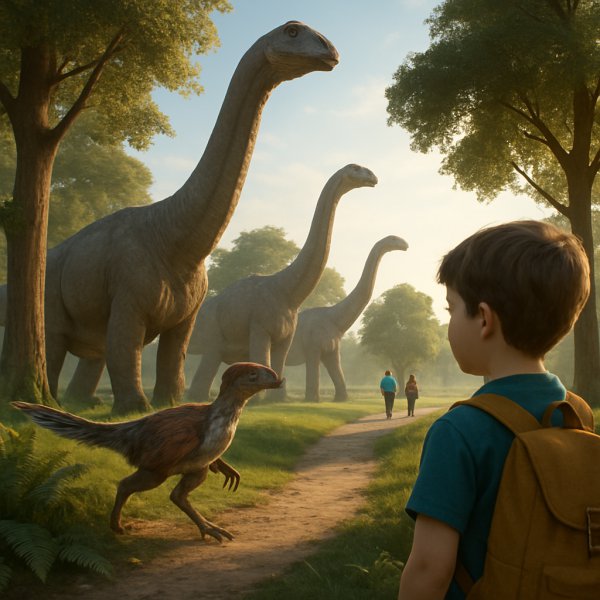
Picture stepping out of your door into a morning chorus of birds and something else - a distant, sonorous trumpet that could belong to a creature the size of a bus. You see a herd of long-necked browsers moving through a park, their heads above the tallest trees, while smaller, feathered predators skitter among the undergrowth. It sounds like a movie, but it is also a useful thought experiment that helps us understand evolution, ecology, and why extinction events reshape life on Earth.
This piece invites you to walk slowly through that alternate world. We will build from solid paleontological facts, use vivid analogies and short challenges to make abstract ideas concrete, and show how the long arc of deep time could plausibly branch into very different present-day ecosystems. Along the way we will correct common misunderstandings, connect these possibilities to modern conservation and planning, and leave you with practical ways to think like an evolutionary detective.
<h2>How we got to the real history, in one breath</h2>
Around 66 million years ago, a global catastrophe - most likely a large asteroid impact at Chicxulub plus extensive volcanic activity in what is now India - triggered rapid environmental upheaval. The K-Pg extinction event wiped out roughly 75 percent of species on Earth, including all non-avian dinosaurs. The survivors included small mammals, birds (which are living dinosaurs), crocodilians, turtles, amphibians, insects, and many plants and marine groups. This reshuffling of ecological cards opened ecological opportunities for mammals, eventually allowing primates and later humans to diversify into many niches.
Now imagine removing that extinction event. Without that sudden reset, the evolutionary trajectories of many groups would likely be very different, because dominant taxa tend to block or redirect ecological opportunities.
<h2>What ecosystems might look like with dinosaurs still dominant</h2>
Ecosystems are webs of interactions - predators, prey, plants, parasites, pollinators. Large herbivores exert especially strong influence on vegetation and landscape, a lesson we see in modern Africa and Asia where elephants, rhinos, and large ungulates shape savannas, seed dispersal, and nutrient cycling. If sauropods, hadrosaurs, stegosaurs, and other large herbivores persisted, plant evolution would likely respond accordingly.
Plant communities would differ depending on which dinosaur lineages dominated. Some plants might evolve tougher defenses, taller growth forms, or traits promoting seed dispersal by huge animals. Conversely, in places where smaller, agile herbivores were common, plants might favor different defenses such as chemical deterrents. The spread of grasses and the rise of modern savannas in our real history owe much to climate shifts and grazing pressure from mammals; in this alternate world, dinosaur grazing strategies could either slow the spread of grasslands or shape them in a different way.
Animals that fill similar ecological roles to modern megafauna would exist, but their behaviors and effects on landscapes would be shaped by dinosaur physiology. Many dinosaurs had feathers or feather-like coverings; feathers are excellent insulation, and their presence in a broader range of dinosaur clades suggests many could persist in cooler climates too. This changes the naive picture of dinosaurs as only tropical reptiles.
Table - Simplified comparison of modern roles versus plausible dinosaur analogues
| Modern ecological role |
Typical living example |
Plausible dinosaur analogue |
| Large browser - shapes forests |
Elephant |
Sauropod or large hadrosaur |
| Fast cursorial predator |
Wolf, big cat |
Dromaeosaur-like theropod |
| Omnivorous opportunist |
Pig, bear |
Medium-sized omnivorous theropod |
| Small arboreal insectivore |
Monkey, possum |
Small feathered maniraptor |
This table simplifies complex possibilities, but it helps anchor intuition: many ecological niches persist across very different faunas.
<h2>Mammals in the shadow of giants - could humans still evolve?</h2>
One of the most common questions is whether humans, or human-level intelligence, could have evolved if dinosaurs never went extinct. The short answer is: possible, but unlikely on the same timeline or via the same path.
When a group dominates ecosystems for tens of millions of years, it restricts the range of empty niches available to other clades. In our world, the K-Pg event created vacant niches in large-bodied herbivores and predators that mammals filled, giving them opportunities to grow in size and complexity. Without that reset, mammals might have remained relatively small, nocturnal, and specialized for far longer.
However, evolution is not entirely deterministic. Convergent evolution shows that similar solutions can arise independently - marsupial sabertooths and placental cats, or the way octopuses evolved complex problem-solving. Intelligence also evolves in many contexts, from the social complexity of primates to the problem-solving of corvids and the culture of cetaceans. If a lineage of mammals, or even birds, found a niche where social cognition and manual dexterity produced survival advantages, higher intelligence could evolve, perhaps in a different form than Homo sapiens. It might take longer, and cultural technologies could look very different if built in a world shared with large dinosaurs.
Reflective question: What ecological pressures fostered human intelligence in our past? Can you imagine alternative pressures that might favor intelligence in a dinosaur-occupied world?
<h2>Climate, continents, and dinosaur biogeography - the long game</h2>
Continental drift, long-term cooling, ice ages, and changing sea levels are forces independent of who is dominant. Over tens of millions of years, continents keep wandering and climates shift. A world with surviving dinosaurs would thus witness many of the same large-scale changes, and dinosaur lineages would either adapt, migrate, or go extinct locally.
Evidence from fossils shows many dinosaurs already had insulating feathers and diverse physiologies. This suggests many could tolerate cooler climates better than once assumed. However, dramatic ice ages would still favor adaptable, small-bodied animals that can shelter and reproduce in constrained habitats. Dinosaurs that could evolve migratory behaviors, social thermoregulation, or wintering strategies might persist across glaciation cycles, just as birds do today.
Case study - feathers changed the game: The discovery of numerous feathered theropods in China over the last few decades reunited many traits once thought exclusive to birds and suggested that insulation, display, and even proto-flight were more widespread. This evidence supports scenarios where dinosaurs could occupy a much broader range of climates and niches than the outdated "big scaly lizards only in the Tropics" picture.
<h2>How humans would live with dinosaurs - practical coexistence strategies</h2>
Assuming human-like species evolved, societies would need to develop systems to coexist with large, powerful animals. We can learn from how humans today manage elephants, cattle, wolves, and sharks - tools, institutions, and cultural practices that reduce conflict and make use of animal roles.
List - Steps humans would likely take to coexist with large dinosaurs
- Habitat zoning: establish protected corridors and human settlements in areas less critical for dinosaur migration.
- Fencing and barriers: design flexible, large-scale barriers for agricultural fields, learning from elephant-proof fencing.
- Herding and domestication: attempt to domesticate species that have social hierarchies amenable to training; success would depend on reproductive cycles, temperament, and diet.
- Veterinary and disease control: study zoonotic risks and establish monitoring to prevent spillover between humans and dinosaurs.
- Cultural adaptation: incorporate dinosaurs into mythology, rituals, and art, shaping agriculture, transport, and economies.
Domestication is not guaranteed. Most large dinosaurs had reproductive strategies, life histories, and diets that might make domestication difficult, for example very long gestation or slow maturation, specialized diets, or highly migratory habits. But medium-sized, social herbivores or omnivores could become cooperative partners in farming or transport, similar to horses or camels.
<h2>Technology, culture, and the economy with living dinosaurs</h2>
Every major biological presence shapes culture and technology. Elephants shaped warfare, religion, and agriculture in parts of Asia, while horses transformed Eurasian transport and military affairs. Dinosaurs could have analogous cultural impacts, from myth-making to technology inspired by their physiology.
Imagine art motifs of feathered predators, or engineering that accounts for the weight and reach of sauropods. Agricultural systems would need to be robust against trampling, and urban design might include elevated walkways or reinforced roofs. On the other hand, dinosaurs could spur new industries - veterinary sciences specialized in megafauna, biomechanical research into flexible heavy-body movement, or ecological tourism centered on viewing living dinosaurs.
Ethical questions would emerge early. Should humans hunt large predators to protect livestock, or invest in coexistence methods? How would conservation status be assigned to charismatic but dangerous species? These debates would mirror current discussions about large mammal conservation, but with added biological complexity.
<h2>Clearing up common misconceptions about dinosaurs and extinction</h2>
Misconception: Dinosaurs were universally huge. Reality: Dinosaurs ranged from mouse-sized to building-sized. Many were small and highly agile, and birds are their living descendants. Misconception: The asteroid was the only cause of the K-Pg extinction. Reality: The picture is nuanced - a powerful asteroid impact coincided with massive volcanism and climate stress, and when multiple stresses align, extinctions become more likely. Misconception: Extinctions always favor mammals. Reality: Extinctions open niches to any group capable of exploiting them; mammals did well after K-Pg, but in a different past, other groups could have risen instead.
Quote: "Evolution is a tinkerer, not an engineer." This captures the essence of contingency - life reuses and remodels existing parts, and historical accidents shape long-term outcomes. The survival or disappearance of a single dominant group can change the path of life in profound ways.
<h2>Small thought experiments to sharpen your evolutionary imagination</h2>
Try these mini-challenges to make the alternate history feel concrete and test your assumptions:
- Design a city park that accommodates a herd of 8-ton herbivores and families of humans. Where would dwellings go, what kinds of plants would you choose, and how would you prevent trampling?
- Draw a food web for a temperate forest that includes a small raptor-sized predator, a 3-ton herbivore, and an omnivorous, raccoon-like dinosaur. Include parasites and decomposers, and think about energy flow.
- Imagine a domestication trial. Pick a dinosaur species and describe three traits that would make it more or less domestication-friendly.
Each exercise deepens understanding of ecological constraints and human adaptation.
<h3>How this alternate-history thinking helps in real life</h3>
Thinking through "what if" scenarios trains skills humans use in planning, conservation, and risk assessment. It helps us appreciate that biodiversity loss is not reversible in practical terms, and that ecosystems are products of long, contingent histories. By imagining different outcomes, we become better at anticipating cascading effects of species loss, climate shifts, and human interventions.
Practical steps you can take right now include visiting natural history museums to see fossils in context, reading accessible paleontology books, taking a course in ecology, and practicing thought experiments to sharpen your systems-thinking skills. These habits make you a better decision maker about conservation and design, whether you plan city parks or support policies to protect threatened species.
<h2>Final image to carry with you</h2>
Imagine a twilight plain where a chorus of small, feathered dinosaurs calls from the brush, a slow line of long-necked herbivores passes past a farmhouse, and in the sky a raptor-like shadow crosses an electric moon. The image is fantastical, but not impossible. It reminds us that life has many potential futures, and that the world we live in is both fragile and rich in improbable history.
Closing question to ponder: If you could design a museum exhibit showing one alternate evolutionary trajectory where dinosaurs persisted, what three artifacts or displays would you include to make the story convincing, surprising, and relevant to people today?
Keep asking that kind of question, and you will not only learn more about life on Earth, you will think more clearly about how our choices shape the next chapters of that story.