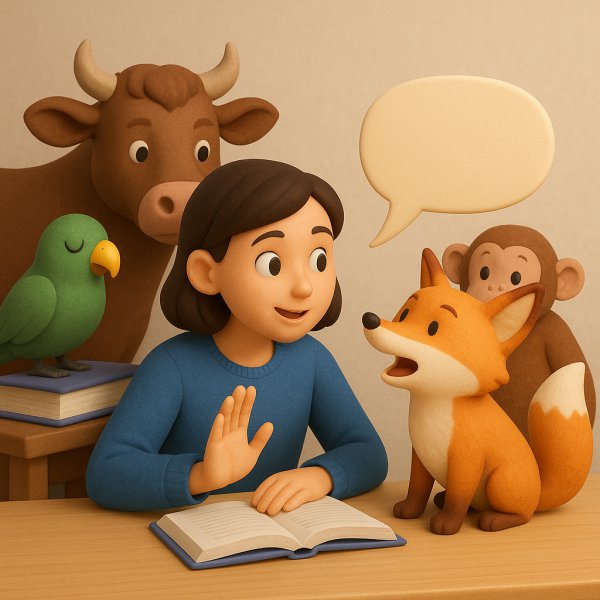
Imagine your dog saying good morning - and then asking for more than a treat
Picture waking up, half-asleep, when your golden retriever pads into your bedroom, hops onto the bed, and says in a clear, slightly gravelly voice, "Morning. By the way, the neighbor's car alarm at 3:14 a.m. ruined my sleep. Also, what's that email about?" That vivid, improbable moment is sticky because it flips the familiar into the uncanny. We know animal noises, gestures, and expressions, yet human speech carries a kind of moral and practical weight that nonverbal signals do not. What if those signals were suddenly translated into words? How would relationships, laws, science, and daily life change if animals could talk as we do?
This thought experiment is not just a party trick. It helps us probe deep questions about intelligence, communication, and ethical responsibility. By imagining conversational animals, we test assumptions we make about minds that are not our own, and we practice the skills of listening, translating, and acting on unfamiliar information. Along the way we will use science, real cases, and imaginative scenarios to explore what "talking animals" would really mean for people and the planet.
What talking would really look like: the science of animal communication and human language
Most animals already "talk" in their own ways - birds sing, whales call, bees perform dances, and dogs bark, whine, or nuzzle. The difference between these signals and human speech is often a matter of complexity, flexibility, and symbolic reference rather than a categorical gap. Researchers like Michael Arbib and scientists behind the Cambridge Declaration on Consciousness have argued that many animals exhibit rich cognitive capacities. Studies of vervet monkeys show context-specific alarm calls that function like labels, Irene Pepperberg’s work with Alex the African grey parrot demonstrated symbolic learning and concept comprehension, and research into dolphin signature whistles suggests individualized identity calls. Each of these findings shows that animals can convey information that influences others' behavior in predictable and meaningful ways.
However, human language has unique features such as recursive syntax and complex abstraction. If animals spoke in human-like sentences, it might mean they had developed new representational systems, or we had found a way to translate their cognition into our words. Alternatively, "talking" could be a mediated translation - software or interpreters that map animal signals into phrases humans understand. Either way, the core takeaway is that communication reflects cognition and social necessity. Whether through vocal cords, clicks, scents, or machine interfaces, meaningful dialogue would reveal intentions, preferences, and experiences previously hidden from us.
How society would shift overnight - rights, responsibility, and practical puzzles
If animals could speak, the ethical and legal landscape would not just wrinkle, it would reweave itself. Pets could articulate consent or distress, farm animals could describe living conditions, and wild animals could tell scientists about habitat changes and threats. Lawmakers would face urgent questions about personhood, labor, and consent - for instance, could a working elephant refuse to perform, or would a language-capable cow be eligible for different legal protections? Groups like the Nonhuman Rights Project have already pursued legal recognition for great apes and other animals in limited contexts, arguing for habeas corpus and legal standing. Talking animals would intensify these debates and make them harder to ignore.
The social ripple effects would extend into everyday institutions: zoos, farms, laboratories, and homes. Businesses that rely on animals for labor or entertainment would need new consent protocols; medical research would confront stronger ethical pressures if subjects could describe pain, fear, or coercion. Religious, cultural, and economic norms would all be tested. Some communities might celebrate newfound friendships with animals, while others might fear economic disruption or legal chaos. Either way, speaking animals would force societies to confront the moral status of beings they have historically treated as resources rather than conversational partners.
Everyday scenes rewritten by a single sentence: short stories to imagine impact
Imagine a farmer hearing, "We are thirsty and our legs hurt after the truck," from one of his cows, not as a poetic metaphor but as plain complaint. If he listens, he might change transport practices, leading to healthier herds and fewer losses. Picture a city pigeon humming, "There is a new toxin on the east side," enabling targeted investigations that save wildlife and people alike. Or think of a rescue dog saying, "I remember a man with a red hat who left me," which could reunite families. These small, concrete moments show how information changes choices when it moves from speculation to testimony.
Such vignettes also reveal complex trade-offs. A talking wolf asking to cross a highway presents a public-safety puzzle; an octopus describing its pain in a research lab could halt experiments that were previously justified as low-cost or low-harm. Listening does not mean instant agreement or easy fixes; it means accounting for new voices in planning, budgets, and moral calculus. The point is practical - words change incentives. When we can no longer interpret behaviors as ambiguous, policy and everyday decisions will have to adapt.
A simple decision table for everyday dilemmas
| Situation |
Likely spoken message |
Immediate human choice |
| Pet at home repeatedly pacing |
"I feel lonely and anxious" |
Increase enrichment, adjust routine, consult vet |
| Livestock in crowded pen |
"We need more space, sunlight, time to lie down" |
Change stocking density, improve management, audit welfare |
| Wild animal near road |
"We come here for salt and food left by humans" |
Modify roadside waste, create safe crossings, educate drivers |
| Lab animal describes distress |
"The procedure causes unbearable stress" |
Reevaluate methods, refine protocols, seek alternatives |
This quick table compresses how speech alters practical responses. When animals can articulate needs and histories, human choices tend to shift toward better care, because the moral argument becomes less abstract and more immediate.
How conversations would actually work - a practical guide to listening and responding
Talking to an animal would not be a straightforward translation of human conversational norms. Animals have different life histories, sensory priorities, and social goals. A good conversational strategy begins with humility - accept that your assumptions will be wrong sometimes - and proceeds with structured listening. Use the ASK method: Acknowledge, Slow down, Keep it simple. Acknowledge the animal's utterance by repeating or paraphrasing to confirm meaning, slow down to allow time for clarification, and keep questions concrete rather than abstract. Instead of asking, "What do you want from life," ask, "Are you hungry, hot, or afraid right now?"
Practical questions to ask include: Where does it hurt? What would make you feel safe? Do you trust this person? If the animal references people or events, validate and follow up with context-based enquiries. Avoid projecting human motives or emotions that may be inaccurate. Anthropomorphism is tempting and sometimes useful for empathy, but it can also mislead. Observe bodily cues and environment as corroboration. If a parrot says it remembers a specific person, check timelines and corroborating signs. If a whale reports distress near a shipping lane, prioritize independent verification through scientific methods.
Law, labor, and liberty - precedent and the path forward
The legal system has been slowly shifting toward recognizing animal interests in limited ways. The Cambridge Declaration on Consciousness, signed by leading scientists in 2012, affirmed that many nonhuman animals possess the neurological substrates of consciousness. Policies such as the UK’s Animal Welfare (Sentience) Act 2022 reflect a growing recognition that animals can experience feelings that matter in policy. Legal precedents have also emerged where courts considered the rights of animals, notably cases brought by advocacy groups seeking legal personhood or protection for specific great apes and elephants. These cases have been contentious and limited in success, but they illustrate a trajectory.
If animals could speak, the pressure for legal reform would intensify, moving debates from philosophical abstractions to courtroom testimony. New legal categories might arise - limited personhood for certain cognitive capabilities, contractual frameworks for human-animal working relationships, or statutory requirements for consent and compensation when animals perform services. Legislators and judges would need new scientific input and ethical frameworks to handle testimony from nonhumans. This transition would mirror past shifts in civil rights and disability law where new voices forced redefinition of rights and responsibilities.
Misconceptions and surprises - what talking animals would not immediately solve
A common misconception is that if animals could speak, they would instantly become like humans in thought, culture, and desire. That is unlikely. Communication and cognition are related but distinct; speech would likely reveal alien ways of experiencing the world. For instance, a bat might focus on echoic landscapes rather than visual aesthetics, and a honeybee might communicate in terms of floral economics rather than morality. Another error is assuming speech would equal consent. Animals might still be coerced, misinformed, or constrained by survival needs when they "agree" to something.
There are also surprising benefits that go beyond ethics. Practical knowledge from animals - migration cues from birds, underwater acoustic maps from cetaceans, or olfactory descriptions from dogs - could revolutionize environmental monitoring, medicine, and disaster response. Moreover, the cultural value of interspecies storytelling could transform art, education, and philosophy. The key is to avoid simplistic fantasies and instead treat talking animals as new participants in a shared world with their own perspectives, merits, and limits.
Exercises and prompts to sharpen your listening, today and in imagined tomorrows
Try this short exercise to practice being a better interspecies listener. Spend ten minutes watching an animal - your pet, a bird at a feeder, or even a recorded nature clip. Take notes on behavior, environment, and apparent goals. Then write a 150-word imagined quote that the animal might say about what is happening, and follow up with a 150-word reflection on how that quote changes what you would do. Repeat once a week. This practice trains observation, empathy, and the humility needed to revise assumptions.
Here are some thought prompts to explore on your own or in groups: What would your city sound like if all domestic animals could speak at noon? How would public transit change if urban birds organized as messengers? If a lab mouse described a memory of a maze, how would that affect the ethics of research reliant on memory formation? These prompts can be used in classrooms, ethics committees, or creative writing workshops to deepen understanding and prepare practical responses.
"Listening is not waiting to speak - it is allowing a world that was silent to become part of the conversation." - adapted wisdom for interspecies dialogue
Moving forward with curiosity and responsibility
If animals could talk, we would gain remarkable information, new friendships, and thorny obligations. The ethical and practical landscape would not realign overnight - it would evolve through debates, experiments, and policy changes shaped by science and social values. The immediate practical step for readers is simple and empowering: become a better observer and advocate today. Learn about animal cognition, support welfare-centered policies, and practice the faint but valuable skill of translating behavior into questions rather than assumptions.
In the end, imagining talking animals is a tool for sharpening our moral imagination and scientific curiosity. Whether or not parrots start holding town meetings, the exercise teaches us to listen harder, ask better questions, and design institutions that can accommodate voices previously ignored. That makes us better citizens of a multispecies world, and that matters even if the talking never becomes literal.