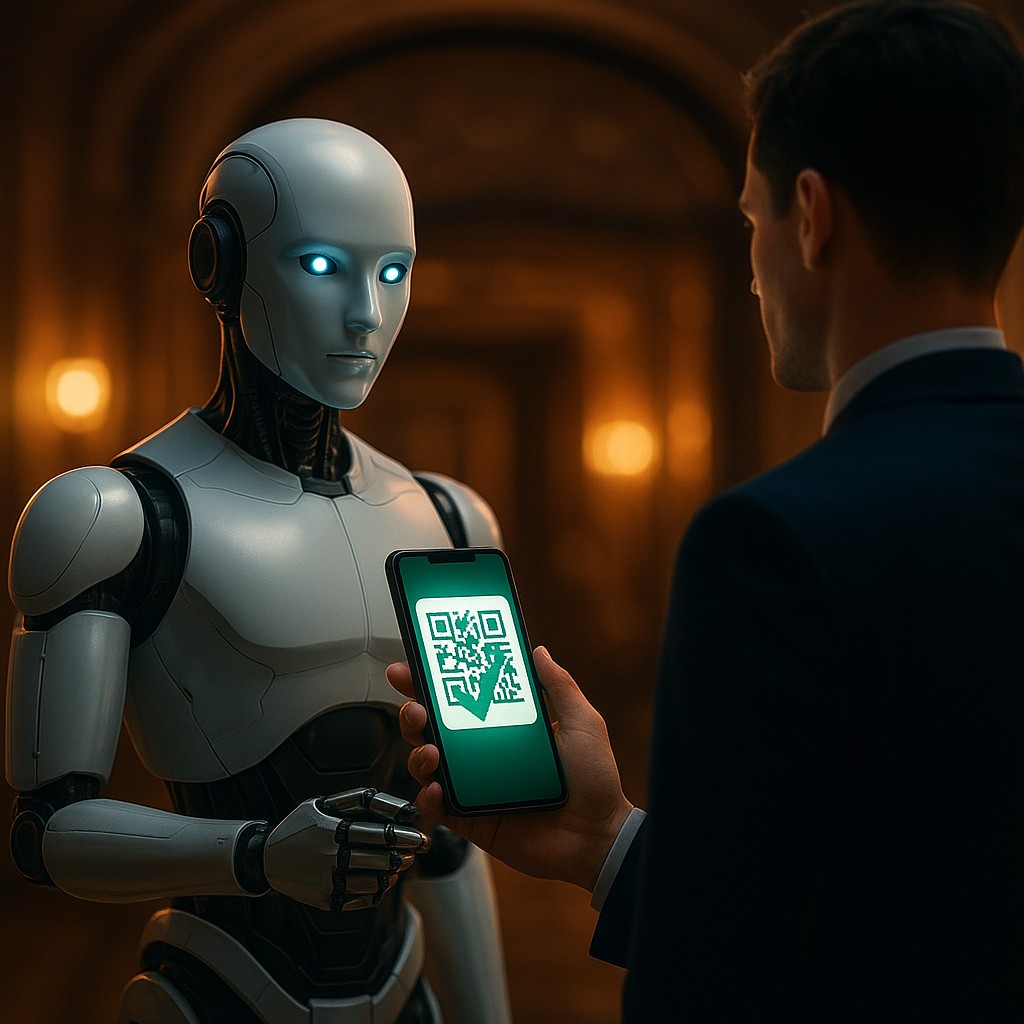
Imagine walking into a high-end club where the bouncer is a high-tech robot. Instead of handing over your driver's license - which reveals your full name, home address, exact birthdate, and whether you are an organ donor - you simply hold up your phone. The robot scans a code, sees a green checkmark confirming you are over twenty-one, and lets you in. The robot never learns who you are, when you were born, or where you live. This might sound like a scene from a science fiction novel, but it is actually the cutting edge of modern data security. This concept, known as a Zero-Knowledge Proof (ZKP), is rapidly moving from the world of abstract math into the heart of digital residency programs and online safety.
In our current digital world, we are constantly forced into a "data for trust" bargain. To prove you are a citizen, you show your entire passport. To prove you have enough money for a loan, you hand over months of bank statements. We are essentially giving away the keys to our entire personal kingdom just to prove we own a single brick. Zero-Knowledge Proofs change this dynamic entirely. They allow a "prover" to convince a "verifier" that a statement is true without revealing any information beyond the fact that it is true. It is a world where saying "I know the secret" is enough, while the secret itself stays locked in your pocket.
The Magic of Proving Without Telling
To understand how a computer can prove something without showing the actual data, it helps to use a classic analogy: "Where's Waldo?" Imagine you and a friend are looking at a giant, cluttered Waldo poster. You claim to have found him, but your friend doesn't believe you. You want to prove you found him without showing your friend where he is on the map, because that would ruin the game. To solve this, you take a massive sheet of cardboard with a tiny hole cut in it. You slide the cardboard over the poster until Waldo appears in the hole. Your friend now sees Waldo and knows for a fact that you found him. However, because the cardboard covers the rest of the poster, your friend still has no idea where Waldo is located on the map.
This is the essence of a Zero-Knowledge Proof. In the digital world, the "poster" is your encrypted personal data, and the "hole in the cardboard" is a mathematical formula. The formula allows a computer to look at a very specific piece of information - like a digital fingerprint of your birth year - and confirm it meets certain requirements without seeing the rest of your identity. You provide a proof that is mathematically linked to your ID, but the proof itself does not contain your ID. It separates the "fact" from the "data," ensuring the other party learns only the single bit of information they actually need.
This process relies on three core rules that make it reliable for governments and banks. First is "completeness," meaning if a statement is true, an honest person can successfully prove it. Second is "soundness," which ensures that a cheater cannot trick the system into believing a lie, except for a mathematically impossible fluke. Finally, there is the "zero-knowledge" property itself, which guarantees the person checking the information learns nothing else. This trio creates total trust in an environment where no one actually trusts each other with their private files.
Moving from Paper Passports to Digital Certainty
Governments across the globe are currently figuring out how to handle digital residency and online voting. The old way of doing things involves creating massive, central databases that store scanned copies of everyone's birth certificates and IDs. These databases are like giant targets for hackers. If a hacker gets in, they get everything. By using Zero-Knowledge Proofs, a government can issue a protected digital credential to a citizen. When that citizen needs to use a service, they create a ZKP locally on their own device. The government or a business verifies the proof, not the original document.
This shift would change how we interact with the state. For example, if you are applying for digital residency in a country like Estonia or Palau, you could prove you have a clean criminal record or a certain income without a government official ever looking through your private bank transactions. The system simply asks the data a question: "Does this person meet the requirement?" and the math returns a "Yes" or "No." This minimizes the amount of data moving across the internet, which reduces the risk for identity thieves and hackers looking to steal personal information.
| Traditional Verification |
Zero-Knowledge Verification |
| Requires sharing original documents (PDFs, Scans). |
Shares only a mathematical proof of a specific fact. |
| Data is often stored in risky central databases. |
Personal data stays on the user's own device. |
| Reveals too much info (address, full date of birth). |
Reveals only the necessary "True/False" answer. |
| High risk of identity theft if the verifier is hacked. |
Low risk because the verifier never held your data. |
| Often requires a human to review the documents. |
Fully automated through computer math. |
The Mathematical Heavy Lifting Under the Hood
While the concept sounds like magic, the reality involves some of the most complex math ever created. Most modern ZKPs use a specific type called zk-SNARKs. Let’s break that down into plain English. "Succinct" means the proofs are very small and can be checked quickly. "Non-interactive" means the person proving and the person checking don't need to go back and forth with a hundred questions; the prover just sends one single "proof" package. This is vital for the internet, where we want things to happen instantly with the click of a button.
The challenge is that while checking a proof is fast, creating one takes a lot of computing power. It requires a device to do a lot of "heavy lifting" to scramble the data into a valid proof. This is why we are only now seeing these systems go live. A decade ago, a smartphone wouldn't have had the power to create a complex ZKP quickly. Today, as our phone chips get faster and researchers find more efficient ways to write these equations, the dream of instant, private verification is becoming a reality. The complexity is the price we pay for absolute privacy.
Furthermore, these systems require what is known as a "trusted setup." This is like creating a master key and then destroying the mold so no one can ever make a copy. If the starting settings of the system are leaked, someone could potentially fake a proof. To prevent this, developers often use "Multi-Party Computation." This involves dozens of people around the world contributing random data to start the system. As long as at least one person in the group is honest and destroys their part of the data, the whole system remains secure. It is a community effort to create an unhackable foundation.
Navigating the Myths of Digital Shadows
With any technology this complex, myths are bound to pop up. A common misunderstanding is that Zero-Knowledge Proofs are a tool for criminals to hide their tracks. In reality, ZKPs are about "selective disclosure." They allow you to prove you are following the law without giving up your entire private life. It is not about being invisible; it is about being precise. Another myth is that ZKPs are the same thing as encryption. While they use similar math, encryption is about hiding a message so only the recipient can read it. A ZKP is about proving something about that message without the recipient ever reading it at all.
There is also the fear that if you lose your "private key" or the device holding your data, your identity is gone forever. This is a real concern, but the systems being built by national governments often include recovery methods. These might involve "social recovery," where trusted friends or institutions can help you re-verify your identity if you lose your phone. The goal is to create a system that is more secure than a physical passport, which can be stolen or forged, while still being easy enough for a regular person to use.
Another concern is whether these systems are truly "zero-knowledge" if the government issued the data in the first place. The answer lies in the design. While the government knows your identity (they gave you the passport, after all), the ZKP ensures that the other people you interact with - like a store, a bank, or a website - do not get that data. It prevents companies from tracking your life. You are effectively putting a privacy shield between your government ID and the rest of the world, giving you control over who knows what about you.
Designing the Privacy-First Future
As we move deeper into the 21st century, the way we prove "who we are" will define our freedom. If we continue to use massive databases and over-share our info, we risk a "surveillance state" where every login and purchase leaves a permanent trail of our personal documents. Zero-Knowledge Proofs offer a different path. They provide a blueprint for a world where we can enjoy the convenience of digital living without the danger of digital exposure. It is a rare "win-win" that increases both security and privacy at the same time.
Learning about these systems now is like learning about the internet in the early 1990s. The tools are being built, the math is being polished, and the first national systems are starting to roll out. By understanding how ZKPs work, you are preparing yourself for a future where your data stays where it belongs: with you. We are entering an era of "verifiable privacy," where the truth is all that matters, and the details of our lives can finally remain our own. Embrace the math, value your privacy, and get ready for a world where you can prove everything while revealing nothing.