When you flush a toilet or drain a sink in a modern city, you likely imagine the water traveling through a gentle, horizontal slope under the street. For much of the journey, that is exactly what happens. Civil engineering relies on a subtle one or two percent grade to keep waste moving toward the treatment plant. However, cities are not flat, and the infrastructure beneath them is no different. When a sewer line from a high-altitude neighborhood meets a massive interceptor tunnel buried hundreds of feet deep, the water faces a terrifying vertical plunge. Without a plan, thousands of gallons of wastewater would turn into a liquid cannonball, accelerating under the pull of gravity until it reaches terminal speed.
If we simply let that water fall straight down a pipe, the result would be catastrophic for the city's hidden plumbing. A direct drop of 50 or 100 feet creates a chaotic slurry of air and water that acts less like a stream and more like a jackhammer. When this high-speed mass hits the bottom, it releases a violent burst of energy that can shatter concrete, eat through reinforced steel, and send shockwaves back up the line. This is the hidden challenge of urban engineering: how do you drop a literal ton of water into a deep hole without destroying the hole itself? The answer lies in the elegant physics of the vortex, a solution that turns a destructive waterfall into a controlled, spinning slide.
The Violent Physics of Free-Falling Fluid
To understand why we need a vortex, we first have to look at what happens when water is allowed to behave badly. In a standard vertical pipe, falling water undergoes a process called "air entrainment." As the water rushes down, it drags air along with it, creating a turbulent, frothing mess. This air-water mixture is highly unpredictable. As the water speeds up, it doesn't fall as a solid column; instead, it breaks into droplets and heavy chunks of liquid that trap pockets of air against the pipe walls. When these pockets are squeezed or suddenly pop, they create pressure spikes that can actually "pluck" bits of concrete out of the sewer wall-a process engineers call cavitation.
The most dramatic type of failure is known as "water hammer." This happens when a large volume of fast-moving water reaches a bend or a flat "bench" at the bottom of the shaft and is forced to stop or change direction instantly. Water does not compress like a sponge. When its momentum is suddenly halted, that energy has to go somewhere, so it converts into a high-pressure shockwave. These waves can travel back up the system at the speed of sound, rattling manhole covers, bursting joints, and causing a "geyser" effect where sewage is launched back out of street-level grates.
Beyond the physical damage to the hardware, free-falling water is a chemical nightmare. As the water crashes and splashes, it releases dissolved gases like hydrogen sulfide. This is the "rotten egg" gas that gives sewers their smell, but it is more than just a stink. When hydrogen sulfide hits the damp walls of the upper pipe, bacteria turn it into sulfuric acid. This acid eats through the top of the pipe, leading to a structural collapse from the inside out. A simple vertical drop, therefore, is a recipe for noise, smells, and a multi-million-dollar repair bill within just a few years.
Engineering the Perfect Swirl
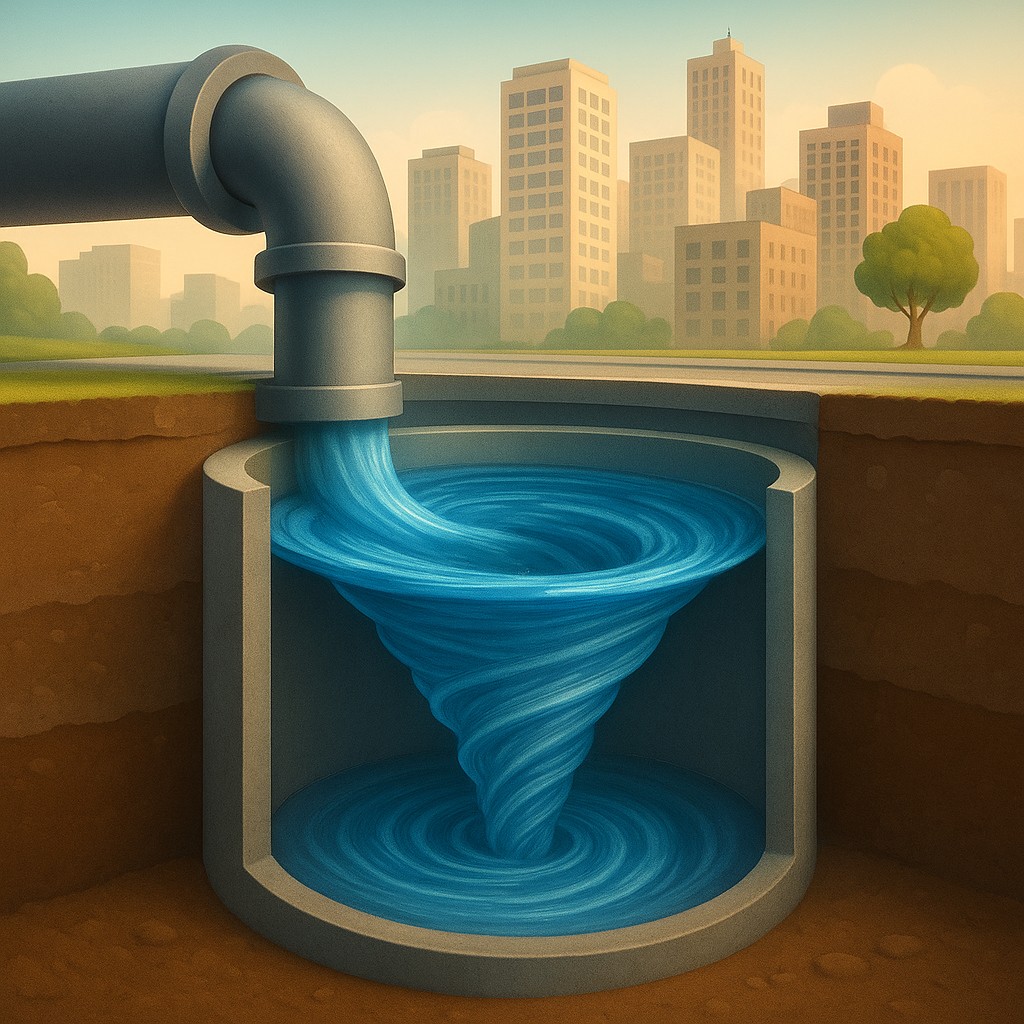
The vortex drop shaft solves these problems by changing the shape of the entry point. Instead of letting the water pour over an edge like a waterfall, engineers design a "scroll" or a tangential intake. This intake looks much like a snail shell or a specialized funnel that forces the incoming flow to hug the outer edge of the vertical shaft. By introducing the water at an angle, the system converts the downward "falling" energy into "spinning" energy. This centrifugal force pins the water against the walls of the pipe, leaving a clear, hollow core of air in the center.
This hollow core is the secret to a quiet, stable sewer. Because the water is stuck to the walls, it can no longer trap large air bubbles in the middle of the flow. The central air column acts as a built-in vent, allowing gases to travel freely up or down the shaft without being forced into the surrounding pipes. This prevents the pressure build-up that causes geysers and reduces the splashing that releases gases. The water essentially rides a spiral staircase all the way down, using friction against the walls to steady its speed.
| Feature |
Conventional Drop Shaft |
Vortex Drop Shaft |
| Flow Pattern |
Direct plunge/Chaotic splash |
Helical/Spiral wall flow |
| Air Management |
Trapped air causes pressure spikes |
Central air core allows venting |
| Energy Control |
High-impact crash at the bottom |
Continuous friction along walls |
| Odor Control |
High gas release from turbulence |
Low gas release; limited air contact |
| Maintenance |
Frequent repair due to erosion |
Long lifespan; minimal wear |
The Art of Absorbing Energy
One might wonder if rubbing water against the walls of a pipe is a good idea. Doesn't that cause wear and tear? In reality, the friction generated by the spinning water is a deliberate feature. As the water spirals down the shaft, the centrifugal force keeps it in a thin, fast-moving film. The resistance between the water and the pipe surface acts as a continuous brake. Instead of gathering all its speed and dumping it in one violent collision at the base, the vortex sheds that energy gradually throughout the entire fall. By the time the water reaches the bottom, much of its destructive power has "bled off" into low-level heat and noise scattered along the vertical drop.
To further protect the system, the bottom of a vortex drop shaft often features a "de-aeration chamber" or a "plunge pool." This is a widened area where the water is allowed to slow down even more so any remaining air bubbles can rise to the surface before the liquid enters the next horizontal pipe. This ensures that the flow exiting the drop is "solid" water, free of the air pockets that cause damage downstream. It is a masterpiece of fluid dynamics that relies on the natural laws of physics rather than expensive pumps or mechanical gates.
The materials used in these shafts must be incredibly tough. While the vortex prevents the worst impacts, the sliding friction is still intense. Modern shafts are often lined with high-density plastic (HDPE), acid-resistant bricks, or specialized concrete coated in epoxy. These materials are slick enough to encourage the vortex but strong enough to withstand the "sandpaper" effect of the grit and sediment found in city wastewater. In many ways, the vortex drop shaft is a self-cleaning machine; the high-speed spinning action prevents solids from settling and clogging the shaft, keeping the city’s veins clear.
Beyond the Sewer: Scaling the Spiral
The use of vortex technology isn't limited to the depths of the municipal sewer system. The same principles are being scaled up for massive stormwater projects designed to protect cities from "thousand-year floods." In places like Chicago, London, and Singapore, massive underground reservoirs use giant vortex drops to swallow millions of gallons of rainwater in minutes. Without these systems, the sheer volume of water entering a deep tunnel during a hurricane would create a "geyser" several stories high, potentially launching manhole covers like frisbees through the streets.
In skyscrapers, smaller versions of these systems are used to manage "graywater" (wastewater from sinks and baths) and traditional plumbing. If you live on the 50th floor of a luxury apartment building, your morning shower water has quite a journey ahead of it. Architects use offset pipes and "sovent" systems that mimic the vortex effect to prevent the sound of your neighbor's plumbing from sounding like a thunderclap inside your walls. These systems also protect the seals in your own traps. Without proper air venting through a central core, the suction from falling water on a lower floor could literally suck the water out of your toilet bowl, allowing sewer gases into your home.
The vortex drop shaft is a testament to the idea that the best engineering solutions often work with nature rather than against it. Instead of building thicker concrete walls to withstand the "shattering" force of falling water, we simply ask the water to dance its way down. By understanding the relationship between gravity, friction, and centrifugal force, civil engineers have built a world where massive volumes of waste move silently and safely beneath our feet, forgotten by the millions of people who rely on them every day.
A Legacy of Hidden Brilliance
Our modern world is built on layers of clever solutions to invisible problems. The vortex drop shaft is a perfect example of how observing simple fluid behavior can be used to protect the massive investments we make in our cities. It transforms a potential disaster of broken pipes and flooded streets into a boring, reliable utility. When we look at the skyline of a major city, we usually see triumphs of glass and steel reaching upward, but the true triumph might just be the spiraling water safely descending into the dark beneath the pavement.
Learning about the hidden mechanics of our world helps us appreciate the complexity required to maintain a simple standard of living. It reminds us that every time we turn on a tap or flush a drain, we are engaging with a global network of physics-defying structures. The next time you see a whirlpool forming in your bathtub, think of the massive, hidden versions of that same shape spinning beneath the city streets, quietly protecting the foundations of your world. It is a reminder that even in the most mundane places, there is a brilliant logic at work, turning a chaotic torrent into the steady, predictable heartbeat of a functioning society.