Imagine talking to a brilliant friend who seems to know everything but has a strange habit of making things up when they forget a detail. This is essentially the "hallucination" problem found in Large Language Models (LLMs). Although these AI systems are trained on massive amounts of data, they do not actually have a library of facts to look through. Instead, they rely on probability, guessing the next likely word in a sentence based on patterns they learned. When you ask them about an obscure legal case or a specific line of code from a private project, they often fail because that information was never in their training or has become a blurry memory in their digital "subconscious."
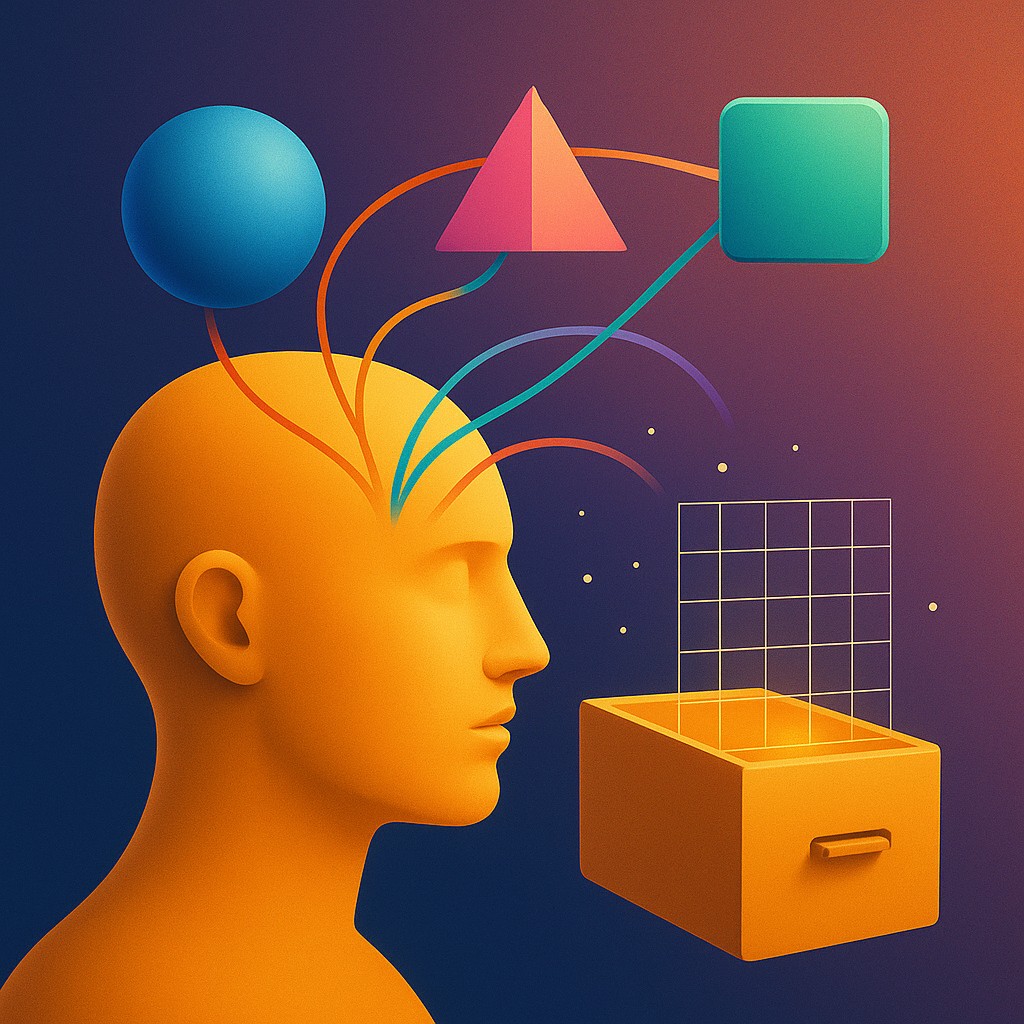
To solve this, engineers have given AI a form of long-term memory called a vector database. Rather than forcing an AI to relearn the entire internet every few months, developers provide a high-speed filing cabinet it can check in real-time. This system does not store information as plain text or spreadsheet rows. Instead, it stores collections of numbers that represent the "essence" of a concept. By turning human language into geometry, it allows a computer to navigate meaning by measuring the physical distance between two points in a mathematical space. This shift is why a chatbot can remember your specific order history or a medical AI can scan thousands of rare case studies in a split second.
The Geometry of Meaning and the End of Keywords
Traditional databases act like rigid librarians who only understand exact matches. If you search for the word "canine," a standard database looks for those specific six letters. If a document uses the word "dog" instead, the librarian will claim it found nothing. Because these systems rely on keyword indexes, they are great for finding a specific price in a list, but they are terrible at understanding that "chilly weather" and "low temperatures" mean the same thing. They see the labels, but they miss the meaning.
Vector databases solve this using "embeddings." In this process, a separate AI model takes a piece of data, such as a sentence or an image, and converts it into a long list of numbers called a vector. These numbers serve as coordinates on a map with hundreds or even thousands of directions, or dimensions. In this space, words with similar meanings are naturally grouped in the same neighborhood. "Dog" and "puppy" end up very close together, while "dog" and "toaster" are miles apart. When you ask the AI a question, your query is also turned into a vector, and the database simply looks for the closest neighbors. This is called semantic search, and it allows the system to find information based on intent rather than just spelling.
Mapping a Universe of Many Dimensions
To visualize this, imagine a basic two-dimensional map with an X and Y axis. You could map fruits by "sweetness" and "crunchiness." An apple would be high on both, a lemon would be low on sweetness but high on crunch, and a banana would be sweet but soft. In this 2D world, it is easy to see which fruits are similar. Now, imagine adding a third axis for "price," a fourth for "shelf life," and a fifth for "vitamin C." Suddenly, you have a 5D map where every fruit has a precise location based on its traits.
A vector database does this on a giant scale, often using 768 or 1,536 dimensions. While the human brain cannot picture a 1,000-dimensional space, the math works the same way. The "closeness" between two points is calculated using geometric formulas, usually one called "Cosine Similarity." Instead of measuring the distance between points, it looks at the angle between the vectors. If two vectors point in the same direction, the AI assumes they are talking about the same thing. This mathematical process is what enables "Retrieval-Augmented Generation" (RAG). Instead of guessing an answer from its faded memories, the AI searches the vector database, pulls out the most relevant paragraphs, and reads them before responding. It is the difference between taking a test from memory and taking an open-book exam.
| Feature |
Traditional Database (Relational) |
Vector Database (Similarity-Based) |
| Data Format |
Tables, rows, and columns |
High-dimensional vectors (embeddings) |
| Search Logic |
Exact keyword matches or logic (AND/OR) |
Conceptual similarity and math distance |
| Input Sensitivity |
Fragile; ruined by typos or synonyms |
Understands context despite wording |
| Main Use Case |
Accounting, inventory, user lists |
AI chatbots, image search, recommendations |
| Performance Metric |
Speed of searching through rows |
Time spent finding "nearest neighbors" |
How the Search for Neighbors Works
The biggest challenge for a vector database is speed. If you have ten million documents turned into vectors, calculating the distance between your query and every single one of those points would take too long for a live conversation. To handle this, vector databases use "Approximate Nearest Neighbor" (ANN) algorithms. These are shortcuts that allow the database to find the "mostly-accurate" results without checking every single item in the system. It prioritizes speed over 100 percent perfection.
One common method is "clustering," where the database pre-groups similar vectors into neighborhoods. When you search, the system first identifies which neighborhood your query belongs to and only searches that specific group. Another method, called "HNSW" (Hierarchical Navigable Small Worlds), builds a web of connections between points, much like a social network. The search starts by leaping across large distances between "hubs" and then gradually narrows down to the specific area where the answer likely sits. This allows the system to sift through billions of data points in less than a tenth of a second.
Why Math is Not the Same as Truth
It is vital to remember that a vector database is a master of similarity, not a judge of truth. This is the "logic gap" in AI. Because the system focuses on mathematical distance, it can easily find information that is related to your query but factually wrong. For example, if you ask, "Is it safe to eat glass?" a vector database might find a document titled "The Dangers of Swallowing Glass." Because the vectors for "eat," "swallowing," and "glass" are so close, the system correctly identifies this as relevant. However, if the database also contains a fictional story where a character eats glass for a magic trick, the AI might pull that too.
The vector database does not "know" that one document is a medical warning and the other is a fairy tale; it only knows the numbers match. This is why the "Augmented" part of Retrieval-Augmented Generation is so important. The database provides the context, but a second layer of logic (the LLM) must then read that context to make sure it makes sense. We are using geometry to organize knowledge, but we still need reasoning to decide what to do with that knowledge once we find it.
Building the Brain of Tomorrow
As we build more complex AI agents, vector databases will become even more important. We are entering an era where AI will not just talk to us, but will manage our personal files, remember our preferences for years, and help scientists find links between research papers that no human could ever read in a lifetime. By turning meaning into a map, we have created a way for machines to navigate human thought without needing a rule for everything.
The next time you talk to an AI that seems surprisingly well-informed, remember that it is likely using a vector database to "look" at a multi-dimensional map of your data. It isn't just searching for words; it is feeling the distance between your questions and the answers hidden in a digital landscape. This marriage of high-level math and human language is one of the most elegant bridges ever built between biology and technology. Data is no longer just a list of facts; it is a shape in a vast, invisible space that we are only beginning to explore.