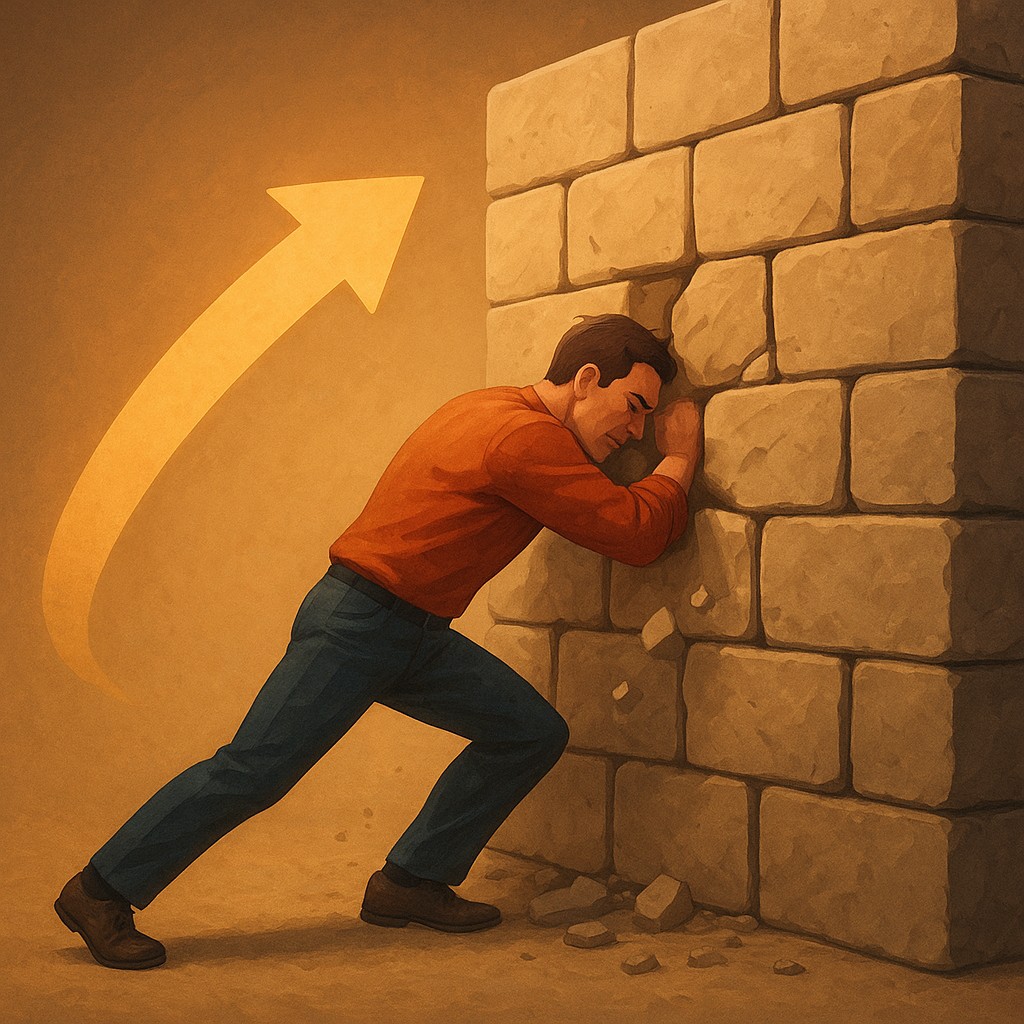
Imagine you are standing in front of a massive stone wall. You have been tasked with tearing it down, and for the last three hours, you have been throwing your shoulder against the center of the masonry. You are bruised and frustrated, yet the wall hasn't moved an inch. Most people, when faced with this kind of creative or intellectual stagnation, simply try to ram harder. They believe that if they just focus more intensely, apply more logic, or drink one more cup of coffee, the barrier will eventually crumble under the weight of pure persistence. This is the trap of "vertical thinking," where we believe the solution always lies further down the same path we are already walking.
The reality is that the human brain is an incredible pattern-matching machine, but it is also deeply lazy. Once it finds a logical groove, it stays there, digging deeper until it creates a trench it cannot see out of. When you are "stuck," you aren't actually running out of ideas; you are running into the edges of your own mental filters. These filters are designed to keep you efficient and sensible, but during a creative crisis, they become your jailers. To escape, you don't need more effort. You need a disruption so sudden and unrelated to your goals that your brain is forced to reboot its entire approach to the problem.
The Cognitive Trap of Optimization
When we work on a project, whether it is writing a computer program, composing a song, or designing a marketing campaign, we tend to focus on optimization. We start with a goal and try to find the most efficient, logical route to reach it. This works perfectly well for routine tasks, but complex creative problems rarely follow a straight line to the finish. As we get closer to what we think is the solution, our analytical mind begins to tighten its grip. We start self-editing before we even produce an idea, discarding anything that doesn't feel "right" or "efficient" according to our internal rules.
This mental tightening leads directly to a phenomenon known as paralysis by analysis. The more you think about how to solve the problem, the more you reinforce the brain’s pathways that led to the block in the first place. You are essentially trying to solve a puzzle using the same three pieces over and over again. Your brain is locked in a loop where it rejects novel solutions because they don't fit the existing logical structure of the project. To break this loop, you must introduce something that the analytical mind cannot categorize or "optimize" away. You must introduce a nonsensical friction.
Enter the Oblique Strategy
In the mid-1970s, musician Brian Eno and artist Peter Schmidt realized they were both hitting these same walls in their studios. They noticed that when they were under pressure, they tended to fall back on "safe" habits, which resulted in uninspired, repetitive work. To solve this, they developed a deck of cards called Oblique Strategies. Each card contained a cryptic, often bizarre instruction like "Put in earplugs," "Honor thy error as a hidden intention," or "Look at the order in which you do things." These were not suggestions for the project; they were demands for the process.
The "oblique move" isn't about finding a shortcut; it is about taking a deliberate detour. If you are struggling with a complex architectural design, an oblique strategy might tell you to "think like a gardener." On the surface, gardening has nothing to do with load-bearing walls or glass windows. However, by trying to connect the concept of "pruning" or "seasonal growth" with a building, you force your brain to engage in lateral thinking. You are no longer trying to solve the problem of the building; you are trying to solve the problem of how a building could be like a garden. In that friction, the original block often simply evaporates because the analytical filters have been bypassed.
The Mechanism of Generative Friction
Why does forcing yourself to solve a problem you don't have actually help you solve the one you do? The secret lies in a concept called "conceptual blending." When you are presented with two unrelated ideas, your brain instinctively tries to find a bridge between them. If you are stuck on a difficult paragraph and you pull a card that says "emphasize the flaws," your mind immediately begins to scan your work for weaknesses. But instead of seeing these flaws as things to be fixed (which is what you’ve been doing for hours), you are now looking at them as features to be highlighted. This shift in perspective changes the emotional tone of the work.
By solving this "fake" problem, you are essentially tricking your brain into moving. Movement, even in the wrong direction, is the enemy of stagnation. When you follow an oblique instruction, you stop worrying about whether the result is "good" or "correct" because the instruction itself is inherently absurd. This lowers the stakes and reduces performance anxiety. You are just following orders from a card or a random prompt. This psychological distance allows you to play again, and play is the natural state of a creative mind.
Comparing Traditional Problem Solving to Oblique Strategies
To better understand how this differs from traditional methods, let's look at how these two approaches handle common obstacles.
| Feature |
Traditional Vertical Thinking |
The Oblique Move |
| Primary Goal |
Finding the "correct" or "best" answer. |
Forcing a change in perspective. |
| Starting Point |
The center of the current problem. |
A random, unrelated external constraint. |
| Mental State |
High focus, high pressure, analytical. |
Fluidity, curiosity, playful exploration. |
| Method |
Refinement and optimization of existing ideas. |
Introduction of "noise" and random friction. |
| Outcome |
Incremental improvement or stagnation. |
Divergent paths and unexpected breakthroughs. |
| Filter Usage |
Maximizes logical filters to avoid errors. |
Bypasses filters by introducing "absurd" tasks. |
Embracing the Random Constraint
The beauty of the oblique move is that it can be applied to almost any field. It is a systematic disruption of predictable thought patterns. Imagine a software developer hit with a bug that refuses to be fixed. They could keep staring at the code, or they could apply a constraint: "Rewrite the function as if memory were infinite," or "Explain the bug to a five-year-old using only kitchen metaphors." These constraints are not literally useful for the final product, but they pull the developer out of the weeds and force them to see the overall structure of their work from a fresh angle.
One of the most famous examples of this in music history occurred during the recording of David Bowie’s "Berlin Trilogy." Brian Eno, working as a producer, would use the cards to dictate how the band members played. In one session, he gave each musician a card that told them to play in a style completely contrary to their personality. The resulting tension and the "mistakes" that happened because players were outside their comfort zones created a sound that was entirely new. They weren't trying to make a "hit" record; they were trying to solve the problem of "how do I play like a person I am not?"
Removing the Goal to Find the Path
The greatest misconception about creativity is that it is a result of clarity. We often think that we need to see the destination clearly before we can walk toward it. In reality, clarity is often the very thing that prevents us from seeing side opportunities. When we have a clear goal, we become hyper-focused, and we ignore anything that doesn't seem immediately relevant. This is what psychologists call "inattentional blindness." We are so busy looking for the keys we lost that we don't notice the door is already unlocked.
The oblique move removes the goal entirely for a brief period. It gives you a new, temporary goal that is easy to achieve because it doesn't matter. By the time you’ve "solved" the random constraint, you’ve fundamentally changed your relationship with the original problem. You have shifted the focus from the output (the finished product) to the input (the process of creation). This friction between what you were doing and what you are now being told to do generates heat, and that heat is the energy required to melt the creative block.
How to Build Your Own Oblique Toolkit
You don't need a physical deck of cards to use this method, though having one can be a helpful ritual. The key is to have a list of "proactive distractions" ready before you actually need them. When you are in the middle of a creative block, you are in no state to come up with clever ways to break it. You need a pre-built system of disruptions that you can turn to when the wall appears. These disruptions should be broad, metaphorical, and slightly annoying.
Good constraints often fall into a few categories. Some are about Subtraction (e.g., "Remove the most important element"), some are about Reversal (e.g., "Start from the end and work backward"), and some are about Externalization (e.g., "What would your harshest critic tell you to do?"). The goal is to have a variety of "flavors" of disruption. If you feel your work is getting too cluttered, a subtraction prompt is perfect. If you feel it's too predictable, a reversal prompt might be the spark you need.
Moving Through the Friction
It is important to remember that using an oblique move feels uncomfortable. It feels like a waste of time. Your analytical brain will scream at you, "We don't have time to think about gardens! We have a deadline for this bridge design!" You must learn to ignore that voice. The discomfort is actually a sign that the strategy is working. It is the sound of your mental gears grinding because they are being forced to mesh in a way they haven't before.
This mechanism shifts the focus from the result to the moment. In that moment of trying to reconcile the "senseless" instruction with your very "sensible" project, new patterns emerge. These patterns aren't just random; they are the result of your expertise being filtered through a new lens. You aren't just throwing spaghetti at the wall to see what sticks; you are using a systematic method to force your brain to look at the wall from the other side.
As you move forward in your creative or professional journey, remember that the straightest path is rarely the most innovative one. When you find yourself stuck, don't just push harder. Step back, embrace the absurd, and solve a problem you don't have. You might find that the detour leads you exactly where you were trying to go all along, but with a destination far more interesting than the one you originally imagined. True mastery lies not in avoiding the walls, but in knowing how to dance around them through the power of the intentional diversion.