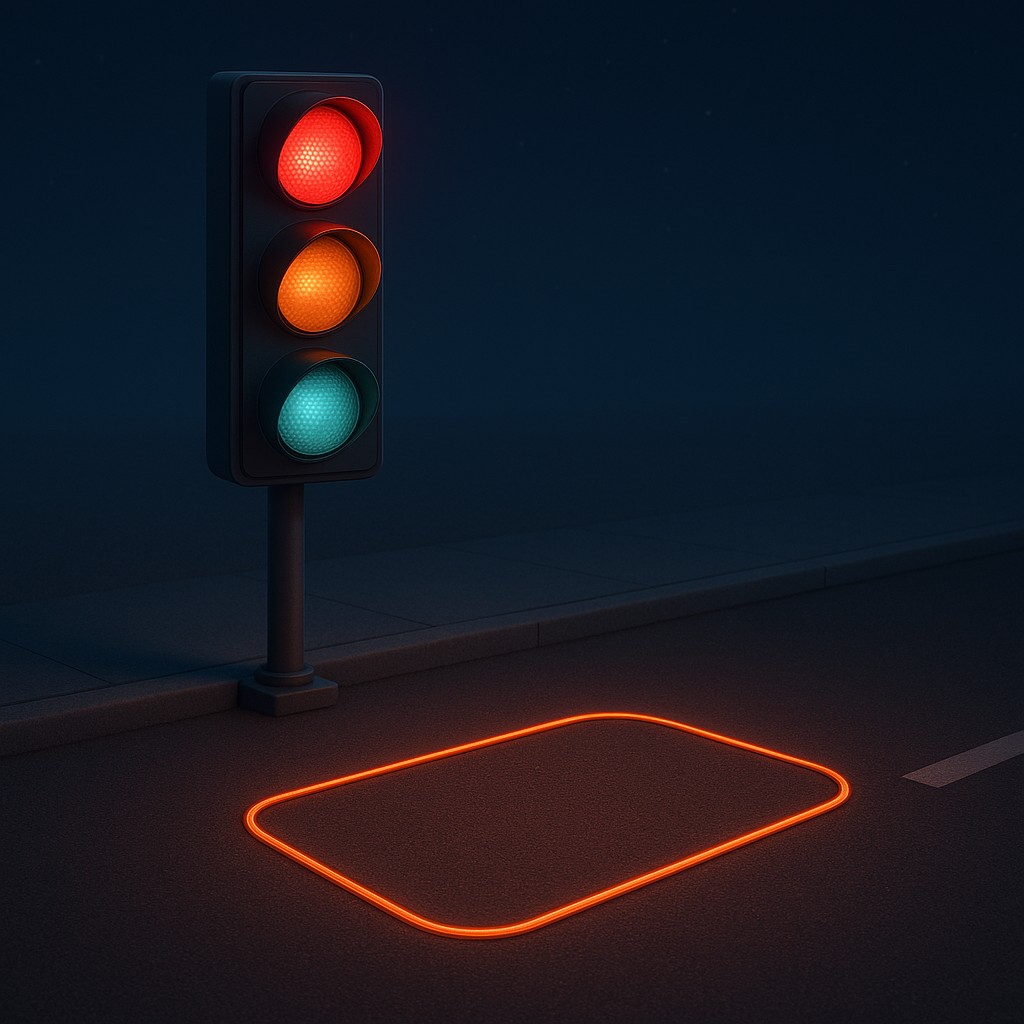
It is two in the morning, and you are sitting at a red light. You are the only person on the road for miles. As you stare at the glowing red circle, you wonder how long you are stuck in this asphalt purgatory. Then, like magic, the light turns green the moment your bumper passes over a specific rectangular scar in the pavement.
You might have heard that cameras on the signal arms are watching you, or that pressure plates under the road "feel" the weight of your car. In reality, the truth is much cleaner and relies on the invisible world of electromagnetism.
The secret stays hidden in those dark, tarred rectangles cut into the turn lanes of almost every major intersection. These are not just patches in the road; they are the footprints of inductive loops. These loops act as the nervous system for the city’s traffic grid. Instead of using sight or touch, the road "sniffs" for metal. To understand how they work, you have to change how you view the relationship between electricity and the objects moving through our world.
The Invisible Lasso of Electromagnetism
To understand the inductive loop, we first have to look at how copper wire acts when it is wound into a circle. When an electric current flows through a wire, it creates a magnetic field around it. If you coil that wire into a loop, those individual magnetic fields overlap. This creates a much stronger field that pulses outward from the center of the coil. To manage traffic, the city buries several loops of heavy wire into a shallow trench in the asphalt, creating a giant horizontal coil.
This coil connects to an oscillator inside the silver metal cabinet usually found on the sidewalk corner. The oscillator sends a low-frequency alternating current through the buried wire. This creates a pulsing magnetic field that reaches up through the pavement and into the air. At this point, the loop is a "tuned" circuit with a specific level of inductance - a term for its ability to resist changes in electrical current. As long as the environment stays the same, the magnetic field is stable, and the sensor tells the computer the lane is empty.
Everything changes when a massive hunk of metal, like your car’s frame or engine block, enters that field. Most people assume the car "completes a circuit" or "pushes down" a switch, but the science is more subtle. When your car enters the field, the magnetic lines of force interact with the metal of the vehicle. This creates tiny, swirling currents within the car’s metal called eddy currents. These tiny currents produce their own magnetic fields that push back against the loop in the road. This opposition shifts the frequency of the circuit. The sensor in the control box detects this shift and realizes several thousand pounds of steel are now sitting right on top of it.
Decoding the Signal at the Control Box
Once your car "disturbs" the magnetic field, the work moves from the asphalt to the brains of the intersection. Inside that metal cabinet on the corner, a detector unit constantly monitors the "health" of the buried coil. It does not just look for a simple on-and-off signal. Modern detectors are tuned to look for specific "signatures" of magnetic change. This helps the system tell the difference between a Honda Civic and a stray shopping cart or a piece of metal trash blowing through the lane.
The detector measures the change in frequency and sends a "call" to the traffic signal controller. This call is a request for a green light. If the light is red, the controller puts your lane in a digital waiting line. Depending on how the intersection is set up, it might give you a green light immediately, or it might wait for a timer to finish. This responsiveness is what separates "actuated" signals (those that respond to traffic) from "fixed-time" signals (those that run on a set schedule regardless of who is waiting).
| Sensor Type |
How It Works |
Strength |
Weakness |
| Inductive Loop |
Tracks changes in magnetic fields |
Extremely reliable in all weather |
Struggles to detect non-metal objects (bikes) |
| Video Camera |
Uses images to find motion |
Can detect pedestrians and track speed |
Fails in fog, heavy rain, or sun glare |
| Microwave/Radar |
Bounces radio waves off moving objects |
Great for tracking vehicle speed |
Less effective at seeing stopped cars |
| Magnetometer |
Measures changes in Earth's magnetic field |
Small and easy to install |
Small detection zone; needs more units |
Why Your Bicycle Often Goes Unnoticed
One of the big frustrations for cyclists is the "immortal red light" - a signal that refuses to acknowledge they are there. Because the system relies on metal disrupting a magnetic field, small vehicles have a hard time. A bicycle made of carbon fiber has almost zero impact on the field. Even a steel-framed bike is so small compared to the large wire loop that it might not cause enough of a change to trigger the sensor.
Motorcycles face a similar problem. Even though they are made of metal, they have much less surface area than a car. If a motorcyclist stops in the dead center of a large loop, the magnetic field might "pass around" them without enough contact. This is why you sometimes see "T" shapes painted on the pavement. These marks show the "sweet spot" of the loop, usually right over the buried wire where the magnetic field is strongest. Putting a wheel or a metal kickstand directly over the wire is often the only way a small vehicle can "trip" the light.
To fix this, many cities are moving toward "Type D" loops, which look like a rectangle with a diagonal line, or "quadrupole" loops shaped like a figure-eight. These patterns create a much more sensitive magnetic field that is better at catching small pieces of metal, like a bicycle rim. But until these sensitive loops are everywhere, people on two wheels are often forced to wait for a car to pull up behind them to provide enough magnetic "bulk" to get the computer's attention.
Durability and the Hidden Costs of the Road
You might wonder why we still bury wires in the ground when we have high-definition cameras and artificial intelligence. The answer is simple: reliability. Inductive loops are protected under the surface. They don't care about the blinding glare of a sunset, thick blankets of snow, or heavy rain. A camera can be confused by shadows or water spraying off a tire, but a magnetic field does not need to "see" anything. As long as the wire stays in one piece, the loop works.
However, "staying in one piece" is the biggest weakness. Roads are not permanent; they expand and shrink with the seasons, settle over time, and are often ground down and repaved. When a road is prepared for new asphalt, heavy machinery often chews right through the buried copper wires, killing the sensor. Also, the vibration of heavy trucks can eventually rub through the wire's insulation, causing a short circuit. Fixing these failures is a headache for maintenance crews, who have to stop traffic to cut new slots in the road and "pour" a new loop into place.
Despite these flaws, the inductive loop is still the global standard because it is simple. It is an "invisible" technology that needs no light and very little power. It is a rare case where we use a basic law of physics to solve the everyday problem of getting home in time for dinner.
The Future of the Magnetic Intersection
As we move toward a future of self-driving cars and "smart cities," the way we detect vehicles is starting to change. Inductive loops are being joined by new tech that doesn't require cutting into the road. Some cities use wireless magnetometers - sensors the size of a hockey puck that sit in a single drilled hole and talk to the controller via radio. Others use thermal imaging, which can tell a warm human body from a cold metal car, allowing lights to prioritize people walking or biking.
There is also the rise of "Vehicle-to-Infrastructure" (V2I) communication. In this world, your car wouldn't need to be "detected" by a magnetic field. Instead, your car’s computer would broadcast its position and speed to the intersection using a specialized Wi-Fi signal. The light would "know" you were coming from blocks away and stay green for you. But since there are still millions of older cars and bikes on the road, the humble inductive loop isn't going away. It will remain the silent, magnetic gatekeeper of our streets for a long time.
The next time you are waiting at a quiet intersection, look at the ground. Look for those thin, tar-filled lines in the lane. Know that beneath your tires, electricity and magnetism are hard at work. You have stepped into a magnetic field, changed its frequency, and signaled your presence to a machine hundreds of feet away. You aren't just sitting in traffic; you are part of a silent conversation between your car and the world beneath your wheels.