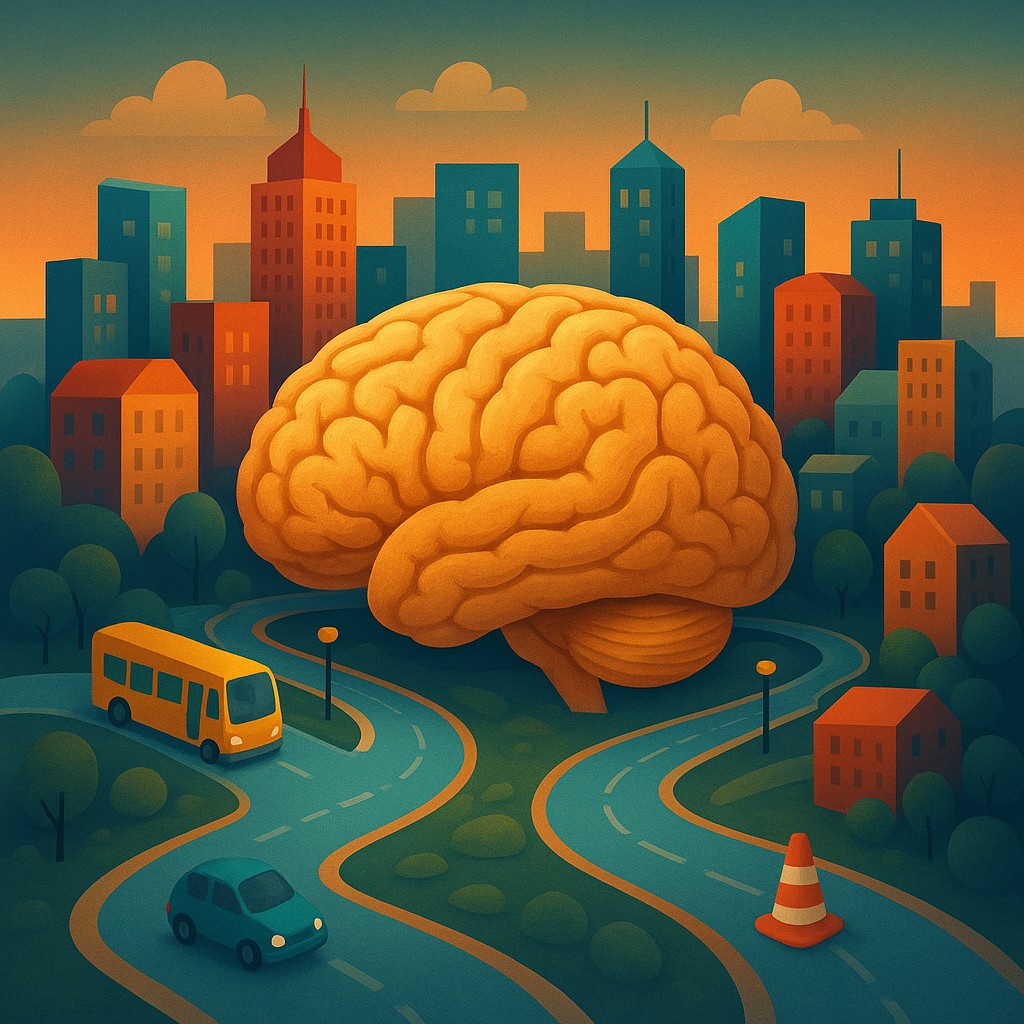
Imagine for a moment that you are a high-level logistics manager for a sprawling, bustling city. Your job is to ensure that commuters get from their suburban homes to their downtown offices every single morning without fail. In a perfect world, every highway is paved, every bridge is sturdy, and every traffic light functions with clockwork precision. But life is rarely perfect. Floods happen, construction crews shut down major arteries, and occasionally, a giant sinkhole opens up in the middle of Main Street.
If your city has only one road connecting point A to point B, the entire system grinds to a halt the moment a single orange cone appears. However, if your city is a rich tapestry of winding side streets, hidden alleys, and robust public transit, the commuters simply shrug, turn the steering wheel, and find a different way to get to work.
This is the fundamental secret of the human brain, a concept scientists call Cognitive Reserve. For decades, the medical community assumed that brain health was a direct, simple reflection of physical condition. If a scan showed "wear and tear" or the physical markers of aging, it was assumed the person must be struggling with memory or mental clarity. But then, researchers discovered something startling. They found individuals whose brains showed significant physical decline during an autopsy, yet these people had lived their final years with sharp minds and vibrant personalities. Their "city" had sustained serious structural damage, but the traffic was still moving perfectly. They had built a mental infrastructure so resilient that the brain could effectively outsource its tasks to healthy regions when the primary circuits failed.
The Architecture of Mental Resilience
At its core, Cognitive Reserve is the brain’s ability to improvise and find alternate pathways to complete a task. Think of it as "functional flexibility." While some people have a brain that works like a brittle glass sculpture - beautiful but easily shattered by a single crack - others possess a brain that functions more like a high-speed internet network. If one server goes down in a resilient network, the data is simply rerouted through three other hubs until it reaches its destination. This isn't just a metaphor; it is a physical reality of how our neurons interact. When we challenge ourselves, we aren't just memorizing facts; we are literally "paving" new neural roads.
This reserve is built through a process called neuroplasticity, which is the brain's lifelong capacity to reorganize itself by forming new connections between nerve cells. Every time you learn a new skill, whether it is mastering the tango or figuring out how to use complex software, your brain creates new physical pathways. These connections act as backup systems. High cognitive reserve does not necessarily prevent the physical damage of aging or disease, but it changes how that damage affects your daily life. It acts as a buffer, a sort of intellectual shock absorber that allows you to maintain a high quality of life even when the biological hardware begins to fail.
The Nun Study and the Paradox of the Healthy Mind
One of the most famous pieces of evidence for Cognitive Reserve came from a long-term research project known as "The Nun Study." Starting in the late 1980s, researchers followed a group of sisters for decades, documenting their lives, their mental health, and eventually, their brains after they passed away. The beauty of this study was its controlled environment. These women lived similar lives, ate similar food, and shared the same surroundings.
However, the results were shocking. Some nuns showed advanced physical signs of Alzheimer's disease in their brain tissue, with plaques and protein tangles everywhere. Yet, while they were alive, these same women had scored incredibly high on cognitive tests and showed no symptoms of dementia.
What was their secret? The researchers found that the sisters who stayed mentally active, expressed complex ideas in their writing, and spent their lives teaching had fundamentally different "wiring." Their brains were so well-connected and their library of neural pathways was so deep that the disease couldn't easily shut them down. It was as if the disease was trying to cut the power to a house, but these women had so many backup generators and solar panels that the lights stayed on anyway. This study changed how we view aging, proving that our life experiences and the way we use our minds can physically transform our resilience to decline.
Building the Buffer through Lifelong Learning
So, how do you actually go about building this mental reserve? It isn't as simple as doing a daily crossword puzzle, though that certainly doesn't hurt. The key is "cognitive challenge." To build reserve, you need to step outside your comfort zone and force your brain to solve problems it hasn't seen before. Think of it like physical exercise. If you lift the same five-pound weights every day for twenty years, your muscles won't grow; they will simply stay where they are. To grow, you have to increase the weight or change the movement. The brain works the same way. It craves novelty and complexity.
Education and occupation play massive roles here. People who have spent their lives in jobs that require complex decision-making, social negotiation, or creative problem-solving tend to have higher levels of reserve. But you don't need a PhD to build it. Learning a new language is perhaps one of the most powerful "brain workouts" available because it requires the brain to navigate entirely different sets of rules and sounds. Similarly, learning a musical instrument forces the brain to process touch, sound, and sight all at once. Even social interaction is a massive builder of reserve. Navigating the nuances of a conversation, reading body language, and managing social dynamics are actually incredibly taxing for the brain, which is why "social butterflies" often stay sharper for longer.
Comparing Reserve Builders and Their Impact
To better understand how different activities contribute to your mental bank account, it is helpful to look at how they challenge the brain's internal systems. Not all "brain games" are created equal. Some build "passive" reserve (the physical size and density of your brain), while others build "active" reserve (how efficiently your brain uses what it has).
| Activity Type |
Primary Benefit |
Why it Works |
| Formal Education |
Structural Density |
Builds a broad foundation of knowledge and analytical skills early in life. |
| Learning a Language |
Executive Function |
Forces the brain to switch between different rule sets and sounds quickly. |
| Complex Socializing |
Emotional Intelligence |
Requires real-time processing of non-verbal cues and social strategy. |
| Playing an Instrument |
Multi-Sensory Integration |
Links motor skills with sound processing and mathematical timing. |
| Strategy Games |
Problem Solving |
Trains the brain to anticipate future scenarios and pivot when plans fail. |
The Role of Lifestyle and Physical Health
While we often think of Cognitive Reserve as a purely mental phenomenon, it is deeply connected to our physical health. The brain is an energy-hungry organ, consuming about 20 percent of the body's total calories despite being only 2 percent of its weight. Therefore, the "pipelines" that deliver fuel to the brain - our cardiovascular system - must be in top shape. High blood pressure, high cholesterol, and a lack of exercise can "clog the streets" of our mental city, making it harder for the brain to use the reserve it has worked so hard to build.
Regular aerobic exercise has been shown to increase the size of the hippocampus, the part of the brain responsible for verbal memory and learning. This means that a brisk walk is just as much a "brain activity" as reading a book. Sleep is another critical factor. During sleep, the brain's "cleaning system" washes away metabolic waste and clears out the cellular trash that can lead to decline. If you aren't sleeping, you are essentially leaving garbage in the streets of your city, making those detour routes much harder to navigate. A holistic approach to cognitive reserve means nourishing the hardware (the physical brain) while you are upgrading the software (your skills and knowledge).
Moving Beyond the "Use It or Lose It" Myth
There is a common misconception that if you don't build this reserve in your youth, you are destined for a quick decline. This is far from the truth. While early education provides a great head start, the brain remains "plastic" and capable of building new pathways throughout your entire life. The "use it or lose it" mantra is a bit too pessimistic. It is more accurate to say "use it and improve it, no matter your age." Even small changes in your daily routine can spark the growth of new connections.
Another myth is that cognitive reserve can "cure" or "reverse" diseases like Alzheimer's. It is important to be clear: heart-healthy habits and mental stimulation do not stop the underlying biological processes of these conditions entirely. However, what they do is move the "finish line." If a person with low reserve starts showing symptoms at age 70, a person with high reserve might not show those same symptoms until age 80 or 85, even if the physical damage in the brain is identical. They have effectively "bought" themselves another 15 years of high-functioning, independent life. In the world of neurology, that extra decade is everything.
The Social and Emotional Dimension of Resilience
We often underestimate how much our emotions and social connections contribute to our mental strength. Long-term stress is like acid for the brain's wiring; the constant flood of stress hormones can actually shrink certain brain regions over time. This is why building emotional resilience and a strong support network is a vital pillar of cognitive reserve. Engaging in meaningful social roles - whether that is volunteering, joining a club, or simply maintaining deep friendships - provides a "social scaffolding" that keeps us engaged and alert.
When we interact with others, our brains are constantly making predictions, empathizing, and responding. This is a high-level mental "load" that we often take for granted because it feels natural. But for the brain, a dinner party is a massive workout. It involves processing sounds in a noisy room, recognizing faces, remembering a person's history, and the motor control required for speech and eating. Isolation, conversely, is a quiet killer of cognitive reserve. Without the "traffic" of social interaction, the brain's side streets begin to fall into disrepair from lack of use.
Crafting Your Own Mental Infrastructure
Building a resilient brain is not a sprint; it is an ongoing project that can be deeply enjoyable. It is about curious engagement with the world. You don’t have to become a theoretical physicist to protect your mind. You simply have to remain a student of life. Whether it is choosing a different route home from work, picking up a hobby that makes you feel like a clumsy beginner again, or having deep conversations with people who hold different perspectives, you are doing the essential work of paving those "side streets."
The beauty of the Cognitive Reserve model is that it puts the power back in your hands. It tells us that our destiny is not purely written in our genes or our past. Every book you read, every new person you meet, and every difficult puzzle you solve is an investment in your future self. You are building a city that is robust enough to handle the storms of time. So, go ahead and take that introductory pottery class, start that journal, or finally learn how to play the harmonica. Your brain will thank you for the extra detours, and when the main bridges of life eventually get a little shaky, you will still be moving forward at full speed, enjoying the view along the way.