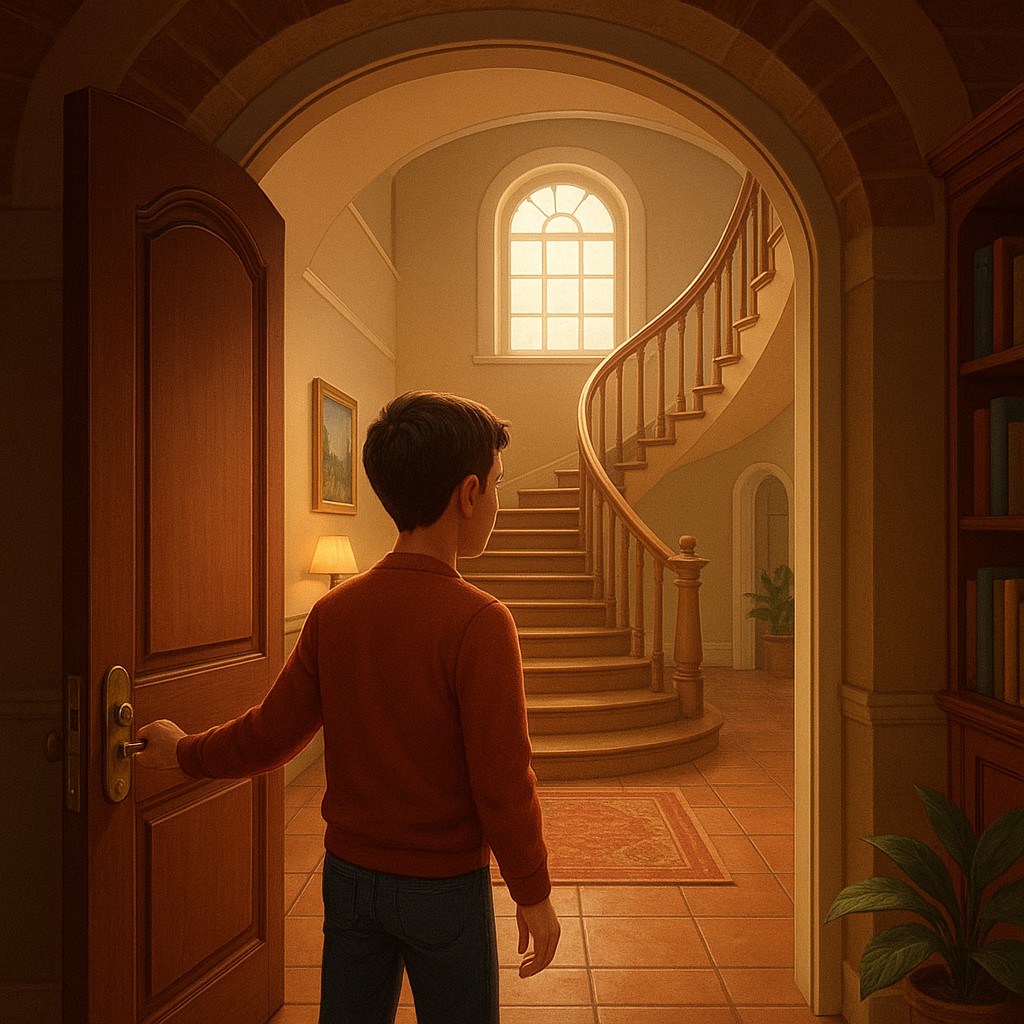
Imagine you are standing at the front door of your childhood home. You can feel the weight of the doorknob, hear the slight creak of the floorboards, and catch the faint, familiar scent of the hallway. Most of us could navigate our homes in total darkness, sidestepping the coffee table and reaching for the light switch without a second thought. This incredible ability to map physical space is one of the oldest survival mechanisms in our evolutionary toolkit. Long before humans needed to remember credit card numbers or grocery lists, we had to remember where to find fresh water, which trails led to predators, and which cave belonged to our tribe.
Despite this powerful spatial hardware, we often feel like our memories are failing us when we try to learn a new language, study for an exam, or remember names at a party. We blame our brains for being "bad at remembering," when the truth is that we are simply trying to store data in a format that the brain finds boring. Our minds are not natural filing cabinets for abstract text, but they are world-class architects of three-dimensional environments. The Method of Loci, also known as the Memory Palace, is the secret bridge that allows you to take abstract, "un-memorable" data and hook it onto the permanent spatial maps already living in your head.
The Architectural Blueprint of the Mind
The Method of Loci is an ancient Greek memory technique that translates to "the method of places." Legend has it that the poet Simonides of Ceos discovered it after a tragic banquet hall collapse. He found that by visualizing where each guest had been sitting, he could identify the bodies even when they were otherwise unrecognizable. While the origin story is a bit macabre, the logic is sound: your brain is hardwired to remember where things are located. When you use this technique, you aren't just memorizing a list; you are decorating a room. By placing "mental objects" in specific locations around a familiar building, you create a durable, navigable path for your consciousness to follow later.
This works because of how our hippocampus functions. This part of the brain is heavily involved in both moving short-term memories into long-term storage and in spatial navigation. When you combine the two, you are essentially "tricking" your brain into treating a list of chemistry terms as if they were physical landmarks in your neighborhood. Because the brain considers spatial information a high priority for survival, it holds onto these "locations" with much more tenacity than it would a page of notes or a series of flashcards. You don't need to be an artist or an architect to do this; you just need to be able to close your eyes and imagine your kitchen sink.
Designing Your First Mental Real Estate
To begin using this technique, you must first select a "Locus" or a place. The most effective starting point is usually a building you know intimately, such as your current apartment, your high school, or even your favorite local park. The key requirement is that you must be able to visualize it clearly without effort. Once you have chosen your palace, you define a specific route through it. You might start at the front gate, walk through the front door, turn left into the living room, and continue into the kitchen. This sequence provides the "hooks" upon which you will hang your information.
As you walk this mental path, you identify "stations" or specific furniture items and corners. A coat rack, a bookshelf, a television, and a dining table all serve as excellent slots for information. The beauty of this system is that it creates an inherent order. If you need to remember the first ten US Presidents or the steps of a biological process, the physical layout of your house dictates that order for you. You cannot get to the kitchen without passing the living room, so you cannot forget the third item on your list if you have already visualized the second.
The Art of the Absurd and the Vivid
If you simply imagine a gallon of milk sitting on your sofa to remember your grocery list, you might forget it. The human brain is efficient, which is a polite way of saying it is lazy; it filters out the mundane and the "normal." To make a memory stick, you must make the mental image vivid, strange, and even ridiculous. If you need to remember to buy milk, don't just see a carton. Instead, imagine a giant, six-foot-tall cow wearing a tuxedo sitting on your sofa, sipping tea and splashing milk all over your cushions. The more senses you involve - the sound of the splashing, the smell of the cow, the coldness of the liquid - the more hooks you create in your neurons.
This "Vivid Imagery" rule is what separates casual users from memory champions. When an image is funny, shocking, or bizarre, the brain flags it as important. If you are trying to remember that the Spanish word for "table" is "mesa," you might imagine a giant, messy "mess" of spaghetti being dumped all over your dining room table. The linguistic connection (mesa/mess) combined with the sensory shock of the visual ensures that when you mentally walk past your dining room, that image will pop back into your mind immediately.
Strategic Comparison of Memory Techniques
While the Method of Loci is exceptionally powerful for structured lists and sequences, it is helpful to see how it stacks up against other common study methods. Most people default to rote rehearsal - just saying things over and over - which is the least efficient way to move data into long-term storage.
| Technique |
Primary Mechanism |
Best Used For |
Effort Level |
| Rote Rehearsal |
Repetition |
Short-term survival, phone numbers |
Low (but boring) |
| Acronyms |
First-letter cues |
Simple lists (e.g., HOMES for Great Lakes) |
Low |
| Flashcards |
Testing effect |
Vocabulary and quick facts |
Medium |
| Method of Loci |
Spatial visualization |
Long lists, speeches, complex hierarchies |
Medium-High |
| Mind Mapping |
Visual hierarchy |
Brainstorming and connections |
Medium |
As the table suggests, the Method of Loci requires more upfront mental energy than simply reading a textbook. However, the return on investment is significantly higher. Once a "palace" is built and populated, the information tends to stay there for weeks or even months with minimal review. In contrast, something learned through rote repetition often vanishes the moment the exam is over.
Navigating the Rooms of Complex Data
One common misconception is that this method is only for simple lists like groceries or errands. In reality, modern memory athletes use the Method of Loci to memorize thousands of digits of Pi, the entire works of Shakespeare, or complex medical terminology. The trick for complex data is "layering" and "nesting." If you are a medical student learning the bones of the hand, you don't just put one bone in one room. You might turn your entire bathroom into the "Carpal Tunnel," where each tile on the wall represents a different bone, and the shower curtain is the ligament holding them together.
You can also create "themed" palaces for different subjects. You might have a "History House" where the Victorian era lives in the basement and the Space Age is stored in the attic. You might also use your favorite video game map or the street you walk every day to work. By diversifying your mental real estate, you prevent "ghosting," which is when images from a previous list interfere with a new one. If you use your kitchen for groceries every single day, the images might get muddled. However, if you use your grandmother's house for Spanish vocabulary and your office for a work presentation, the two will never cross paths.
Debunking the Myth of the Gifted Memory
Many people watch memory grandmasters on television and assume these individuals have a biological "photographic memory." This is almost never the case. Research has shown that when memory champions are memorizing, their brains show massive activity in regions associated with spatial navigation, not just pure "data storage." These individuals have simply trained themselves to use the Method of Loci so fluently that it becomes second nature. They aren't smarter; they are just better "mental interior decorators."
Anyone can improve their recall by 200% or 300% within a few days of practice. The hurdle isn't intelligence; it is the willingness to play. Adults often struggle with this technique initially because we have been conditioned to think in a very linear, dry, and professional way. We feel silly imagining a giant neon penguin in our bathtub to remember to pay the electricity bill. However, once you embrace the whimsy and realize that your brain actually craves these ridiculous associations, the process becomes more than just effective; it becomes genuinely fun.
Expanding the Palace Beyond Four Walls
As you become more comfortable with your mental architecture, you can start using "outdoor palaces" or "journey methods." Your walk from the train station to your office can serve as a massive, open-air memory palace. Every storefront, traffic light, and statue becomes a station where you can deposit a piece of information. Because these routes are part of your daily life, they are constantly reinforced, making them some of the most stable foundations for storage. One famous practitioner even used the layout of the London Underground to store vast amounts of historical data, turning a morning commute into a mental library.
You can even create "imaginary" palaces. If you are a fan of a particular movie or a fictional world, you likely have a very strong sense of its layout. Using the bridge of the Starship Enterprise or the halls of Hogwarts is just as effective as using your own house, provided you can "see" the space clearly. The brain doesn't distinguish between a "real" physical space you have walked through and a "virtual" space you have spent time visualizing. This opens up infinite storage possibilities for a lifetime of learning.
The true power of the Method of Loci lies in the realization that your mind is not a passive container to be filled, but an active landscape to be explored. You have already spent decades naturally building high-resolution maps of the world around you; it is time to start using that infrastructure for more than just finding your keys. By turning boring, abstract information into vibrant, three-dimensional experiences, you are no longer fighting against your brain's nature. Instead, you are finally giving it the kind of fuel it was designed to burn. Start small today with just five items and your own living room, and you will quickly discover that your memory is far more capable and creative than you ever imagined.