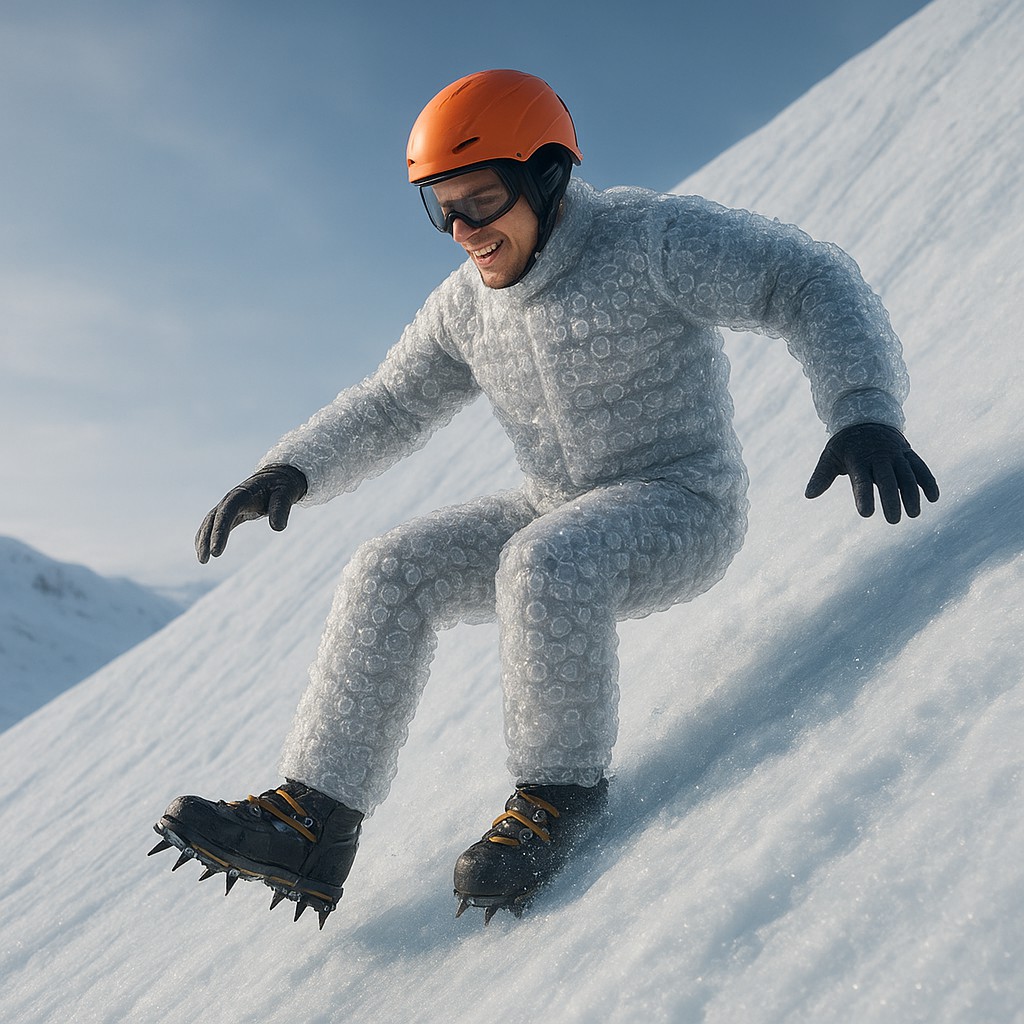
Imagine you are standing at the top of a steep, icy hill. If you were wearing nothing but a t-shirt and sneakers, you would likely climb down with the extreme caution of a cat walking on wet glass. Every step would be calculated, you would keep your center of gravity low, and your eyes would be glued to the ground. Now, imagine someone wraps you in a thick suit of bubble wrap, places a high-tech helmet on your head, and fits you with professional climbing spikes. Suddenly, that terrifying sheet of ice looks like a playground. You might find yourself jogging down, perhaps even attempting a playful slide. While the gear technically makes you "safer," you have completely changed your behavior to use up that extra margin of safety.
This shift in behavior isn't just a personality quirk; it is a fundamental psychological habit called risk compensation. It suggests that humans have a "target level" of risk they are willing to tolerate. When a new safety feature, such as a seatbelt or a helmet, lowers the perceived danger of an activity, we don't always keep our behavior the same to enjoy the added protection. Instead, we often ramp up the intensity of our actions to return to our original comfort level. This phenomenon is famously known as the Peltzman Effect, named after the economist Sam Peltzman, who first proposed that safety regulations might be canceled out by changes in human psychology.
The Invisible Thermostat of Danger
To understand why we act this way, it helps to think of risk-taking like a thermostat in a house. Most of us have a preferred "temperature" for danger. If the room gets too cold, representing a life that is too cautious and misses out on rewards like speed or excitement, we turn up the heat. If the room gets too hot and feels genuinely life-threatening, we turn the heat down. The Peltzman Effect occurs because a new safety invention effectively "cools the room" of our environment. By making a car crash or a fall less damaging, technology lowers how hot the risk feels.
In response, many people instinctively "turn up the heat" to get back to their preferred setting. This might mean driving five miles per hour faster on the highway because they know their car has side-impact airbags. Or it could be a skier taking a more aggressive path through the trees because they are wearing a high-end back protector. The fascinating part of this theory is that the total amount of "heat" or risk often stays the same. The safety gear essentially acts as a subsidy for recklessness, allowing us to trade security for performance, speed, or convenience.
This does not mean we are making a conscious choice to be reckless. Risk compensation mostly happens below the surface of our awareness. Our brains are constantly performing a "cost-benefit" analysis of every move we make. When the cost of a mistake goes down, the relative benefit of going faster or trying something new goes up. This internal calculation is so seamless that we rarely notice we are doing it until we are halfway through a risky maneuver we never would have dreamed of attempting ten years ago.
Why Better Brakes Don't Always Lead to Fewer Crashes
One of the most cited examples of the Peltzman Effect involves the introduction of Anti-lock Braking Systems (ABS). On paper, ABS is an engineering miracle. It prevents your wheels from locking up during a hard stop, allowing you to keep steering while you slow down. Engineers and safety advocates originally expected accidents to plummet as this technology became standard. However, several studies, including famous research by the Highway Loss Data Institute, found that cars equipped with ABS weren't necessarily involved in fewer accidents than those without them.
The reason for this statistical mystery lies in the driver’s seat. Once people realized their cars could stop more effectively on wet or slick roads, they started driving faster in the rain. They followed the car in front of them more closely than they used to, subconsciously trusting that the ABS would "save" them if the lead driver slammed on the brakes. By using the safety margin provided by the technology to drive more aggressively, they effectively canceled out the benefit of the invention. The car was better, but the driver was worse.
This creates a puzzling dilemma for designers. If every safety improvement is simply "spent" by the user to gain more efficiency or speed, how do we actually make the world safer? The answer lies in how much people compensate. Not everyone offsets the risk by 100 percent. While some may use a modern car's safety to drive like a stunt performer, many others will only increase their risk slightly, leading to an overall gain in safety. However, the Peltzman Effect serves as a stern warning that technology is never a simple "plug and play" solution for human survival.
Comparing Perceived Safety and Behavioral Response
To better understand how this looks in the real world, we can compare various safety measures and the common behavioral shifts that follow them. The following table illustrates how a perceived increase in security often leads to a "re-balancing" of risk.
| Safety Measure |
Intended Goal |
Potential Behavioral Offset |
Resulting "Peltzman" Effect |
| Mandatory Seatbelts |
Reduce deaths in a crash |
Higher speeds and later braking |
Drivers feel "buckled in" and secure, leading to less caution. |
| Bicycle Helmets |
Prevent head injuries from falls |
Passing closer to cars or riding faster |
Cyclists may take tighter turns; drivers may pass them more closely. |
| Improved Street Lighting |
Reduce crime and accidents |
Pedestrians and drivers moving faster |
Better visibility leads to higher speeds in residential areas. |
| Reserve Parachutes |
Provide a backup for failure |
Attempting more complex aerial stunts |
Divers take risks at lower altitudes knowing they have a "second life." |
| Pilot Assistance Tech |
Reduce pilot fatigue and error |
Less focus on manual control |
Pilots may become overly reliant on automation during critical moments. |
The Psychological Lure of the Safety Net
The reason the Peltzman Effect is so persistent is that humans are naturally wired to seek rewards. In the wild, if an animal finds a way to get food with less risk of being eaten, it doesn't just sit back and relax; it uses that extra energy and safety to gather even more food. We are the descendants of the most efficient risk managers in history. In a modern context, "food" has been replaced by "time" and "excitement." If a safety feature makes a commute feel safer, we use that safety to arrive five minutes earlier by pushing the speed limit.
A classic study from the 1980s involving taxi fleets in Munich, Germany, perfectly illustrated this. Half of the taxis were equipped with ABS, while the other half were not. Researchers monitored the drivers for three years and discovered that the drivers with the superior brakes actually had a slightly higher crash rate in certain conditions because they drove much more aggressively. They made sharper turns and changed lanes more abruptly. They were literally "testing" the limits of their safety systems, proving that the more protected we feel, the more willing we are to dance on the edge.
This leads to a confusing paradox: sometimes, making things look dangerous is the best way to keep people safe. In some urban planning circles, there is a movement toward "shared space" designs. In these areas, curbs, signs, and lane markings are removed, making the street look chaotic and confusing. Counter-intuitively, because the drivers feel "at risk" and unsure of their surroundings, they slow down significantly and pay much more attention. By removing safety "crutches," planners force the human brain to switch from "autopilot" to "high alert."
Navigating the Myth of Total Protection
A common misconception is that the Peltzman Effect makes safety gear useless. This is a dangerous myth. Even if people drive faster because they have airbags, an airbag is still infinitely better to have during a collision than a solid steering column. The goal of understanding risk compensation is not to discourage safety inventions, but to manage our own reactions to them. If we know we tend to "speed up" when we feel safe, we can consciously choose to stay cautious even after upgrading our gear.
Another myth is that the Peltzman Effect applies equally to everyone. In reality, risk compensation varies wildly based on personality and experience. A professional race car driver might use safety gear to push a car to its absolute physical limit, whereas a cautious grandparent might keep the same slow speed regardless of how many safety features their car has. However, across a whole population, the "average" human behavior tends to follow the Peltzman model. When we design policies and products for millions of people, we have to assume that at least some of them will use the new safety as a license for adventure.
We must also distinguish between "perceived safety" and "actual safety." The Peltzman Effect is triggered by how safe we feel. If a person is given a safety feature they don't know exists, they won't change their behavior because their internal risk thermostat hasn't been moved. This is why some of the most effective safety features are "passive" or hidden. If a car's frame is strengthened to survive a rollover, but the interior looks and feels exactly the same, the driver is less likely to compensate for that extra protection because they don't "feel" the safety subsidy.
Harnessing the Power of Risk Awareness
The most important takeaway from the Peltzman Effect is that the ultimate safety device is not a piece of hardware, but our own mindset. Technology can protect our bodies, but it often relaxes our brains. By realizing that our "risk thermostat" is always trying to adjust itself, we can take back control of the dial. When you buy a newer car, a better helmet, or a smarter home security system, take a moment to ask yourself: "Am I about to start acting more recklessly because I feel protected?"
Understanding this concept makes you a more sophisticated observer of the world around you. You will begin to notice why people on "safe" playgrounds might try more dangerous jumps, or why companies with robust insurance policies might take larger financial risks. It is a lens that brings human nature into sharp focus, revealing that we are not passive users of technology, but active participants who are constantly negotiating with our environment.
As you move forward, use this knowledge as a tool for personal growth. The next time you feel "invincible" because of a new tool or a supportive environment, remember those Munich taxi drivers. True safety comes from combining great tools with the wisdom to act as if you don't have them. When you can master the gear without letting the gear change your character, you have found the secret to navigating a complex world with both courage and intelligence. Let your tools be your backup, not your excuse, and you will find that you can reach your goals faster without ever losing your edge.