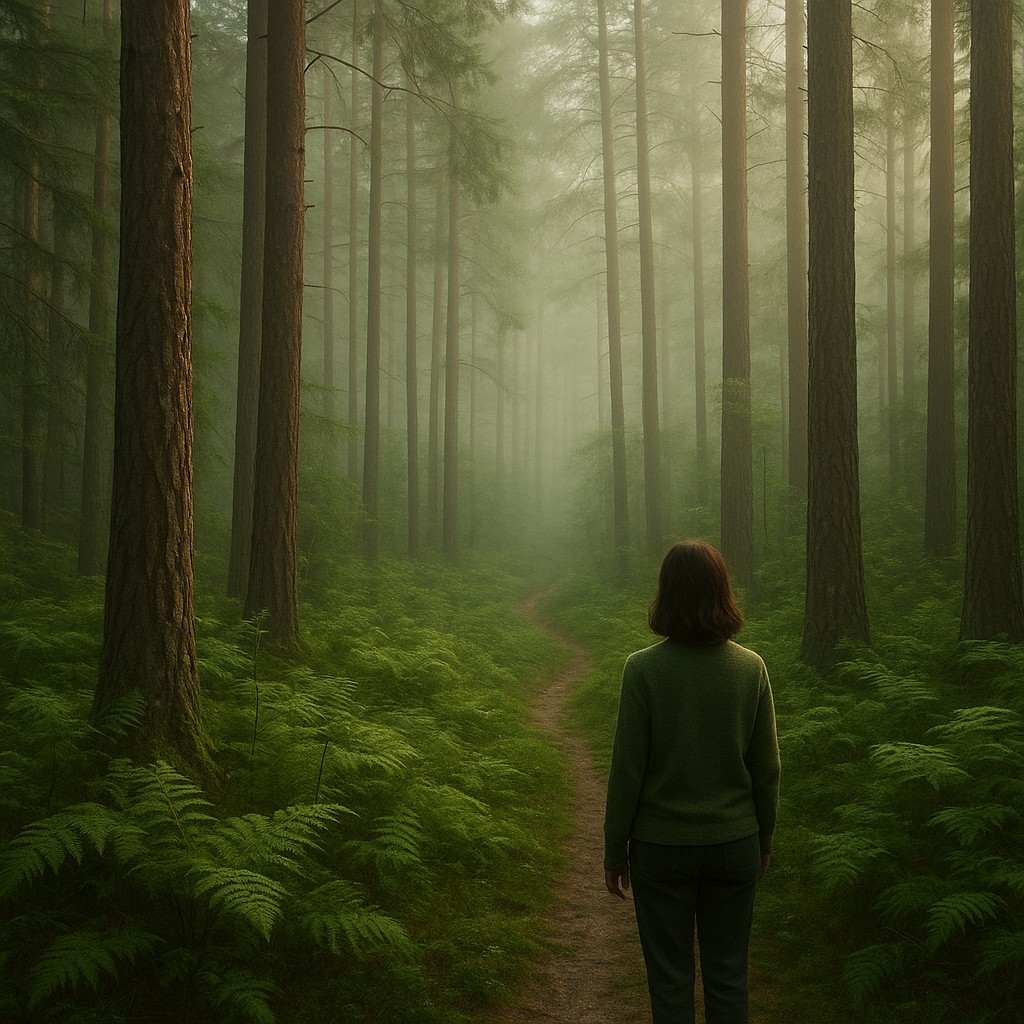
Imagine for a moment that you are standing in a thick grove of pines, the morning mist still clinging to the bark. Your phone, usually a buzzing extension of your hand, is tucked away or, better yet, has no signal at all. The air doesn’t taste like the recycled ventilation of an office or the exhaust of a busy street; it tastes green, cool, and crisp. As you take a deep breath, that tight knot in your chest, the one you have been carrying since Monday morning, begins to loosen. You aren't just imagining this feeling, and you aren't "relaxing" simply because you’re away from your desk. There is a deep, biological conversation happening between your body and the ecosystem around you.
The human relationship with the forest isn't just about pretty views or poetry; it is ancestral. For almost all of human history, we didn't live in climate-controlled boxes looking at glowing screens. We lived in the filtered light of the canopy, tuned to the rustle of leaves and the scent of damp earth. When we step back into the woods, our nervous systems recognize it as a "homecoming." Science is now catching up to this instinct, proving that the forest acts like a pharmacy for the stressed-out modern mind. Once we understand how this transformation works, we can stop seeing nature as a luxury and start seeing it as a vital health requirement.
The Invisible Chemistry of the Canopy
When you walk through a forest, you are essentially walking through a giant, slow-motion chemical explosion. Trees don't just sit there looking beautiful; they actively communicate and defend themselves using organic compounds. One of the most important groups of these chemicals is called phytoncides. These are natural oils, like alpha-pinene and limonene, which trees release to protect themselves from rotting or being eaten by insects. When we breathe in these forest scents, our bodies react with what feels like a superpower boost to our immune system.
Research shows that inhaling these compounds significantly increases the activity and number of our "Natural Killer" (NK) cells. These are white blood cells that find and destroy virally infected cells and even tumors. In one well-known study, people who spent two nights in a forest saw a 50 percent increase in their NK cell activity. Remarkably, these high levels lasted for more than a month after they returned to the city. It turns out that "fresh" forest air is actually a complex chemical cocktail that proactively helps your body fight off disease and stress-related inflammation.
Beyond the immune system, these airborne chemicals have a direct line to our hormones. Breathing in the scent of the woods lowers levels of cortisol, the primary hormone that keeps us in a "fight or flight" state. Modern life often keeps us in a state of chronic, low-grade stress where our cortisol never fully drops back to zero. This leads to exhaustion, brain fog, and irritability. The chemical signals from the trees act as a biological "off switch," telling our brains that the environment is safe and that we can finally relax our guard.
The Instinctive Comfort of Natural Patterns
Have you ever wondered why you can stare at a forest for hours without getting bored, yet staring at a blank wall for ten minutes feels like torture? The secret lies in "Soft Fascination" and the geometry of nature. Urban environments are filled with hard lines, sharp angles, and "hard fascination" triggers like traffic lights, ads, and sirens. These things demand our direct attention, which is a limited resource that drains quickly. When we use too much of this focused energy, we suffer from "Directed Attention Fatigue," which makes us grumpy and prone to mistakes.
Nature, on the other hand, is built on fractals. Fractals are complex patterns that repeat at different sizes, like the vein of a leaf looking like the branch of a tree, which in turn looks like the shape of the entire forest. Our eyes are evolved to process these patterns with almost no effort. When we look at swaying willow branches or the intricate details of a fern, our brains enter that state of "soft fascination." This allows our mental energy to recharge, much like a battery plugged into a steady charger.
This mental rest does more than just relax us; it restores our ability to think. When we are immersed in the beauty of the woods, the brain’s "Default Mode Network" takes over. This is the area responsible for daydreaming, self-reflection, and creative problem-solving. It explains why your best ideas often come during a walk in the park rather than while staring at a spreadsheet. By giving the logical, analytical part of your brain a break, you clear the clutter and let your subconscious do the heavy lifting.
Tuning the Body to the Rhythms of the Earth
Modern cities are loud, but it isn’t just the volume that stresses us out; it’s how unpredictable and harsh the sounds are. A car horn or a jackhammer triggers a "startle response" in the amygdala, the brain's alarm center. In contrast, forest sounds, like a bubbling stream or wind through the pines, are often what scientists call "pink noise." Unlike white noise, pink noise has more power at lower frequencies, which mimics the natural rhythms of our own biological systems, such as our heartbeats and brain waves.
Listening to these sounds shifts the balance of our nervous system. We have two main modes: the Sympathetic system (fight or flight) and the Parasympathetic system (rest and digest). A fast-paced life keeps the "fight or flight" mode on a hair-trigger. The rhythmic sounds of nature coax the "rest and digest" system back into the driver’s seat. This shift is measurable: your heart rate slows, your blood pressure drops, and your "heart rate variability" (a key sign of health and resilience) improves.
Forests are also among the few places where we can experience true silence, or at least the absence of human machines. This "golden silence" lets us reconnect with our own internal rhythms. When we aren't bombarded by the noise of civilization, we can finally hear our own thoughts. This reduction in sensory "static" is incredibly soothing for a brain that is usually trying to filter out thousands of irrelevant noises every hour. In the forest, every sound has a purpose, creating a sense of order that our bodies find deeply calming.
| Feature |
City Environment Impact |
Forest Environment Impact |
| Primary Chemicals |
CO2, pollutants, artificial scents |
Phytoncides, oxygen, soil microbes |
| Visual Input |
Hard angles, bright lights, flat planes |
Fractals, filtered light, varied greens |
| Sound Profile |
Sudden, harsh "Startle" noise |
Rhythmic "Pink Noise", natural silence |
| Nervous System |
Fight or Flight (Sympathetic) |
Rest and Digest (Parasympathetic) |
| Mental State |
Attention fatigue (exhaustion) |
Soft Fascination (creativity/rest) |
| Hormonal Response |
High Cortisol and Adrenaline |
More NK cells, lower Cortisol |
Why Green and Blue are the Colors of Contentment
If you look at a color wheel, the shades most common in a forest (deep greens, soft yellows, and the blue of the sky) hold a special place in our psychology. Evolutionary psychology suggests we prefer these colors because they once signaled life-sustaining resources. Green meant water and edible plants; blue meant clear weather and fresh water. Even today, just looking at the color green can lower our heart rate and reduce anxiety. We are biologically wired to feel safe when surrounded by the colors of a healthy ecosystem.
Furthermore, forest lighting is rarely harsh. The leaf canopy acts as a giant filter, creating "dappled light." This soft, shifting light is much easier on the eyes than fluorescent office bulbs or the glare of the sun on pavement. Dappled light creates a sense of depth and beauty without being threatening. It creates an environment that is interesting enough to keep us engaged but gentle enough to prevent us from feeling overwhelmed.
There is also the "Prospect and Refuge" theory. Humans feel most comfortable in places where they have a good view (prospect) but are also protected (refuge). A forest provides this perfectly. You can tuck yourself under a large oak while looking out into a clearing. This satisfies a primitive part of our brain that is constantly scanning for safety. When we feel both protected and able to see what’s coming, the brain sends a signal that it’s okay to relax and enter a state of peaceful thought.
The Microscopic Friends in the Soil
While we often focus on the trees, there is a world of calm beneath your boots. One of the most fascinating discoveries in recent years is the role of Mycobacterium vaccae, a harmless bacterium found in forest soil. When you walk in the woods or garden, you inevitably inhale or touch this bacterium. Research shows that M. vaccae actually triggers the production of serotonin in the brain, the same "feel-good" chemical targeted by many antidepressant medications.
Essentially, the dirt itself may act as a natural antidepressant. This helps explain why "getting your hands dirty" in nature feels so grounding. It isn't just the satisfaction of the work; it’s a chemical interaction with the earth’s microbes. This reminds us that we are not separate from nature, but part of a massive biological web. When we distance ourselves from the soil, we lose out on these microscopic interactions that have helped regulate human moods for thousands of years.
The complexity of the forest floor also releases "geosmin," the earthy smell that follows a rain. Humans are incredibly sensitive to this scent, far more than sharks are to blood in the water. We are evolved to detect the smell of damp earth because it signaled the end of a drought and the growth of food. Today, that smell still triggers a deep sense of relief in our primitive brain, reminding us that the earth is healthy and life is continuing its cycle.
Correcting Myths About Relaxing Outdoors
It’s a common mistake to think you need an intense, five-mile hike to get the benefits of the forest. In reality, "Forest Bathing" (or Shinrin-yoku, the Japanese practice of spending time in nature) has very little to do with exercise. In fact, if you treat your time in the woods like a workout where you’re focused on your pace and fitness tracker, you might miss some of the mental benefits. The goal is to engage your senses, not burn calories. Slowing down is the hardest part for most people, but it’s where the real changes happen.
Another myth is that you have to travel to a huge national park to feel these effects. While a redwood forest is majestic, even a local park or a small "pocket forest" in a city can trigger these physical responses. The phytoncides are still there, the fractal patterns are visible, and the birds are still singing. The key is the "dose" and how much attention you pay. Twenty minutes of sitting mindfully under a few city trees can be better for you than an hour-long hike spent talking on your phone.
Finally, some think the "calm" is just a placebo effect caused by expecting to feel better. While a positive mindset helps, the data on NK cells and cortisol proves these changes happen at a cellular level whether you "believe" in them or not. Your body is a biological machine reacting to its environment. Just as your body reacts to city smog, it reacts to the healing compounds of the woods. It is chemistry, not just wishful thinking.
Bringing the Wild into Modern Life
The beauty of the science behind forest calm is that it empowers you to take control of your mental health. You don’t need to quit your job and move to a cabin to benefit. Instead, think of "nature time" as a type of vitamin for your brain. By making small, intentional choices, you can weave the benefits of the woods into your daily routine, even if you live in a concrete jungle.
Start by looking for "micro-doses" of nature. If you have a lunch break, find a green spot and spend fifteen minutes there without your phone. Practice "active sensing": try to hear five different sounds, see three different shades of green, and feel the air on your skin. If you can’t get outside, even looking at high-quality photos of nature or listening to forest sounds through headphones provides a "lite" version of the stress-reduction effect.
Ultimately, the forest teaches us that we were never meant to be perpetually "on." Just as trees have seasons for growth and seasons for rest, our minds need periods of restoration to function at their best. By stepping into the woods, you are giving yourself permission to disconnect from the artificial urgency of the digital world. You aren't "wasting time" when you sit under a tree; you are repairing your immune system, recharging your brain, and reclaiming your peace. The woods are waiting, and they have everything you need to feel human again.