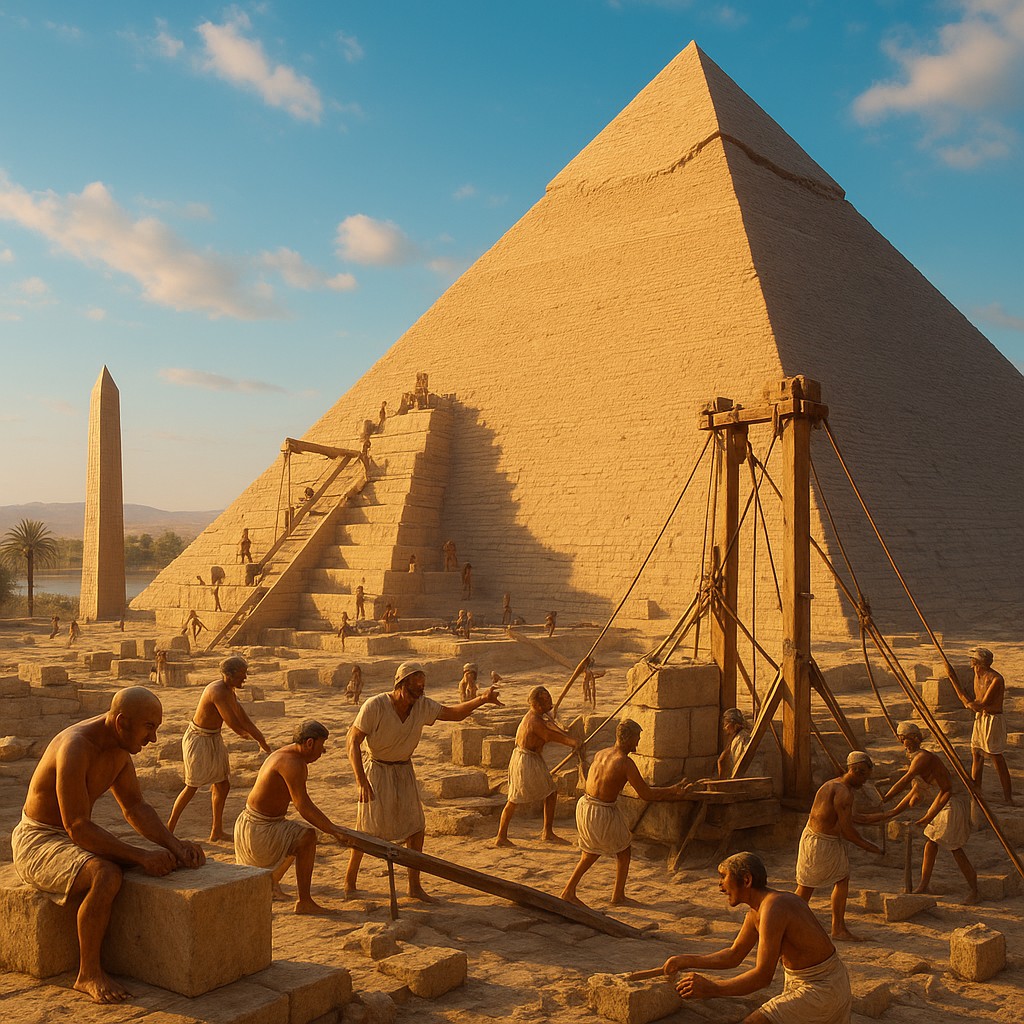
When you look at an Egyptian pyramid, it almost seems to defy common sense. Millions of stone blocks, stacked with astonishing precision, stand in a desert where the heat makes you want to sit down and negotiate with the shade. How did a civilization more than 4,500 years old pull this off without cranes, steel, engines, or an army of "magicians" like in the movies?
The answer is both simpler and more interesting than the myths. The pyramids are not a miracle dropped from the sky, they are the result of smart organization, patient engineering, skilled labor, and an obsession with logistics. In short, it is the story of a huge building project run well, with constraints, tricks, corrected mistakes, and steady improvement across generations.
This topic fascinates not just because the pyramids are large. It is because they are a solid puzzle, literally carved in stone. Understanding how they were built brings you into the daily life of the ancient Egyptians - their view of power, religion, the seasons of the Nil, and a practical science that did not need calculators to be devastatingly effective.
From a simple tomb to the perfect pyramid: an idea that improves with each attempt
Pyramids did not appear all at once, as if someone had a geometric revelation on a Tuesday morning. At first, elite tombs were mastabas, low rectangular brick or stone structures with burial chambers. Then, under Pharaoh Djoser (3rd dynasty), the architect Imhotep stacked several mastabas of decreasing sizes to create the famous step pyramid at Saqqarah. This is a key moment: the idea of monumental height appears, and especially the ambition to build in stone on a large scale.
Next came a period of experimentation, notably under Snéfrou (4th dynasty), who had several pyramids built. Some show useful "mistakes." The rhomboidal pyramid at Dahchour, for example, changes angle partway up, suggesting an adjustment to avoid collapse or to better spread the load. This phase is essential because it shows a very human reality: they learned while building, and they improved their methods.
The Great Pyramid of Khéops, at Gizeh, is not a starting point, but a technical high point. It combines a remarkably flat base, very precise orientation, millions of blocks placed methodically, and complex interior spaces. Looking at it, you do not just see a pile of stones, you see the result of a long series of innovations and practical decisions.
The worksite day to day: workers, specialists, and the logistics that kept it running
One of the biggest misunderstandings is the idea that slaves in chains built the pyramids. Archaeological evidence tells a different story. Near Gizeh, researchers found workers' villages, bakeries, storage areas, and workers' graves, which suggest an organized and recognized workforce. There were likely forms of compulsory labor, like corvée duty, but within a state system that fed, housed, and coordinated teams. So it was not "Hollywood in the desert," it was more like "administration + artisans + big scheduling."
The site brought together different skills. There were stonecutters, haulers, carpenters, rope makers, foremen, and scribes who counted, planned, and drew. Workers were often grouped into crews, with a team identity, sometimes even group names that read like slogans. This is a small but telling detail: to move that much material, you need collective identity and daily discipline.
Food is a strong sign of organization. To keep thousands of workers fit, they needed bread, beer (a common drink, not a constant party), onions, fish, and sometimes meat. That requires supply lines, granaries, river transports, and an administration able to manage stocks. The pyramid, in the end, is not just a monument, it is a temporary economy built around a massive project.
Stone, water, and the Nil: where the materials came from and how they traveled
Most blocks of the Great Pyramid are local limestone, quarried not far from the site. That already cuts down the mystery: when the main material is nearby, you avoid hauling the whole building from the far end of the country. However, some finer stones came from farther away. The white casing limestone was taken from Tourah, on the other side of the Nil, and the granite used in some internal parts came from Assouan, several hundred kilometers to the south.
The Nil was the transport key. The Egyptians mastered river navigation and used the seasonal floods to their advantage. When the level rose, it became easier to reach certain canals, move heavy loads on barges, and deliver stones close to the site. A famous papyrus, the "journal of Merer," records teams shipping limestone blocks by boat to Gizeh, giving a rare glimpse into real logistics.
Once the blocks arrived, they still had to move on land. They used wooden sleds pulled by teams, probably on prepared tracks. Some images suggest they wetted the sand in front of the sled to reduce friction, a simple but effective trick. Nothing supernatural here: just applied physics and a lot of coordinated effort.
Summary table: materials, main source and use
| Material |
Main source |
Why use it |
Where it is found |
| Local limestone |
Quarries near Gizeh |
Abundant, easy to carve, perfect for bulk |
Main body of the pyramid |
| Fine limestone (casing) |
Tourah (region of Caire) |
Smooth, bright surface, prestigious finish |
Exterior facing (often gone) |
| Granite |
Assouan |
Very strong, ideal for chambers and structural parts |
Internal chambers, lintels, corbelled "roofs" |
Building up: ramps, levers and lifting strategies
The big popular question is: "Okay, but how did they lift the blocks so high?" The most likely answer involves ramps, but note - "a ramp" does not mean a single giant structure. Several ideas exist, and researchers still debate details, because an earth ramp leaves fewer clear traces than a stone wall. What we do know is that the Egyptians used simple principles: incline rather than lift, pull rather than carry, and combine many small human forces instead of seeking one huge force.
One option is a frontal ramp, a slope built in front of a face of the pyramid. Easy to understand, but it becomes enormous if you want a gentle grade up high. Another idea is a zigzag or spiral ramp around the monument, which lengthens the path without a giant "slide." There is also the idea of an internal ramp, built into the pyramid's body and filled in later. That could explain some observations, but it is hard to prove without invasive digs.
Beyond ramps, levers were surely used. To shift a block a few centimeters, correct alignment, or gain a little height, a wooden lever and wedges work wonders. It is not dramatic, but these tools turn an "impossible" job into a series of precise moves. That is often what engineering is: a stack of modest solutions that together achieve something huge.
Measuring without lasers: alignment, leveling and old-fashioned precision
Another puzzling feature is precision. The base of the Great Pyramid is remarkably flat, and the building is aligned very close to the cardinal points. How did they do that without a modern compass? The Egyptians could use astronomical observations. By watching circumpolar stars - those that circle the pole - they could find north with good accuracy if they repeated measurements and corrected errors.
To level the ground, simple and effective methods exist. You can dig a grid of trenches, fill them with water, and use the water surface as a horizontal reference. You can also use sighting tools, plumb lines, straightedges, and stretched cords. These low-tech instruments allow solid geometry.
Also imagine the quality control phase. Placing a block slightly off can disturb the next row, then the next, until you have a major problem. So they corrected constantly, adjusted, and checked. The pyramid is not improvisation, it is a build where repetition and verification matter as much as muscle.
Inside the monument: passages, chambers and tricks for stability
A pyramid is not only an exterior. The internal spaces of some pyramids, especially at Gizeh, show a fine grasp of structural needs. Above the King's Chamber, for example, there are "relieving chambers" that help spread the weight and prevent the ceiling from cracking. There are also corbelled structures - stones set like a roof - to divert forces sideways.
Cutting, shaping and placing these internal blocks required planning from the start. You do not say halfway through: "Oh, let's add a chamber here." The passages, blocking stones, slope changes - all reflect technical and symbolic choices. Even closing systems, with sliding blocks or portcullis-type stones, show they thought about security and the long term.
And yet, many pyramids were looted. That is an ironic truth: building a stone safe does not necessarily stop motivated people across centuries from finding ways in. Still, architecturally these interiors remain masterpieces of design under constraint.
Persistent myths and solid explanations: what we know, what we assume, what we imagine
Let's start with the elephant in the room, or the alien in the desert. No, we do not need to call on lost technology or star visitors to explain the pyramids. We have quarries, tools, worksite traces, texts, workers' villages, and plausible transport and lifting methods. The pyramids are extraordinary, but in a human way, and that is more impressive.
Second misconception: "They did it all with slaves." That simple image does not fit the archaeological data. There were probably different worker statuses, and the state mobilized people, especially in certain seasons. But the existence of specialized teams, care, burials, and organized food suggests a complex system with professionals and supervised labor.
Third trap: thinking we know every detail. We understand the general principles well, but some points are still debated, like the exact shape of ramps or the micro-organization at each stage. Pyramid studies are a living field: new digs, material analyses, and modern methods like muography - which uses cosmic rays to detect hidden voids - keep refining our view. This is an ongoing investigation, not a closed story.
What to remember to build a clear picture (without getting lost in the sand)
- A pyramid is the result of evolution: trials, errors, and improvements over several reigns.
- Main materials were often local, and the Nil served as a transport highway.
- Moving and lifting relied on sleds, ramps, levers, and careful coordination.
- Precision came from simple tools, practical geometry, and sky observations.
- Open questions mostly concern the exact technical details, not the overall feasibility.
What the pyramids say about human ingenuity
Learning how the Egyptians built the pyramids is a great antidote to the idea that the past was "primitive." They did not have our machines, but they had something powerful: the ability to organize thousands of people around a common goal, to standardize actions, to measure, check, correct, and repeat until they achieved monumental precision. It is less a miracle than a lesson in method.
The next time you see a pyramid in a photo, try to imagine the living site: crews pulling a sled in rhythm, a scribe noting deliveries, a stonecutter fitting a block to the millimeter, a foreman checking alignment with a cord, and boats returning up the Nil loaded with pale blocks. That picture is almost more dizzying than the pyramid itself.
And remember this: pyramids are not only monuments to a pharaoh's glory. They are also monuments to collective intelligence. Understanding their construction shows that even without modern technology, a society can achieve the improbable if it has ideas, time, and an organization as solid as... well, limestone.