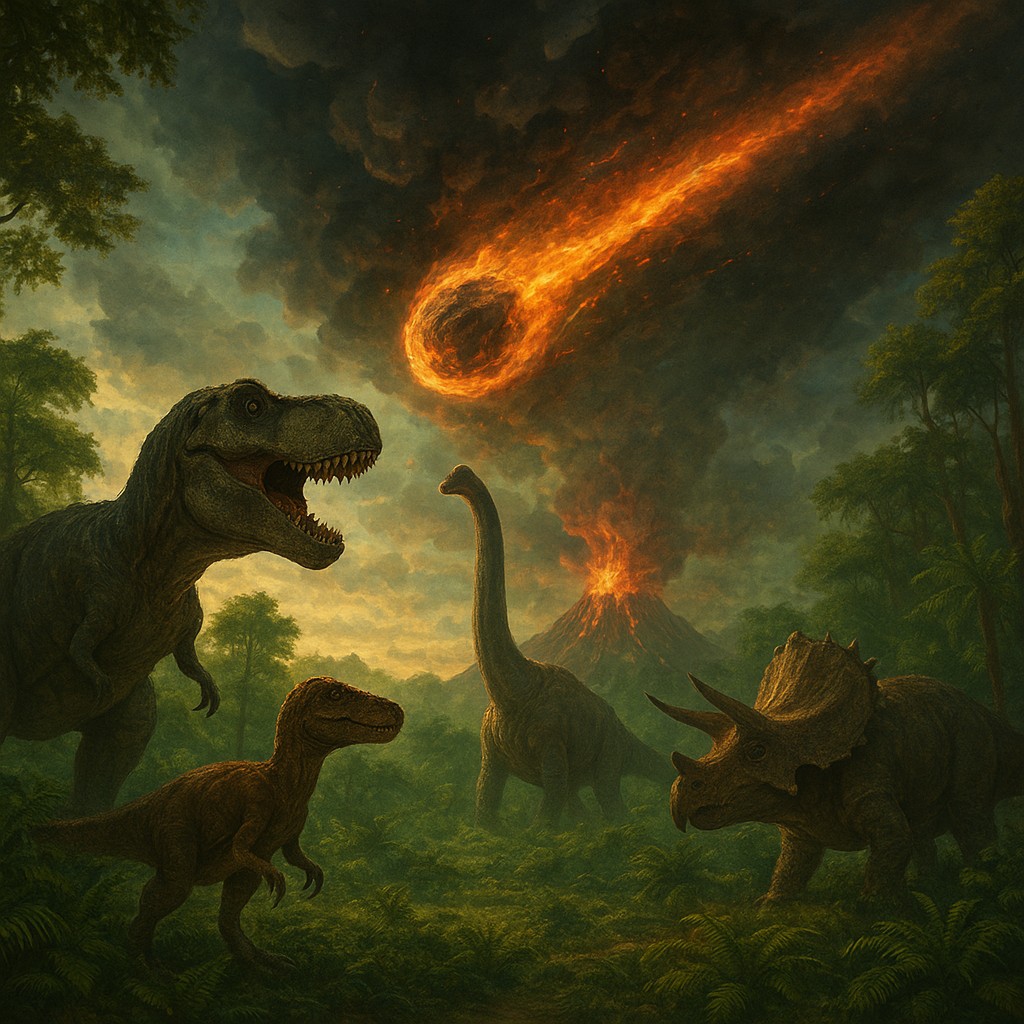
Imagine standing in your backyard 66 million years ago. The air is thick and heavy with humidity, smelling of damp earth and rotting ferns. Instead of a cricket’s chirp or the drone of a neighbor’s lawnmower, you might hear the rhythmic, bone-shaking thud of a multi-ton beast moving through the brush, or the piercing shriek of a predator marking its territory. For over 160 million years, dinosaurs were the undisputed masters of our planet. They spread across every continent, filling every niche from tiny, feathered scavengers to long-necked giants tall enough to peer over a four-story building. They survived shifting continents, rising seas, and the slow march of evolution, looking for all the world like they would rule forever.
Then, in a geological heartbeat, they were gone. One day the world was theirs; shortly after, the stage was cleared for something entirely different. It is one of history’s greatest "whodunits," a cosmic detective story that took scientists decades to solve. While we often imagine their end as a sudden, magical vanishing act, the truth is far more violent and complex. It involves giant rocks from space, exploding volcanoes, a blackened sky, and a few lucky survivors that are likely sitting in the trees outside your window right now. Understanding why they vanished isn't just about dusting off old bones; it’s about realizing how fragile life becomes when the rules of the planet change overnight.
The Day the Sky Fell
For a long time, researchers argued over what exactly killed the dinosaurs. Some pointed to a slow decline caused by a changing climate, while others suspected a sudden disaster. The "smoking gun" finally appeared in the late 1970s. A father-and-son team of scientists, Luis and Walter Alvarez, discovered a thin layer of clay in the Earth’s crust dating back exactly 66 million years. This layer contained massive amounts of iridium. Iridium is very rare on Earth’s surface but is incredibly common in space rocks. This suggested that a massive asteroid had slammed into the planet, wrapping the entire globe in a shroud of cosmic dust.
The impact site was eventually found on the Yucatan Peninsula in Mexico, buried under the ocean and layers of seafloor. Known as the Chicxulub crater, this scar on the Earth is about 93 miles wide. The asteroid that caused it was roughly six miles across, about the size of Mount Everest. It hit the water with the force of billions of atomic bombs. This wasn't just an explosion; it was a world-ending event. The initial crash sent a wall of water hundreds of feet high racing across the oceans. It triggered earthquakes so violent they would have literally knocked dinosaurs off their feet thousands of miles away.
The immediate aftermath was a nightmare of fire and glass. The energy of the collision vaporized rocks and sent red-hot debris flying high into the atmosphere. As this debris fell back down, it heated the air to the temperature of a pizza oven, sparking forest fires across entire continents. Any creature not lucky enough to be underground or underwater in those first few hours faced a grim struggle. But as terrifying as the initial blast was, it was what happened next that sealed their fate. The impact kicked up so much dust, soot, and sulfur that it blocked out the sun, turning day into a freezing, endless night that lasted for years.
A Chain Reaction of Cold and Hunger
When the sun went out, the engine of life on Earth stalled. Plants need sunlight for photosynthesis, the process they use to turn light into food. Without it, the lush jungles and vast fern prairies that fed giant herbivores withered and died. This created a brutal domino effect. First, the massive, long-necked plant-eaters like Argentinosaurus, which needed hundreds of pounds of greenery every day just to survive, began to starve. As the plant-eaters died off, the massive carnivores like Tyrannosaurus rex lost their only food source. In nature, when the bottom of the food pyramid crumbles, the top has nowhere to go but down.
This period is often called a "nuclear winter." Sulfur from the impacted rocks mixed with moisture to create acid rain, which devastated the oceans and the few plants clinging to life. Temperatures plummeted worldwide because the thick shroud of dust kept the sun's warmth from reaching the ground. Dinosaurs, which we now know were likely active and had high metabolisms, were trapped in a world too cold to move in and too empty to find food. It was a perfect storm of environmental collapse where being big and powerful was suddenly a death sentence.
To understand why some things lived and others died, we have to look at the "survival budget" of different species. Large dinosaurs were like gas-guzzling SUVs in a world where every gas station had closed. They simply couldn't find enough fuel to keep their massive bodies running. Meanwhile, smaller creatures like early mammals, lizards, and turtles could get by on very little. They could hide in burrows, eat rotting wood or insects, and wait out the worst of the chaos. The world became a place where the small and scrappy inherited the Earth, simply because they weren't too big to fail.
The Volcanic Conspiracy
While the asteroid is the clear "main villain," the dinosaurs might have already been having a very bad decade before the space rock arrived. In what is now India, a series of massive volcanic eruptions known as the Deccan Traps had been pumping enormous amounts of carbon dioxide and sulfur into the air for thousands of years. These eruptions were constant and intense, covering an area the size of France in thick, molten lava. This wasn't a single volcano blowing its top; it was a massive, sustained outpouring of gas that was already making the climate unstable and the oceans more acidic.
Paleontologists still debate how much these volcanoes contributed to the extinction. Some argue that dinosaurs were already on their way out, weakened by a changing climate and shifting sea levels that broke up their homes. In this view, the asteroid was just the final blow to a struggling system. Others believe the dinosaurs were doing just fine until the sky fell. Regardless of which side you take, it is clear the Earth was under massive stress. The combination of volcanic activity and a cosmic impact was more than the "terrible lizards" could handle.
The real difference between these two events is speed. Evolution is great at helping animals adapt to slow changes over millions of years, like a cooling planet. However, it is powerless against a change that happens in weeks or months. The dinosaurs were perfectly adapted to a world that no longer existed. Their size, their specific diets, and their slow breeding cycles were all built for a stable, warm Earth. When the environment flipped its "off" switch, the very traits that had made them successful for millions of years became their downfall.
Comparing the Survivors and the Lost
A common question is why animals like crocodiles and sharks survived if the disaster was so total. The answer lies in the traits that allow a species to weather a global catastrophe. It turns out that being a "generalist" - someone who isn't picky about food or habitat - is a superpower during an extinction. If you could eat anything, stay small, and hide in the mud, you had a ticket to the future.
| Group |
Survival Status |
Why or Why Not? |
| Non-Avian Dinosaurs |
Extinct |
Too large; high energy needs; specialized diets. |
| Pterosaurs (Flying Reptiles) |
Extinct |
Highly specialized flyers; their food sources vanished. |
| Large Marine Reptiles |
Extinct |
Ocean food chains collapsed; prey disappeared. |
| Small Mammals |
Survivors |
Lived underground; ate insects and seeds; needed little food. |
| Crocodilians |
Survivors |
Cold-blooded; could go months without eating; hid in water. |
| Birds (Avian Dinosaurs) |
Survivors |
Small and mobile; could eat seeds and scavenge. |
As the table shows, the theme of survival was efficiency. Crocodiles have incredibly slow metabolisms and can go a year without a meal. Mammals at the time were mostly the size of mice or rats, living in the shadows and eating whatever they could find. Even the birds that survived were likely those that lived on the ground and could eat tough seeds that lasted long after the fruit and leaves were gone. The "winners" weren't the strongest or the fastest; they were the ones who could handle the worst conditions with the fewest resources.
Correcting the Great Dinosaur Myth
One of the biggest misconceptions is that dinosaurs were "failures" because they went extinct. In reality, they were one of the most successful groups of animals to ever live. Humans have only been around for a tiny fraction of the time that dinosaurs ruled. We often frame their end as inevitable for "clumsy" or "stupid" beasts, but that is simply not true. They were intelligent, socially complex, and incredibly diverse. Their disappearance wasn't a sign of weakness; it was proof of how extreme the Chicxulub impact really was. Even the most advanced species would struggle if the sun disappeared tomorrow.
Another myth is that all dinosaurs died out. While we use the term "extinction" for the end of their age, one specific branch actually made it through. If you look at a sparrow, a hawk, or even a chicken, you are looking at a living dinosaur. Modern birds are the direct descendants of small, feathered predators like the ones in the same family as T. rex. When we say "dinosaurs are extinct," we really mean "land-dwelling" dinosaurs are extinct. The branch that evolved feathers and flight was the only one lean and mean enough to slip through the eye of the needle.
This changes how we see the world. Dinosaurs didn't just vanish; they were pruned by a cosmic disaster, leaving only one resilient branch to carry on. When you eat a turkey sandwich, you are technically eating a relative of a creature that lived sixty million years ago. The story of the dinosaurs is not just about death; it is about transformation and the incredible resilience of life against impossible odds.
Lessons from a World Without Giants
The disappearance of the dinosaurs is a sobering reminder that our planet is part of a larger, sometimes violent universe. It teaches us that the environment is an interconnected web where the fate of a tiny plant can decide the fate of a massive predator. The extinction was a tragic end for millions of species, but it was also a beginning. Without the vacuum left behind by the dinosaurs, mammals might have stayed small and hiding forever. There would have been no room for the rise of primates, large mammals, and eventually, humans. We exist because the world changed.
As we look at our world today, the legacy of the dinosaurs offers both wonder and humility. They remind us that nothing is permanent and that a healthy environment is the foundation of everything we build. By studying why they vanished, we learn how to better protect the diversity of life we have now. Let the story of these fallen giants inspire you to look at the stars with curiosity and at the birds with respect, knowing that life always finds a way to reinvent itself, even after the darkest nights. The dinosaurs may be gone, but their story is etched into the very rocks beneath our feet.