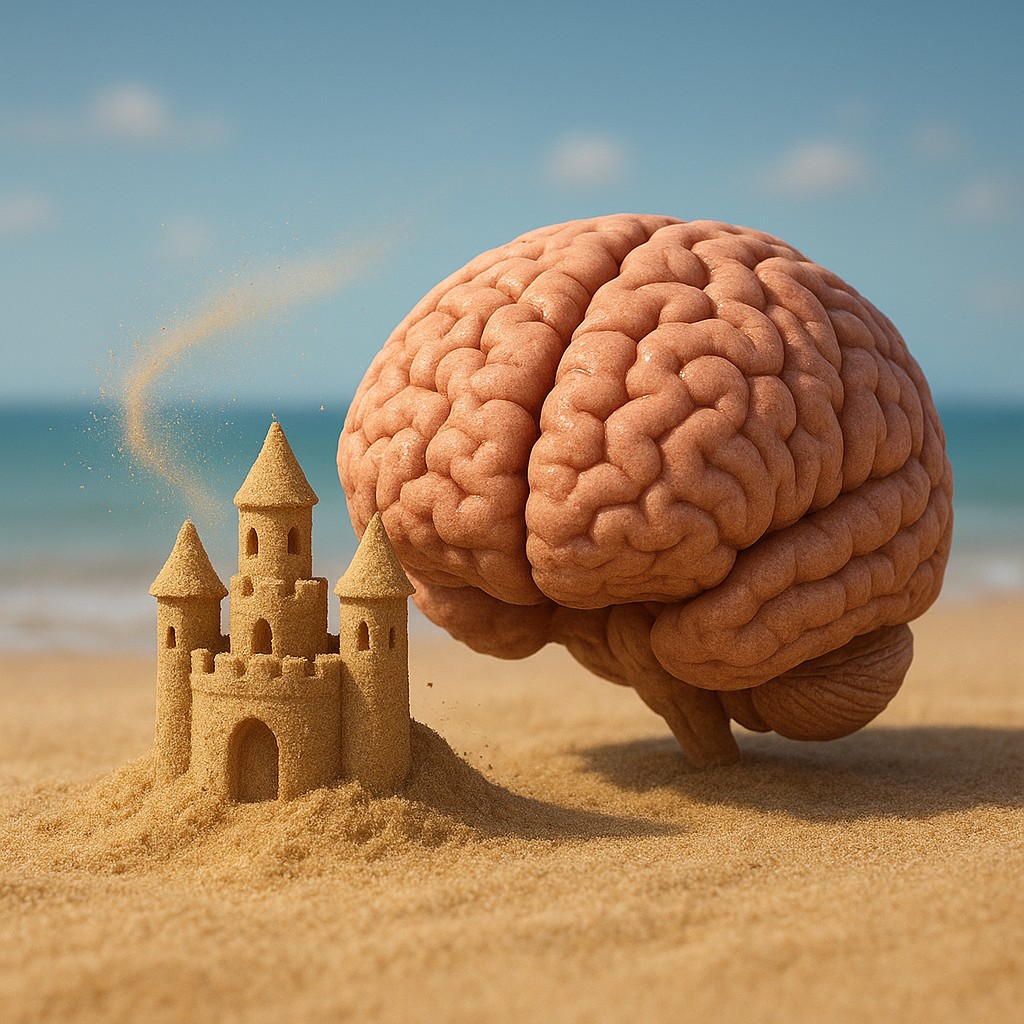
Imagine for a moment that your brain is a sandcastle built on a windy beach. Every few seconds, a gust of wind shifts a few grains of sand, blurring the sharp edges of the towers and smoothing over the intricate patterns on the walls. Physically, this is exactly what happens to your brain cells, or neurons. The proteins and fats that make up these cells are constantly being replaced, recycled, and repaired. In fact, most of the atoms in your head today were not there a year ago. Yet, despite this constant biological churn, you still remember your first grade teacher’s name, the smell of your grandmother’s kitchen, and the exact movements needed to tie your shoes.
This creates a serious engineering problem. If the hardware of your brain is literally falling apart and rebuilding itself every day, how do our memories stay clear and stable for eighty years? If you tried to save a digital photo on a hard drive that was physically melting and re-freezing, the file would be ruined within minutes. The solution, it turns out, is that your brain doesn't just store information, it actively polices it. By using a sophisticated biological version of "error-correcting codes," which is the same math that keeps Netflix streaming during a thunderstorm, your brain ensures that your identity doesn't dissolve into static.
The Fragility of the Chemical Whisper
To understand how the brain fixes errors, we first have to understand why they happen. Communication between neurons is a messy, wet, and chaotic process. When one neuron wants to send a signal to another, it releases a tiny spray of chemicals called neurotransmitters into a gap known as a synapse. This isn't a crisp, digital "on or off" signal like a switch in a computer. Instead, it is more like a whisper in a crowded room. Sometimes the neighboring neurons are too loud, sometimes the "receiving" neuron is distracted by other signals, and sometimes the chemical spray just doesn't land quite right.
Every time you recall a memory, you are essentially re-playing a specific sequence of these chemical whispers. However, the act of remembering is also an act of reconstruction. When you think of a red apple, you aren't opening a video file; you are physically re-triggering the network of neurons that originally fired when you saw that apple. Because the signal is slightly fuzzy, the pattern shifts just a tiny bit every time you remember it. Without a correction mechanism, your memories would undergo a "game of telephone" inside your own skull. After a few years, that red apple might turn into a blurry orange blob, eventually disappearing into random background noise.
Wisdom in the Crowd and Neural Redundancy
The brain’s primary defense against this decay is redundancy. It never trusts a single neuron to hold a piece of information. Instead, it uses what engineers call "distributed representations." If you want to remember a phone number, your brain doesn't pick one single cell to be the "5" and another to be the "2." It recruits a large group of neurons to work together like a committee. When it's time to remember the number, the entire committee tries to recreate the pattern.
This is where error correction kicks in through a process known as "pattern completion." Imagine ten people all trying to sing the same song together. If one person forgets a lyric or hits a flat note, the other nine people who are singing correctly will drown out the mistake. The "noise" from the one confused singer is filtered out by the "signal" of the group. In the brain, neurons are wired in a way that allows them to cross-reference one another. If one cluster of neurons sends a "glitchy" signal that doesn't match the rest of the network, the surrounding neurons exert a sort of peer pressure, forcing the outlier back into the correct state. This allows the original, sharp memory to emerge even if the individual cells sending the signal are performing poorly.
Comparing Biological and Digital Error Correction
Engineers face the same problem when sending data from a Mars rover back to Earth. Space radiation or solar flares can flip bits, turning a 1 into a 0. To fix this, they use "parity bits" or "checksums," which are extra pieces of data that let the computer calculate if something went wrong. Your brain performs a biological version of this math, though it relies on interconnected loops and "attractor states" rather than binary code.
| Feature |
Digital Hard Drives |
Human Brain (Neurons) |
| Storage Method |
Binary bits (0 and 1) |
Connection strengths and firing patterns |
| Source of Error |
Magnetic decay or electronic noise |
Chemical fluctuations and molecular turnover |
| Correction Tool |
Checksums and parity bits |
Pattern completion and attractor networks |
| Tolerance |
High precision, low failure tolerance |
Lower precision, massive failure tolerance |
| Result of Failure |
System crash or "Blue Screen" |
Gradual forgetting or "False Memories" |
The Power of the Attractor Network
One of the most elegant ways the brain maintains its "truth" is through something called an attractor network. Think of a bowl with a marble at the bottom. If you nudge the marble a little to the left, it rolls right back to the center. The bottom of the bowl is a "stable state." The brain creates these metaphorical bowls out of groups of neurons. When you learn something new, like a friend's face, your brain carves a "new bowl" into your neural landscape.
When you see that friend years later, but they are wearing a hat or have grown a beard, the signal entering your brain is "off-center." It doesn't perfectly match the original memory. However, because the brain uses attractor dynamics, the neural activity "rolls" down the sides of the bowl until it settles at the bottom: the original, correct memory of the friend's face. This is why you can recognize a song even if it's played on a different instrument, or read a word even if it’s spelled with a few typos. Your brain ignores the noise and "attracts" the signal toward the closest known truth.
The Hippocampus as the Chief Editor
While error correction happens all over the brain, the "Chief Editor" of our memories is a small, seahorse-shaped structure called the hippocampus. This area is famous for its ability to perform "pattern separation" and "pattern completion." Pattern separation is what allows you to remember where you parked your car today versus where you parked it yesterday, even though the two memories are almost identical. It pushes similar memories apart so they don't blur together.
In contrast, pattern completion is the error-correcting magic that kicks in when you are given a partial cue. If you smell a specific type of perfume, the hippocampus can trigger the entire memory of a summer evening from ten years ago. It takes a small, shaky input and uses it to reconstruct a large, stable output. However, this system isn't perfect. Sometimes, if the error is too great or the memory isn't "deep" enough, the brain can "correct" a signal into the wrong pattern. This is a primary cause of false memories, where we might feel certain we saw a stop sign when it was actually a yield sign. Our brain "fixed" the blurry image by pulling it toward the more common "stop sign" pattern.
Staying Sharp in a World of Noise
This constant internal maintenance is what allows us to navigate a world that is always changing. Without these biological error-correction codes, our skills would fade the moment we stopped practicing them, and our sense of self would evaporate as our brain cells died or were replaced. We are, in a very real sense, a continuous story being told by a trillion tiny editors, each one dedicated to making sure the plot doesn't get lost in the noise.
As you go about your day, take a moment to appreciate the relentless work happening behind the scenes. Your brain is not a dusty library; it is a vibrant, self-correcting conversation that never sleeps. You are the product of a system designed to endure, capable of preserving the "you" of a decade ago within the ever-changing "you" of today. This hidden resilience is the secret to human expertise, long-term wisdom, and the beautiful, steady persistence of memory.