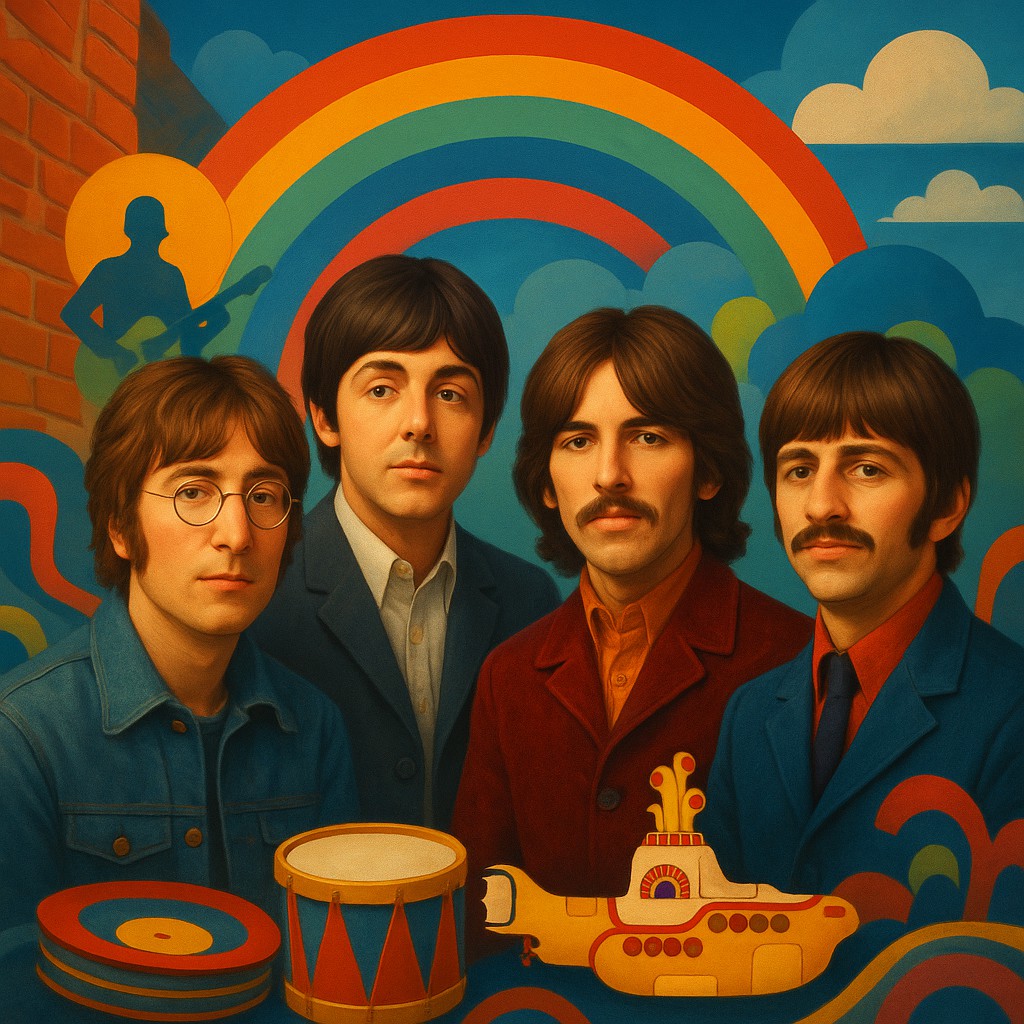
In the spring of 1970, a brief, formal press release from Paul McCartney officially ended the career of the most influential band in history. To the public, it felt like a mountain range had suddenly collapsed. In reality, the end was far more complex, beautiful, and messy. For eight years, four working-class young men from a rainy port city in northern England had done more than just play music; they had fundamentally redesigned global culture. From their early days sweating in basement clubs to their final performance on a silent London rooftop, the Beatles moved at a speed that would have torn any other group apart.
To understand the Beatles is to understand the moment the modern world truly began. Before them, "teenagers" were seen as children waiting to become adults, and pop music was a disposable product made by middle-aged men in suits. John Lennon, Paul McCartney, George Harrison, and Ringo Starr changed that forever by proving that young people had something vital to say. Their story is more than a collection of hits; it is a masterclass in curiosity, the power of working together, and the bravery required to change who you are just when the world thinks it has you figured out.
The Cauldron of Hamburg and the Birth of a Sound
Long before the world was screaming for them, the Beatles were a gritty bar band in leather jackets. While many fans imagine they arrived fully formed as the "moptops" in suits, their real education took place in the red-light district of Hamburg, Germany. There, they were forced to play for eight hours a night, seven nights a week, in front of tough crowds of sailors and outcasts. To keep the audience from throwing beer bottles, they had to be loud, energetic, and incredibly tight as a group. This grueling schedule acted as a musical pressure cooker, turning amateur hobbyists into the most polished live act in Europe.
Back in their hometown of Liverpool, they became the kings of the Cavern Club, a basement cellar that smelled of damp walls and excitement. It was here that they met Brian Epstein, a local record store owner who saw a rare spark in their messy charm. Epstein polished their image, putting them in their famous collarless suits, but he never stifled their wit. When they finally signed with producer George Martin at EMI’s Abbey Road Studios, the last piece of the puzzle fell into place. Martin, a man with a classical background and a dry sense of humor, became the "Fifth Beatle." He provided the technical skill needed to turn their raw rock and roll into sophisticated art.
The early years of "Beatlemania" were a whirlwind of noise that is hard to imagine today. Communication was slower in the 1960s, yet the band’s fame spread like a wildfire that couldn't be stopped by borders. When they stepped off the plane in New York in 1964 to appear on The Ed Sullivan Show, 73 million people tuned in. At that moment, the crime rate in America actually dropped because everyone was glued to their television sets. This was the first true global media event, proving that a catchy melody could make the world feel much smaller and more connected.
The Great Evolution: 1965 to 1967
Most bands, after reaching the top of the world, would have been happy to repeat the same formula forever. The Beatles, however, grew bored with being "idols." By 1965, they were tired of performing for screaming fans who couldn't even hear the music over their own shrieks. They began to experiment, influenced by the poetic lyrics of Bob Dylan and the complex sounds of the Beach Boys. This period led to the albums Rubber Soul and Revolver, which signaled the end of simple "boy meets girl" songs and the start of something much deeper and more thoughtful.
This change was driven by a constant curiosity about the world. George Harrison began studying the sitar, a stringed instrument from India, and Indian philosophy, introducing Eastern sounds to Western listeners for the first time. John Lennon started writing lyrics about his own fears and dreamlike visions, while Paul McCartney began using string quartets and experimental recording techniques. They stopped touring in 1966, realizing the music they were creating in the studio was too complex to play on the stage equipment of the time. This was a revolutionary move; it was unheard of for a band to give up the road at the height of their popularity.
The peak of this creative explosion was Sgt. Pepper’s Lonely Hearts Club Band. Released in 1967, it was more than an album; it was a cultural landmark for the "Summer of Love." The band took on the roles of a fictional old-fashioned brass band, which allowed them to escape the pressure of being "the Beatles." They used the studio itself as an instrument, using tape loops, orchestral sounds, and animal noises. They proved that a pop record could be high art, deserving the same intellectual respect as a symphony or a great novel.
Mastering the Studio Laboratory
To appreciate how much the Beatles changed recording, you have to look at the tools they had. In the mid-1960s, technology was primitive compared to today’s digital world. They mostly worked with four-track tape machines, meaning they had to "bounce" or combine multiple sounds onto a single track to make room for more. This required incredible planning. If they made a mistake on the tenth layer of sound, they often had to start the entire process over again.
They became masters of the "happy accident." When a guitar buzzed by mistake or a tape was accidentally played backward, they didn't fix it; they celebrated it and turned it into a new technique. This spirit of trial and error led to the birth of sampling, artificial double-tracking (a way to layer voices), and the use of guitar feedback as a musical tool. They were the first to put lyrics on the back of an album cover and the first to include "hidden" tracks. Their time at Abbey Road turned the recording booth from a place that simply captured a performance into a laboratory for creating new realities.
Below is a summary of the major shifts in the band's work during their most influential years:
| Era |
Key Albums |
Primary Style |
Major Innovation |
| Early (1962-1964) |
Please Please Me, A Hard Day's Night |
High-Energy Rock & Roll |
Writing their own songs as a team |
| Middle (1965-1966) |
Rubber Soul, Revolver |
Folk Rock & Psychedelia |
Using Indian instruments and tape loops |
| Peak (1967) |
Sgt. Pepper, Magical Mystery Tour |
Art Rock & Experimental |
The "Concept Album" and complex studio layers |
| Late (1968-1970) |
The White Album, Abbey Road, Let It Be |
Eclectic Rock & Blues |
Raw sounds mixed with grand production |
The Internal Chemistry
The magic of the Beatles wasn't just about talent; it was about the specific, often explosive chemistry between four very different people. John Lennon was the cynical, witty rebel who pushed for honesty. Paul McCartney was the melodic genius and perfectionist who drove the band's work ethic. George Harrison was the "quiet one" who grew into a world-class songwriter, adding spiritual depth. Ringo Starr was the heartbeat, a steady and inventive drummer whose personality acted as the glue that kept these three massive egos in the same room.
The core of the band was the Lennon-McCartney songwriting partnership. While they eventually wrote mostly on their own, they could still "veto" each other's work. If John wrote something too sentimental, Paul would suggest a darker lyric to balance it. If Paul wrote something too upbeat, John would add a gritty guitar part. They were each other’s biggest fans and toughest critics. This healthy competition meant they never settled for "good enough," constantly pushing one another to be great.
However, the same intensity that fueled their rise eventually caused friction. After their manager Brian Epstein died in 1967, the band lost the person who settled their arguments. Paul tried to take the lead to keep them focused, which the others often saw as bossiness. John became more interested in his life and art with Yoko Ono, pulling away from the group. George, tired of his songs being ignored by John and Paul, wanted his own creative freedom. By the time they recorded The White Album in 1968, they were often recording in separate rooms, acting more like four solo artists than a band.
Correcting Common Myths
When a story becomes legendary, myths often replace facts. One of the most common lies is that Yoko Ono "broke up" the Beatles. In reality, the band was already falling apart due to money stress, the weight of fame, and the fact that they were simply moving in different directions. Yoko's presence in the studio bothered the other members, but she was a sign of John's desire for a new life, not the sole cause of the split. The breakup was a slow-motion car crash caused by legal fights and the simple fact that four men who had been together since their teens had grown into different people.
Another myth is that Ringo Starr was just a "lucky" drummer who wasn't very skilled. This is not true. While Ringo didn't play flashy solos, he had a perfect sense of time and a unique "feel" for what a song needed. He played his drums like a composer, creating parts for every track that are still studied by musicians today. Without Ringo’s steady hand and calm personality, the band would likely have collapsed years earlier under the weight of the Lennon-McCartney rivalry.
Finally, some believe the Beatles simply "stole" their sound from Black American artists. The band was the first to admit they were deeply influenced by Chuck Berry, Little Richard, and Motown. However, they didn't just copy them. They took those influences and mixed them with British folk traditions, classical music, and experimental noise. They were also vocal supporters of their heroes, often insisting that Black artists like Little Richard and Mary Wells join them on tour, which helped introduce those legends to wider, segregated audiences in the United States.
The Rooftop Finale and an Enduring Legend
The end of the Beatles was as dramatic as their beginning. In January 1969, they tried to go "back to basics" by recording an album without any studio tricks. This project eventually became the film and album Let It Be. The recording sessions were tense, but they ended with one final, brilliant moment of unity. The band climbed to the roof of their London office and played a surprise concert for the people on the streets below. For 42 minutes, the arguing stopped, and they were a great rock band again, playing in the cold wind until the police arrived to shut them down.
Even as they were drifting apart, they managed to record Abbey Road, a final masterpiece that served as a farewell to their fans. The second half of the album weaves several song fragments together, ending with the famous line: "And in the end, the love you take is equal to the love you make." It was a dignified exit for a group that had spent a decade in the center of a storm. They officially split in 1970. Each member went on to a successful solo career, but the world never stopped asking them to get back together.
The reason the Beatles still matter isn't just nostalgia. Their music contains a universal quality that speaks to every new generation. They represent the idea that four ordinary people can do extraordinary things if they stay open to change and work hard at their craft. They taught us that it is okay to grow up, change your mind, and look for deeper meaning. When you listen to a Beatles song today, you aren't just hearing a relic of the sixties; you are hearing a conversation between four friends who decided the world could be a bit more colorful, a bit louder, and a lot more thoughtful.
You now have a solid understanding of how four boys from Liverpool changed the world through music and curiosity. The best way to continue is to put on some headphones and listen to their albums in order, starting with the raw energy of Please Please Me and ending with the polished brilliance of Abbey Road. As you listen, try to hear how their voices grow and notice the courage in their experiments. The Beatles prove that curiosity is the greatest engine for success, and that even the biggest cultural shifts begin with a few people in a room, trying something new and refusing to play it safe.