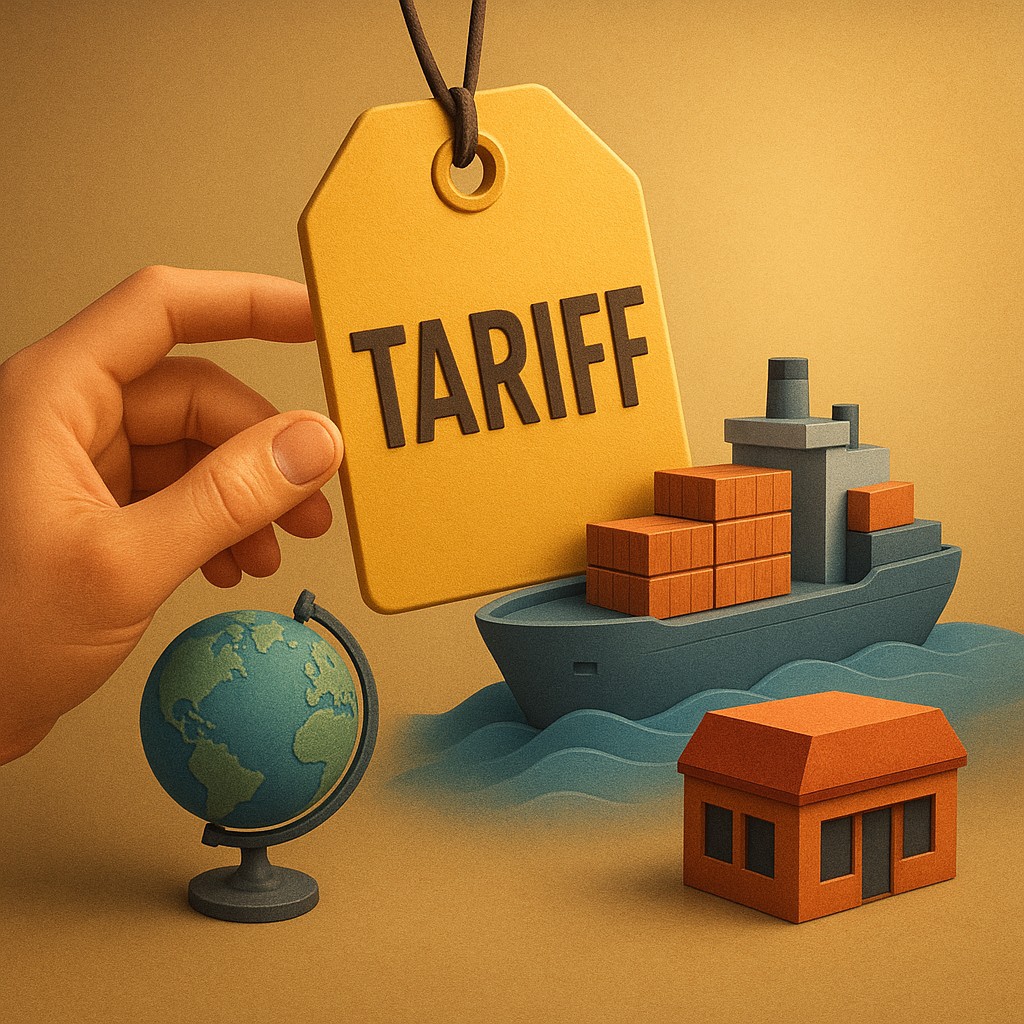
Imagine you are standing in a local electronics store, eyeing a sleek new smartphone designed and built in a country halfway across the globe. The price seems fair, but have you ever wondered how the store settled on that specific number? Behind that price tag is a complex dance of international diplomacy, massive cargo ships, and a powerful economic tool known as a tariff. While it might sound like a dry term from a history book, tariffs are actually one of the most active and controversial levers governments pull to shape how we live, shop, and work.
At its simplest, a tariff is a tax a government places on goods coming in from other countries. Think of it as a "cover charge" a product must pay to enter a national party. But it is much more than just a way to collect extra cash. Governments use tariffs to send political signals, protect local jobs, and sometimes even settle scores with other nations. Understanding them is like having a secret key to the evening news; once you grasp how they work, you start to see the hidden strings attached to everything from the shoes on your feet to the steel in your car.
The Invisible Border Guard in Your Wallet
To understand how a tariff actually functions, we have to look at the moment a product crosses a border. When a shipment of foreign-made televisions arrives at a port, the customs agency of the importing country calculates a tax based on the value or quantity of those goods. A domestic company, such as a major retailer or a wholesaler, pays this tax before the items can be loaded onto trucks and sent to stores. These companies do not simply eat that cost out of the kindness of their hearts. Instead, they usually pass that extra expense directly to you by raising the retail price.
This means that while a tariff is technically a tax on international trade, the person who ultimately "pays" for it is often the local shopper. If a 20 percent tariff is placed on imported washing machines, that foreign brand suddenly becomes much more expensive than it was the week before. This is the main goal of a tariff: it artificially inflates the price of foreign goods to make them less attractive. By making the import more expensive, the government creates an environment where locally made products can compete more easily, even if those local products are naturally more expensive to produce.
There are generally two ways these taxes are calculated. The first is an "ad valorem" tariff, which is just a Latin way of saying "according to value." This is a percentage tax, like a 10 percent charge on the total value of a shipment of laptops. The second is a "specific" tariff, which is a flat fee based on weight or volume, such as fifty cents for every ton of imported iron ore. Both methods serve the same purpose: they act as a financial speed bump that slows the flow of foreign goods into the local market.
Cultivating the Home Team Advantage
Why would a government purposefully make things more expensive for its own citizens? It sounds backward, but the logic usually revolves around protecting "the home team." Imagine a country that has a long history of building high-quality furniture. If another country starts producing similar furniture at half the price because they have lower labor costs or cheaper wood, the local factories might go out of business. To prevent a massive wave of unemployment and the loss of a traditional industry, the government might slap a tariff on imported chairs and tables.
By doing this, the government is essentially creating a shield. This "protectionism" aims to give domestic businesses a fighting chance against lower-priced global competitors. It is not just about saving old industries, either; sometimes tariffs are used to protect "infant industries." These are brand-new sectors, like electric vehicle manufacturing or green energy technology, that are just starting to grow. A government might use tariffs to keep out established foreign giants until the local startups are strong enough to stand on their own.
Beyond protection, tariffs are often used for national security. A country might decide it is too dangerous to rely entirely on foreign nations for essential goods like steel, computer chips, or medicine. If a war or a pandemic breaks out and you do not have your own factories because you were busy buying cheaper imports for decades, you are in a very vulnerable position. In this light, a tariff is less like a tax and more like an insurance premium paid to ensure the country can still function if the rest of the world stops selling to them.
The Global Game of Economic Chess
Sometimes, tariffs are not about protection at all, but about playing a high-stakes game of poker on the international stage. If Country A feels that Country B is being unfair, perhaps by giving its own companies illegal help or stealing trade secrets, Country A might slap a tariff on Country B’s goods as a punishment. This is often the spark that ignites a "trade war." It is a way of saying, "If you don't play by the rules, we will make it very expensive for you to do business in our backyard."
This retaliatory use of tariffs is designed to bring the other side to the negotiating table. The hope is that the economic pain caused by the tariff will force the foreign government to change its behavior. However, this is a double-edged sword. If Country A puts a tax on Country B’s luxury cars, Country B will almost certainly respond by putting an equal tax on Country A’s farm exports. Suddenly, car buyers in one country and soybean farmers in the other are both caught in the crossfire of a dispute they had nothing to do with.
The complexity of these relationships is why economists debate whether tariffs are "good" or "bad." While they help certain groups, like factory workers in a protected industry, they almost always hurt others, like consumers who have to pay more for daily goods. Below is a quick breakdown of how a tariff affects different people in the economy.
| Stakeholder |
Potential Benefit |
Potential Drawback |
| Domestic Producers |
Higher sales and less competition from abroad. |
Can become less efficient without competition. |
| Domestic Workers |
Better job security in protected industries. |
Cost of living increases as goods get pricier. |
| Consumers |
May see more locally made products. |
Higher prices and fewer choices at the mall. |
| Government |
Collects extra tax revenue from imports. |
Risks starting a trade war that hurts exports. |
| Foreign Exporters |
N/A |
Lower sales and loss of market share. |
The Domino Effect on the Supply Chain
One of the most misunderstood parts of a tariff is how it ripples through the entire economy, often hitting people in ways they never expected. Take the example of a tariff on raw aluminum. A government might pass this tariff to help local aluminum plants stay in business. On the surface, this looks like a win for the local metal industry. However, think about all the companies that use aluminum as an ingredient for their own products. Soda companies need it for cans, airplane builders need it for wings, and construction firms need it for window frames.
When the price of aluminum goes up because of the tariff, the costs for all these other businesses go up as well. A local beer company might find that their canning costs have jumped by 15 percent. To stay profitable, they have to raise the price of a six-pack. Now, the consumer is paying more for beer because the government tried to help the aluminum industry. This is an "unintended consequence." By trying to protect one specific group, the government might accidentally punish dozens of other industries that rely on that material.
Furthermore, tariffs can slow down innovation. When a company is protected by a high tariff wall, it does not have to work as hard to make its products better or cheaper. It has a "captured" audience of local buyers who cannot afford foreign alternatives. Over time, this can lead to a "rusting" of the industry, where factories become outdated because they never had to compete with the best in the world. This is why many economists argue that while tariffs offer a short-term boost, they can be a long-term drag on a country's ability to stay modern.
Debunking the Myths of "Free" Money
There is a common misconception that tariffs are a clever way to "tax other countries" and make them pay for your government's expenses. It is an enticing idea, but in the vast majority of cases, the foreign country never writes a check to the importing government. The tax is paid at the border by the local company that wants to sell the goods. If an American company imports a crate of shoes from Italy, it is the American company that pays the U.S. Customs office.
Another myth is that tariffs are the only way to protect jobs. While they can save jobs in specific industries, they often "trade" jobs between sectors. For every manufacturing job saved by a steel tariff, a job might be lost in the car or construction industry because those businesses can no longer afford the materials they need to grow. Large-scale studies often show that the "cost per job saved" by a tariff is incredibly high, sometimes costing consumers hundreds of thousands of dollars in higher prices for every single position that is kept in a factory.
Finally, it is worth noting that tariffs are not the same as a "quota." A quota is a hard limit on the amount of a good that can be imported (for example, saying only 10,000 cars can enter per year). A tariff is more flexible; it doesn't forbid the goods from coming in, it just makes them more expensive. If people are wealthy enough or want a specific foreign brand badly enough, they can still buy it - they just have to pay extra. This flexibility is why tariffs remain a favorite tool for leaders; they allow for a degree of control without cutting off the country from the global market.
Finding the Balance in a Globalized World
The world of international trade is rarely black and white. While it would be wonderful if every country could trade freely without any barriers, the reality is that different nations have vastly different laws, wages, and environmental standards. For a country with strict environmental rules and high minimum wages, a tariff can feel like a necessary tool to keep its businesses from being wiped out by competitors who do not have to follow those same expensive rules. In this context, the tariff is seen as an "equalizer" that levels the playing field.
As you navigate life as a consumer and a citizen, being aware of tariffs helps you understand the true cost of the things you buy. It encourages you to look past the price tag and see the complex political decisions that brought that item to your shelf. Whether you view them as a vital shield for local industry or a frustrating tax on shoppers, tariffs are a fundamental part of how our modern world operates. They remind us that our local economies are deeply connected to everyone else's, and that a single signature on a trade document in a distant capital can change the price of your groceries tomorrow morning.
Armed with this knowledge, you are no longer just a passive participant in the economy; you are a savvy observer of the global stage. You can now see the strategy behind trade headlines and appreciate the delicate balance governments try to strike between global cooperation and national interest. The next time you see a price change or a news story about a trade dispute, you will know exactly what is happening at the border. Embrace this clarity, keep questioning why things cost what they do, and never stop exploring the hidden systems that power our interconnected lives.