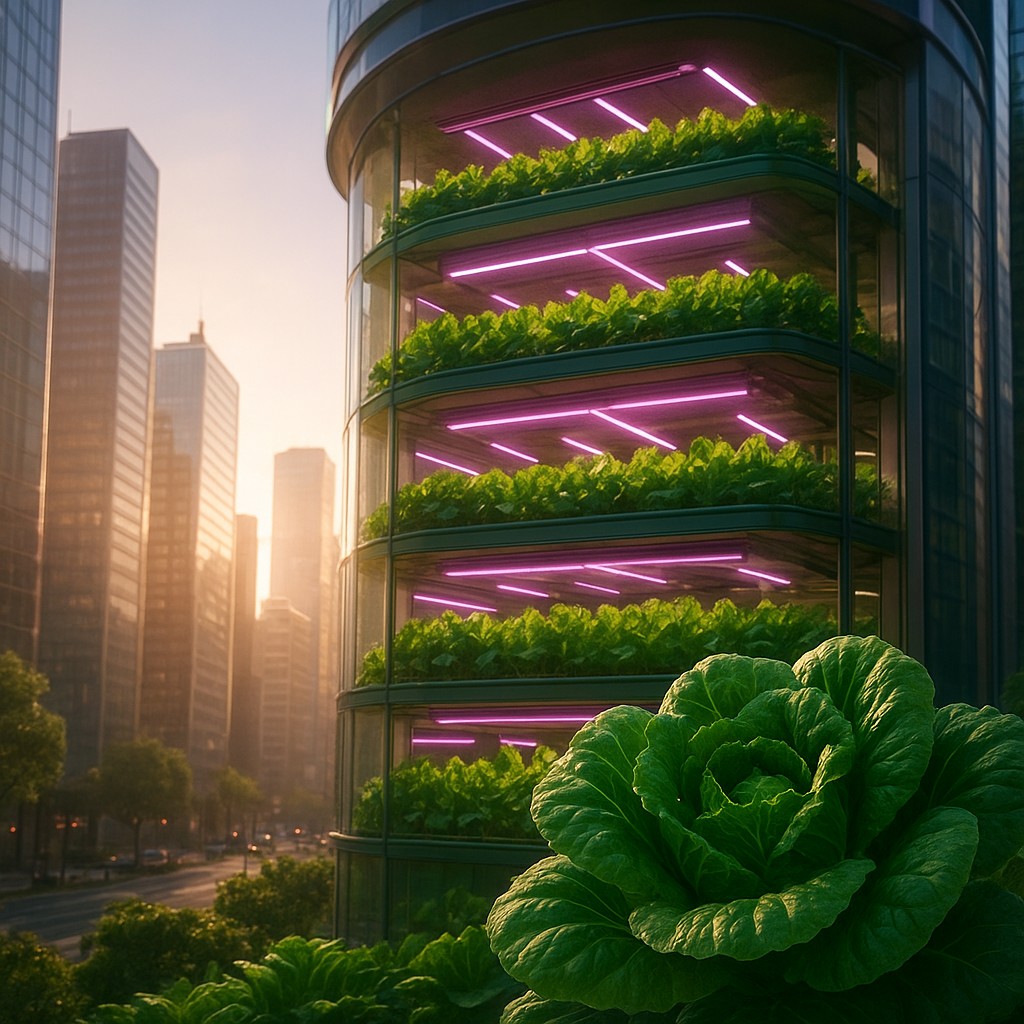
Imagine walking through a busy city center, flanked by glass skyscrapers and the drone of traffic, only to realize the building next to you is actually a massive salad bowl. Vertical farming has long promised a future where our food travels floors instead of miles. This would shrink the carbon footprint of shipping and bring fresh greens to "food deserts" in the middle of the city. However, for a long time, this futuristic dream hit a very expensive wall: the electricity bill. Pumping artificial sunlight into a windowless warehouse uses an incredible amount of power, often making that local kale more expensive than a handcrafted cocktail.
The challenge is that plants are surprisingly picky eaters when it comes to light. In a traditional field, they take whatever the sun gives them, but in a controlled environment, every photon costs money. If you blast a head of lettuce with constant, high-intensity light, it eventually reaches a "saturation point" where it simply cannot process any more energy. At that stage, any extra light just turns into heat, which then requires even more energy to cool down with air conditioning. To solve this, the industry is moving toward a sophisticated strategy called dynamic light recipes. This approach treats light not as a steady stream, but as a precise ingredient delivered only when the plant is ready to digest it.
The Secret Language of Photosynthesis
To understand why we are changing the way we light our farms, we first have to look at the biology of a leaf. Plants do not see light the way we do. While we enjoy the warm glow of a white lightbulb, plants are mainly interested in specific parts of the spectrum, mostly red and blue wavelengths. Red light is the workhorse of photosynthesis, driving the expansion of leaves and the structural growth of the plant. Blue light, on the other hand, acts like a coach. It tells the plant how to behave, helping it set its internal clock and determining how thick its leaves should be.
In 2025, the cutting edge of vertical farming involves using specialized LED panels that can shift these colors in real time. Instead of keeping a steady purple hue over the crop, growers now use software to pulse light at specific intervals that match the plant's natural rhythm. This is called "flicker" or "pulsed" lighting, and it takes advantage of a fascinating quirk of plant biology: plants have a tiny "reset" period after they absorb light. By timing the pulses to match these micro-breaks, farmers can get the same growth with significantly less total energy. It is like the difference between trying to shove a whole pizza into your mouth at once versus taking small, steady bites.
Engineering the Perfect Growth Cycle
A light recipe is about more than just the color of the LEDs; it covers the entire life of the plant from seed to harvest. In the early stages of a seedling’s life, it might need a gentle "sunrise" of soft blue light to encourage strong roots without making the stem too thin. As the plant enters its "teenage" years, the recipe shifts toward a heavy dose of red light to build up its size. Finally, as harvest approaches, a grower might spike the blue light or add a splash of far-red light to "finish" the plant. This effectively tells the plant it is time to wrap up production and toughen its cell walls for the trip to the store.
These adjustments are based on a concept called the Daily Light Integral (DLI), which is the total amount of light a plant receives in a 24-hour period. By using sensors and AI, modern farms can track exactly how much light each plant has taken in and turn down the intensity once the plant has had its fill. This prevents "tip burn," a common problem where the edges of lettuce leaves die because the plant grew too fast for its internal plumbing to keep up. By slowing things down just enough to keep the plant healthy but fast enough to beat traditional outdoor farming, dynamic recipes create a perfect balance of speed and sustainability.
Balancing the Cost of Light and the Logic of Growth
When we compare traditional indoor lighting to these new dynamic recipes, the efficiency gains are staggering. Older systems used High-Pressure Sodium (HPS) lamps, which were essentially giant space heaters that happened to produce orange light. Modern LEDs are already much cooler, but the "dynamic" part of the equation is what really makes these farms profitable. The following table shows how these different approaches compare in a typical indoor lettuce operation.
| Lighting Approach |
Energy Efficiency |
Control Level |
Plant Health Impact |
| High-Pressure Sodium (Old) |
Low (mostly heat) |
Very Low (On/Off) |
High risk of heat stress |
| Standard White LED |
Medium |
Low (Dimming only) |
Predictable, but unchanging |
| Fixed Red/Blue "Blurple" |
High |
Medium |
Good, but misses growth phases |
| Dynamic Light Recipes |
Very High |
Exceptional |
Optimized for every life stage |
By focusing the energy exactly where the plant needs it, farmers are reporting energy savings of 30 percent or more compared to standard LED setups. This shift transforms the financial model of vertical farming from a risky tech venture into a reliable way to grow food. When electricity costs drop, the price of the final product can finally compete with field-grown produce, making urban farming accessible to many more people.
The Tradeoff Between Speed and Flavor
While we have mastered the art of making plants grow faster, there is a lingering mystery: why does some indoor produce taste a bit bland? The answer lies in the relationship between light and secondary metabolites. Plants produce the compounds we taste as flavor and aroma mostly as a defense or a response to stress. If a plant lives a perfectly pampered life with the exact amount of light it needs and no pests, it has no reason to produce the complex chemicals that give mustard greens a kick or basil leaves a peppery bite.
Light recipes can be used to fix this, but it requires a delicate touch. Some growers are experimenting with "stress periods" at the end of the growth cycle, where they might blast the plant with high-intensity UV light for a few hours. This mimics a harsh, sunny day, triggering the plant to produce antioxidants and flavorful oils to protect itself. However, if the recipe focuses only on growth speed and volume, the result is often a beautiful, crunchy, but somewhat tasteless leaf. This teaches us that while light provides energy, flavor is a complex conversation between the light, the nutrients in the water, and the stress the plant feels.
Overcoming Myths About Artificial Sunlight
A common myth is that plants grown under artificial light are "unnatural" or less nutritious than those grown under the sun. In reality, a photon is a photon, whether it traveled 93 million miles from a star or three inches from a circuit. The advantage of an indoor farm is that we can actually increase the nutrients by fine-tuning the light. For example, by increasing blue light near harvest, researchers have found they can significantly boost the vitamin C and antioxidant levels in red leaf lettuce. This makes it more nutritious than a field-grown head of lettuce that might have spent a week on a truck losing its vitamins.
Another misconception is that more light always equals faster growth. As we have discussed, plants have a "speed limit" for photosynthesis. Throwing more light at a plant after it has reached its saturation point is like trying to fill a bucket that is already overflowing. Dynamic light recipes recognize that plants have a "sleep cycle" just like humans. They need a rest period to process the sugars they made during the day. By respecting these biological limits, dynamic farming actually aligns more closely with nature’s design than the "always on" mentality of early indoor agriculture.
The Future of the Green Horizon
As we look toward the future of our cities, these refined light recipes represent a major milestone in human ingenuity. We are no longer just passive observers of the seasons; we are becoming architects of the environment that feeds us. By mastering the delicate dance of light and growth, we are making it possible to grow strawberries in the desert and spinach in the arctic, all while using a fraction of the land and water required by traditional methods.
The journey from the "blurple" glow of early experiments to the sophisticated, AI-driven light shows of 2025 shows that the biggest hurdles to technology are often solved through better understanding, not just more power. The next time you enjoy a crisp, local salad in the middle of winter, take a moment to appreciate the science at work. The lights might be artificial, but the innovation driving them is entirely human, proving that with enough creativity and a few well-placed photons, we can truly grow a better world from the ground up.