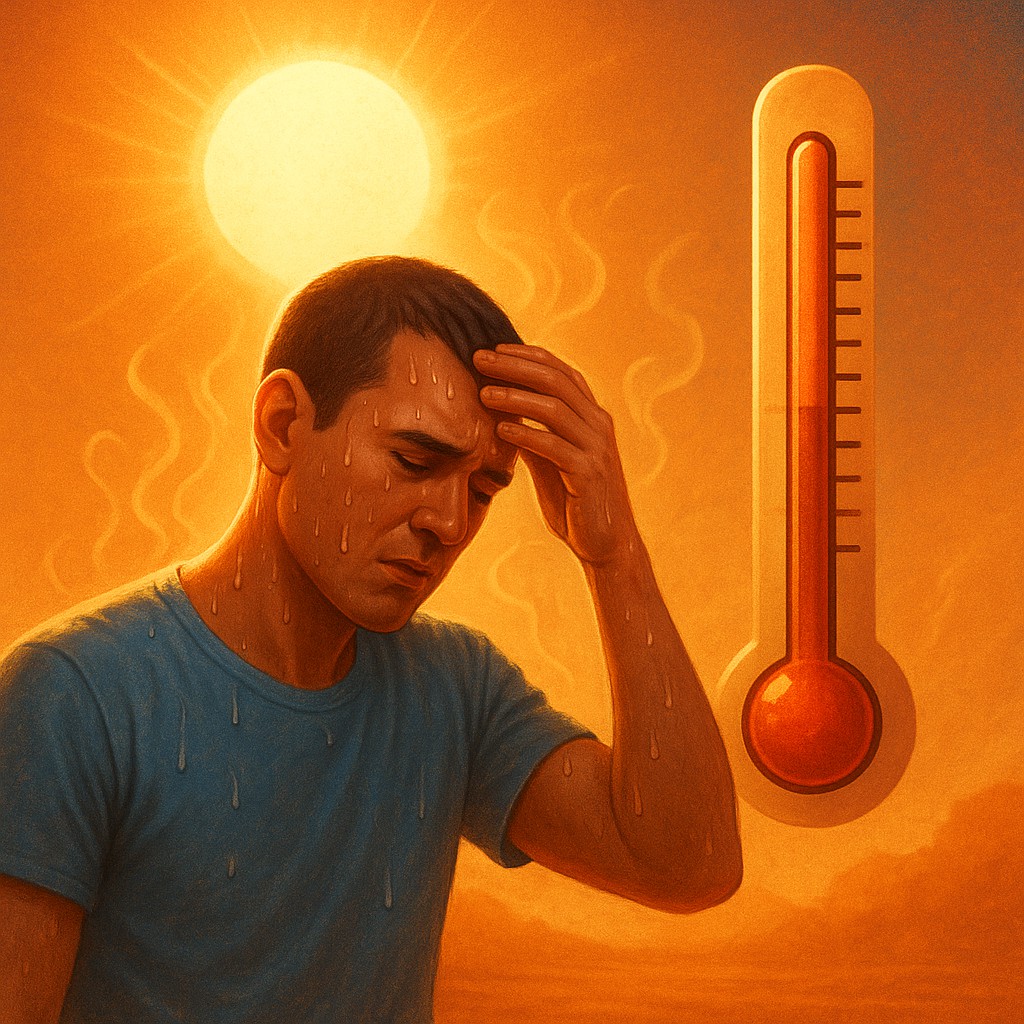
On a scorching summer afternoon, most of us have a standard survival plan: find a shady tree, grab a big bottle of ice water, and maybe sit in front of a powerful fan. We are taught from a young age that as long as we stay hydrated, our bodies are remarkable machines capable of weathering the heat. This belief comes from our understanding of sweating, a biological masterstroke where our skin releases moisture that evaporates, carrying excess heat away into the air. It is a primitive but highly effective form of air conditioning that has allowed humans to thrive everywhere from the Sahara Desert to the Australian Outback.
However, there is an invisible wall built by physics that no amount of ice water or willpower can climb over. This wall is defined by the relationship between heat and moisture in the air, a concept known as the "wet-bulb temperature." While we usually focus on the "dry-bulb" temperature (what a standard wall thermometer shows), the wet-bulb temperature measures the lowest temperature an object can reach through evaporation alone. When this measurement hits a specific threshold, the laws of physics take over, and the human cooling system effectively breaks down. Understanding this limit is no longer just for scientists; it is becoming a vital survival skill in a world where "it is not just the heat, it is the humidity" is shifting from a polite complaint into a physical reality.
The Invisible Limit of the Human Radiator
To understand why the wet-bulb temperature decides our survival, we first have to look at how humans manage their internal "thermostat." Our bodies are remarkably picky about their internal temperature, preferring to stay right around 37°C (98.6°F). When we move or sit in the sun, our core temperature rises, and our brain tells our sweat glands to start pumping. If the air around us is dry, that sweat evaporates almost instantly. This transition from liquid to gas requires energy, which it steals from our skin in the form of heat, effectively chilling us down. This is why a 40°C day in a desert can actually feel easier to handle than a 30°C day in a tropical rainforest.
The wet-bulb temperature is measured by wrapping a piece of wet cloth around the bulb of a thermometer and blowing air over it. If the air is dry, the water evaporates quickly, and the temperature reading drops significantly below the actual air temperature. But as the humidity rises, the air becomes "full" of water vapor. This saturation means the air can no longer take in moisture from the wet cloth, preventing the temperature from dropping. In a human context, once the wet-bulb temperature reaches 35°C (95°F), the air is so saturated and warm that your sweat cannot evaporate. It simply beads up and rolls off, leaving your internal heat trapped inside. Even a perfectly healthy person, nak*d in the shade with plenty of water, will begin to overheat because the basic physics of cooling have been disabled.
Deciphering the Psychrometric Mystery
Weather is often explained through the "heat index" or "feels like" temperatures, but the wet-bulb metric is much more grounded in raw physics. To understand how we calculate the danger, we look at the interplay between temperature and relative humidity. You can think of the air as a sponge. On a dry day, the sponge is empty and can soak up all the sweat you produce. On a humid day, the sponge is already dripping wet. If the air is at 100 percent humidity, it cannot take in a single extra molecule of water. At that point, the wet-bulb temperature and the dry-bulb temperature are exactly the same.
This creates a deceptive danger. Most people see a forecast for 35°C (95°F) and think it sounds like a typical summer day. However, if that temperature comes with 100 percent humidity, it reaches that critical wet-bulb limit. In contrast, in a bone-dry desert, the air temperature might need to soar to 50°C (122°F) before the wet-bulb temperature hits that same 35°C threshold. Our bodies are surprisingly tough in extreme dry heat because our "evaporative engine" is running at full throttle. The danger arises when the environment robs us of our only way to shed heat.
| Air Temperature |
Relative Humidity |
Wet-Bulb Temp |
Safety Status |
| 30°C (86°F) |
20% |
17°C (63°F) |
Safe / Typical |
| 35°C (95°F) |
50% |
26°C (79°F) |
Caution Required |
| 38°C (100°F) |
70% |
33°C (91°F) |
Extreme Danger |
| 35°C (95°F) |
100% |
35°C (95°F) |
Limit of Human Survival |
| 45°C (113°F) |
40% |
33°C (91°F) |
Dangerously High |
Why Fans and Water Can Fail You
During a humid heatwave, one of the most dangerous myths is the belief that an electric fan will save the day. In normal conditions, a fan works by moving air across your skin, speeding up the evaporation of sweat. However, once the wet-bulb temperature reaches or passes your skin temperature, the fan stops being a cooling device and starts acting like a convection oven. If the air is too saturated to allow evaporation, the fan is simply blowing hot, moist air onto your body, which can actually make your core temperature rise faster. This is why many health organizations recommend against using fans as your main cooling method during extreme humidity if the indoor temperature is above 35°C.
Hydration is also misunderstood in this specific context. We are often told to "just drink more water," and while staying hydrated is essential to keep your sweat glands working, it cannot change how much moisture the air can hold. If the air is at its wet-bulb limit, you could drink gallons of water and it wouldn't help you cool down. Your body will produce the sweat, but the sweat will stay on your skin, and your core temperature will keep climbing. In these scenarios, the only way to survive is to change the environment, either by using air conditioning to pull moisture out of the air or by using an ice bath, where heat is transferred through direct contact with cold water.
The Biological Breakdown of Heatstroke
When the wet-bulb threshold is crossed and the body can no longer shed heat, the physical consequences are rapid and severe. Since your "radiator" is broken, your heart begins to pump much faster to move hot blood from your internal organs to the surface of your skin. This puts an immense strain on your heart and veins. As your core temperature climbs toward 40°C (104°F), you enter the territory of heatstroke. This is not just "feeling hot," it is a medical emergency where your internal proteins begin to change, much like the clear white of an egg turning solid when cooked.
The brain is particularly sensitive to this rise in temperature. Confusion, loss of coordination, and eventually loss of consciousness occur as the nerves struggle to send signals correctly in the overheated environment. If the heat continues, the body begins a "cascading failure" where the kidneys and liver are damaged, and the gut lining can become leaky, releasing toxins into the bloodstream. This is why the 35°C wet-bulb limit is often called the "threshold of death." It marks the point where even a young, fit person without any health problems will die within about six hours of total exposure, regardless of how much water they have.
Managing Risks in a Shifting Climate
As we look toward a future where extreme weather is becoming more frequent, understanding the wet-bulb temperature is essential for public safety. Regions previously considered safe, such as parts of the Persian Gulf, South Asia, and the American Midwest, are seeing more frequent spikes in humidity that push toward these dangerous limits. To keep people safe, we have to look beyond just the temperature on the news. We must pay attention to humidity levels and the "dew point," which is another way of measuring how much moisture the air holds.
Modern technology offers some relief, but it uses a lot of energy. Air conditioning units are dual-purpose machines: they lower the temperature and, more importantly, they remove moisture from the air. This lowers the wet-bulb temperature inside a building to a level where human biology can work again. For those without AC, strategies must shift toward finding "cool spots" like basements, which stay cool naturally, or using public cooling centers. The most important thing is to recognize that when the humidity is high, your body's ability to "sweat to cool" is broken, and you must stop physical activity immediately to prevent heat from building up inside you.
Embracing a Smarter Survival Strategy
Learning about the wet-bulb limit might feel a bit daunting, but there is power in this knowledge. By understanding that our cooling ability is tied to the moisture in the air, we can make smarter decisions. We can check specialized weather apps that report wet-bulb or "WBGT" (Wet-Bulb Globe Temperature) readings before planning outdoor work or exercise. We can look out for neighbors who might think they are safe just because they are drinking water while sitting in a stagnant, humid room. Science gives us the tools to predict these invisible walls, and we can use that foresight to protect ourselves.
Ultimately, being aware of how cooling works turns us from passive observers of the weather into informed participants in our own safety. The next time you feel that heavy, "soupy" air on a summer day, you will know exactly why your body is struggling and why a simple fan might not be the answer. Stay curious, stay informed, and always remember that while our bodies are incredibly tough, they still have to follow the rules of physics. With a bit of planning and a healthy respect for the wet-bulb thermometer, you can stay cool even when the atmosphere tries its best to stop you.