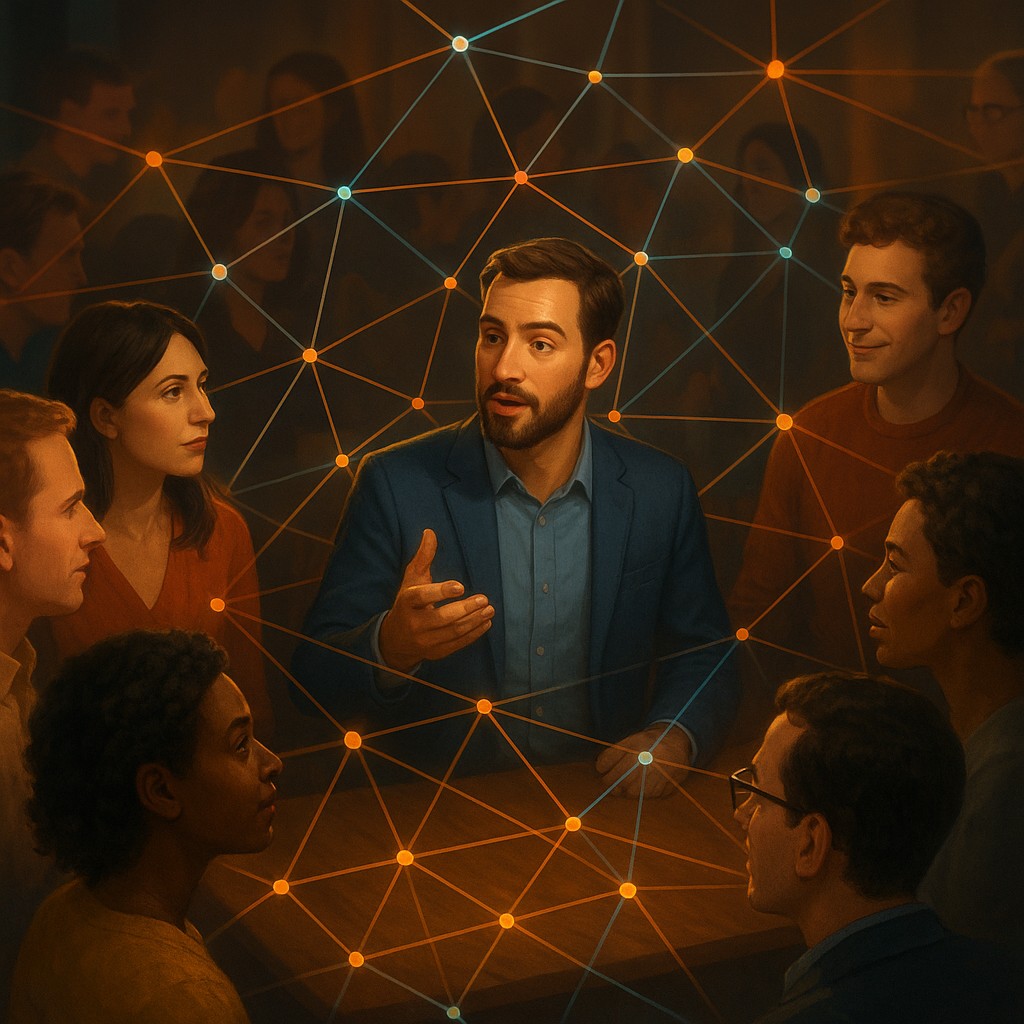
Imagine a packed dinner party where the music is a bit too loud and the snacks are vanishing. You find yourself cornered by a cousin who is dead certain that the moon is made of high-density Swiss cheese. At first, you laugh, but then you notice that everyone he talks to starts nodding along. Within the hour, the whole room is debating the lunar dairy industry as if it were a proven fact. You might wonder if your cousin is a master public speaker or if there is something more mechanical happening. Usually, we credit the "strength" of an argument or a leader's charisma for how ideas spread, but mathematicians look at the room itself.
The way we influence each other is less like a courtroom debate and more like a game of billiards on a very specific table. In the field of social physics, this is studied through the Voter Model. It suggests that the outcome of a national debate or a cultural shift isn't just about who has the best data or the catchiest slogans. Instead, the speed at which we reach an agreement, and whether that agreement lasts, depends almost entirely on the "geometry" of our social circles. Who talks to whom, how many people they influence, and how tightly those groups are linked creates a structural map for how fast an idea can catch fire.
The Digital Neighborhood and the Rules of Imitation
The Voter Model works using a few deceptively simple rules. Imagine a giant grid where every square represents a person holding one of two opinions, color-coded blue or red. In each "turn" of the model, a random person is picked. They look at one of their neighbors, see what color that person is, and immediately adopt it. There is no logic, no weighing of evidence, and no stubborn pride. It is pure imitation. While real humans are obviously more complex, this model serves as a "frictionless surface" for social scientists. It allows them to see how the shape of the network, rather than individual psychology, controls the flow of information.
If you arrange these people in a simple, two-dimensional grid, like a sheet of graph paper, consensus takes a long time. Clusters of blue and red will form and bump into each other like slow-moving tectonic plates. Because everyone only talks to their immediate neighbors, an idea has to travel person-by-person across the whole "map" to win. However, if you add "long-range" connections, the dynamic changes instantly. In the modern world, these are our digital bridges. A person in London can be "neighbors" with someone in Tokyo through a social media feed. These shortcuts shrink the social distance of the entire planet. A single "red" square can influence a "blue" square miles away, effectively teleporting an opinion across the network and shattering local clusters.
Why Some Opinions Stall While Others Sprint
We often feel that society stays the same for decades, only for a massive cultural shift to happen in what feels like a single weekend. The Voter Model explains this through network topology, which is the study of how parts are connected. In a decentralized network where people only interact within small, isolated "tribes," different opinions can live side-by-side for a long time. The boundaries between these tribes act as walls. But as a network becomes more interconnected, the time it takes for one opinion to "win" and become the only color left on the board drops sharply. In math, this is called "mean exit time."
The fascinating part is that a more connected network doesn't just make things faster; it makes them more unstable. In a world with few connections, you might have stable pockets of different views. In a "complete" network, where everyone can talk to everyone else, the system is prone to sudden, massive flips. This is why a brand can be beloved on Friday and completely "canceled" by Sunday morning. The same infrastructure that allows for quick agreement also makes that agreement fragile. The system hits a "tipping point" where a tiny push can ripple through the entire structure before anyone has a chance to argue back.
The Hidden Power of the Committed Minority
One of the most surprising findings from advanced versions of the Voter Model is the massive power of "zealots." In the basic model, everyone is a flip-flopper. But if you add a small group of people who never change their minds, no matter what their neighbors say, the whole mathematical landscape shifts. Research shows that if just 10 percent of a population is made up of committed zealots, they can consistently convert the other 90 percent to their side. The speed of this conversion depends on where these zealots are placed.
If the zealots are huddled together in a corner, they are less effective. But if they are "influencers" with high centrality, meaning they have many connections to different parts of the network, they act as hubs of infection. They never switch colors, but everyone they touch eventually does. This explains why small, organized political or social movements can often override the "will of the majority." The majority is often made up of flexible people just following the local crowd, while the minority is anchored. In a well-connected network, these anchors drag the rest of the ship toward them with surprising efficiency.
| Network Feature |
Impact on Speed of Consensus |
Stability of Minority Opinions |
| Local Grid |
Very Slow |
High (pockets last a long time) |
| Small-World (Shortcuts) |
Fast |
Low (local groups are easily disrupted) |
| Complete (Everyone-to-Everyone) |
Near-Instant |
Non-existent (the system flips as one) |
| Scale-Free (Hub-and-Spoke) |
Varies |
High if hubs are "zealots" |
Why the Best Idea Doesn't Always Win
A common mistake in thinking about public opinion is the "Marketplace of Ideas" myth. This theory suggests that the most logical, helpful, or "true" idea will win because people are rational. The Voter Model offers a humble correction: the "truth" of an idea is often less important than the structure of the network it lives in. A false idea can win a network simply because its supporters were better positioned. Math shows that even if an idea is slightly "worse" for the public, it can still win if the network favors fast spreading over careful thinking.
Another misconception is that more communication always leads to better understanding. People assume that if we just "talked more" to those we disagree with, we would find a middle ground. However, in the Voter Model, more connectivity actually speeds up the death of diversity. Instead of a middle ground, you get a "winner-take-all" result. The more we see the opinions of the entire world rather than just our physical neighbors, the more likely we are to take part in a "global flip" where one dominant story erases all sub-cultures. This suggests that some "social distance" is actually necessary for different opinions to survive.
Engineering the Architecture of Agreement
If we accept that the network structure drives consensus, it changes how we solve societal problems. If you want to stop the spread of misinformation or encourage people to use new green technology, shouting the message louder is rarely the answer. Instead, the focus shifts to "topological intervention." This means changing how people encounter information. For example, if a network is too tightly packed and prone to "groupthink," adding some friction or breaking a few long-distance shortcuts can slow the system down enough for people to think before they change their "color."
On the other hand, if a society is stuck in gridlock, the Voter Model suggests that the gridlock is a symptom of a "modular" network, where different groups are trapped in echo chambers with no bridges between them. In this case, no amount of debating will help because the message cannot physically travel from one group to another. To break the deadlock, you don't need a better argument; you need to create "inter-group edges," which are connections between people who wouldn't normally speak. This doesn't guarantee which side wins, but it "lubricates" the system, allowing a consensus to form instead of leaving everyone in a state of permanent tribalism.
The Tipping Point of Global Shifts
We have all seen moments where a change that seemed impossible on Tuesday became inevitable by Friday. Events like the fall of the Berlin Wall, the rapid shift in views on marriage equality, or the sudden rise of a new social media app all follow this "abrupt flip" pattern. Scientists call this a "phase transition." It is the moment when a system crosses a critical threshold and its individual parts sync up. In the Voter Model, this is when clusters of an opposing view become so small and broken that they can no longer support each other. They "dissolve" into the majority opinion almost overnight.
This volatility is a feature of our connected world. Because we are more "online" and "linked" than ever, global opinion is becoming like a super-cooled liquid. It looks still, but a single tiny seed of a new idea can cause the whole thing to freeze into a solid block in an instant. This makes the future of social movements hard to predict in the long term, but incredibly fast-moving when they do happen. We are no longer a collection of separate ponds; we are one big, connected ocean, and the waves travel faster and farther than ever before.
As you navigate your own social world, remember that you are not just a person with thoughts, you are a "node" in a vast, invisible geometry. Your influence is determined not just by what you say, but by where you stand and who you listen to. While the world can feel chaotic, there is a quiet, mathematical beauty under the noise. By understanding the structures that connect us, we gain a new kind of power. We can choose to build bridges where there are walls, or create space for reflection where there is only a rush toward the finish line. You have the power to reshape the network, and by doing so, you change the speed and direction of the future itself.