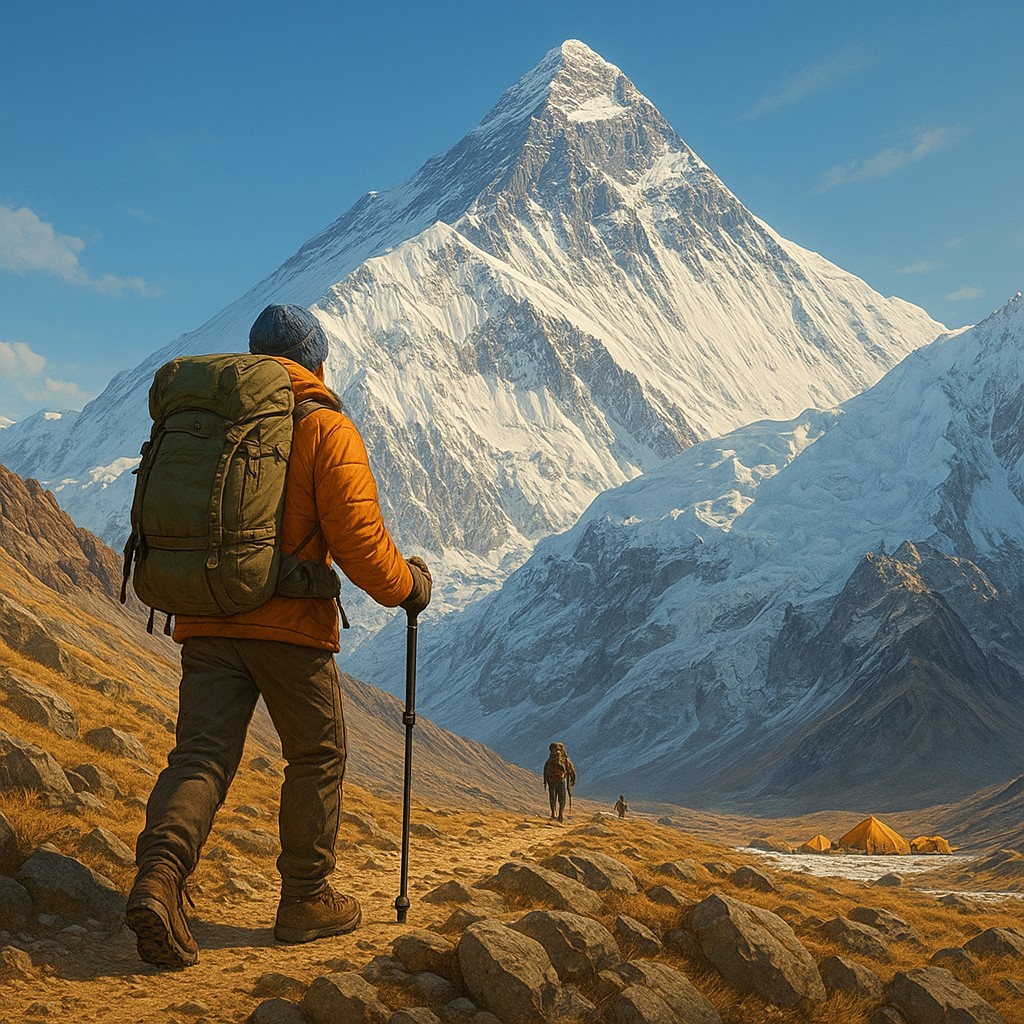
At 29,032 feet above sea level, Mount Everest is more than just a mountain. It is a global symbol of human ambition and, quite literally, the roof of our world. To many, the thought of climbing it sounds like a heroic, if intense, outdoor project - perhaps like a very long hike with a heavy pack. However, the reality of Everest is a complex struggle involving biology, logistics, and atmospheric chemistry. To stand on that summit, you aren't just fighting gravity; you are fighting an environment where your body is slowly dying because the air is too thin to support human life for long.
Understanding how Everest works requires a shift in perspective on what "climbing" actually means. It isn’t a steady walk from the bottom to the top. Instead, it is a grueling game of "yo-yo" mountaineering. You go up a little way, then come back down, repeating the process over and over until your blood chemistry changes enough to keep you conscious. It is a massive operation involving hundreds of people, thousands of pounds of gear, and a very short window of time where the weather decides not to kill you. If you have ever wondered why it takes two months to walk up a hill, or why you can’t just drive a Jeep to the starting line, you are about to find out how the Earth’s highest point really functions.
The Long Road to the Edge of the Sky
The journey to the top of the world doesn't start at the foot of the mountain. It usually begins in the bustling city of Kathmandu or across the border in Tibet. One of the most common questions people ask is whether you can simply drive to Base Camp. The answer depends entirely on which side of the mountain you choose. If you are climbing from the North Side in Tibet, China, there is a paved road that leads right to the North Base Camp. In theory, you could arrive in a tour bus, step out, take a selfie with the mountain, and be back in a hotel by dinner. However, most climbers choose the South Side in Nepal, which offers a much greater adventure.
On the Nepal side, there are no roads to Base Camp. To get there, you typically fly a small, twin-engine plane into Lukla, an airport famous for a short, uphill runway perched on the edge of a cliff. From Lukla, you begin a legendary trek that takes about eight to ten days. You walk through lush forests, cross suspension bridges over roaring glacial rivers, and pass through Sherpa villages like Namche Bazaar. This long walk isn't just for the scenery; it serves as your first stage of acclimatization, the process of letting your body adjust to lower oxygen levels. If you flew a helicopter directly from sea level to Base Camp, which sits at roughly 17,600 feet, you would likely collapse from altitude sickness within hours because your body wouldn't have time to produce the extra red blood cells needed to carry oxygen in the thin air.
By the time you reach the South Base Camp, you are already higher than almost any peak in the continental United States or Europe. Base Camp becomes a temporary city of nylon tents housing hundreds of climbers, guides, cooks, and doctors. It is a colorful, noisy, and surprisingly high-tech village built entirely on a moving glacier. Here, you prepare for the real work: moving through a series of higher camps, each one bringing you closer to the "Death Zone," where the air pressure is so low that human life cannot be sustained for long.
The Myth of the Solo Conqueror
In the early days of Himalayan exploration, there was a romantic image of the "lone climber" taking on the peak with nothing but a rucksack and a dream. Today, the reality is that Everest is a team sport. While a very small number of elite professionals attempt to climb without a support crew, for 99 percent of people, doing it alone is not just nearly impossible - it is often illegal. The governments of Nepal and China have strict permit requirements. In recent years, Nepal has begun requiring all foreign climbers to be accompanied by a licensed guide. This isn't just red tape; it is a vital safety measure designed to keep the mountain from becoming even more of a graveyard.
A typical Everest expedition is a massive logistical machine. Behind every climber is a dedicated team. This usually includes a lead mountain guide, a team of Sherpas - who are often the strongest and most experienced climbers on the planet - and a base camp staff that manages food and communications. The Sherpas are the unsung heroes of the mountain. They do the "fixing," which involves carrying miles of heavy rope up the mountainside and anchoring it into the ice and rock. This provides a safety line for other climbers to clip into. Without these fixed ropes, the traffic jams seen in viral photos would be even more chaotic and far more deadly.
Can you go to Everest and "do it yourself"? Strictly speaking, if you have the right permits and a world-class resume of high-altitude peaks, you could try to carry your own tent, cook your own food, and navigate the treacherous Khumbu Icefall alone. However, the sheer weight of the oxygen bottles, food, and fuel needed to survive for two months makes this a monumental task. Most "solo" climbers still rely on the fixed ropes installed by the large commercial teams. In the modern era, the crew is what makes the summit possible for anyone who isn't a literal superhuman.
Why the Calendar is Your Greatest Enemy
On a map, the distance from Base Camp to the summit of Everest isn't actually that far. If it were at sea level, a fit hiker could probably cover it in a couple of days. So why does a standard expedition take 60 days? The answer lies in the "Yo-Yo Effect," also known as acclimatization rotations. If you went straight to the top, your brain would swell, your lungs would fill with fluid, and you would die. To prevent this, your body needs time to undergo physical changes, like increasing your heart rate and thickening your blood with more red blood cells.
The process is tedious and exhausting. You climb from Base Camp to Camp 1, stay a night, and then climb back down to Base Camp to rest. A few days later, you climb to Camp 2, stay a few nights, and come back down again. You might even go up to Camp 3 before retreating all the way back to the thick, oxygen-rich air of Base Camp. Each "rotation" teaches your body how to survive with less oxygen. By the time you are ready for the final summit push, you have spent weeks in a state of constant physical decline, waiting for the one specific thing that dictates everything on the mountain: the Weather Window.
Everest is home to the Jet Stream, a high-altitude wind that can blow at over 100 miles per hour - strong enough to literally blow a person off the mountain. Climbers wait at Base Camp for days or even weeks for the Jet Stream to lift, creating a brief window of calm weather, usually in late May. Once that window opens, everyone moves at once. This waiting game is why expeditions take so long. You are essentially a hostage to the atmosphere, waiting for a few days of peace in an otherwise violent environment.
The Brutal Physics of the Death Zone
The term "Death Zone" is not a dramatic exaggeration; it is a biological reality for any altitude above 8,000 meters (about 26,247 feet). At the summit of Everest, there is only about one-third of the oxygen available at sea level. In the Death Zone, your body uses up its oxygen stores faster than it can replenish them through breathing. You are essentially dying, and the goal is to reach the summit and get back down before the clock runs out on your physical reserves. This is why the danger level on Everest is so high and why mortality statistics are so sobering.
| Risk Factor |
Description |
Estimated Impact |
| Hypoxia |
Lack of oxygen to the brain and organs. |
Causes confusion, poor judgment, and collapse. |
| HAPE/HACE |
Fluid buildup in the lungs or brain. |
Can be fatal within hours if the climber does not descend. |
| Extreme Cold |
Temperatures can drop to -60°F (-50°C). |
Leads to severe frostbite and hypothermia. |
| Objective Hazards |
Avalanches, falling ice, and crevasses (deep cracks in the ice). |
The most common cause of death in the Khumbu Icefall. |
| Exhaustion |
Total depletion of physical energy. |
Causes climbers to sit down and never get back up. |
Statistically, about 1 percent of people who attempt to climb Everest do not return. Over 330 people have died on the mountain since records began. While that percentage might seem low compared to more technical peaks like Annapurna or K2, the sheer volume of people on Everest means the number of fatalities remains high. The most dangerous parts of the mountain are the Khumbu Icefall, a shifting maze of giant ice blocks, and the "Hillary Step" area near the summit, where crowds can cause delays. When you are stuck in a "traffic jam" at 28,000 feet, you are burning through your limited supplemental oxygen while standing still. If you run out of oxygen while waiting for the person in front of you to take a photo, you are in grave danger.
Surviving the Descent and the Costs of Ambition
Most people assume that reaching the summit is the end of the journey, but for mountaineers, the top is only the halfway point. In fact, a significant portion of deaths on Everest occur on the way down. After the adrenaline of the summit wears off, the body realizes how truly exhausted it is. Your legs turn to jelly, your focus slips, and as the sun sets, the temperature drops even further. Gravity, which helped slightly on the descent, becomes a hazard if you slip and cannot catch yourself on the fixed lines.
The danger of Everest isn't just the mountain itself; it is the human ego. Many climbers suffer from "summit fever," a psychological state where they become so obsessed with reaching the top that they ignore their own physical limits and warning signs from the weather. A good guide knows when to tell a client to turn around, even if they are only 100 yards from the peak. Turning around is often the hardest and smartest decision a climber will ever make - it is the difference between a successful expedition and a tragic headline.
Ultimately, climbing Everest is as much a test of planning as it is a test of strength. You need a massive amount of gear, a small army of support staff, and a deep well of patience to handle weeks of waiting. It is an expensive endeavor, often costing between $40,000 and $100,000 per person. But for those who reach the top, the reward is a view that few humans will ever see. You are standing in the stratosphere, looking out at the curve of the Earth, knowing that for a few brief moments, no one on the planet is standing higher than you.
If you ever feel that your daily life is a bit too routine, remember that there is a place on Earth where people voluntarily spend two months living on a moving glacier, breathing through plastic masks, and walking in circles just to stand on a tiny patch of snow for fifteen minutes. It is a testament to the fact that humans will go to extraordinary lengths to see what lies just beyond the horizon. Whether you dream of climbing it yourself or are perfectly happy watching documentaries from your couch, Mount Everest remains the ultimate reminder of our desire to reach for the stars while keeping our crampons firmly planted in the ice.