Imagine a world where the biggest challenge of the green energy transition isn't generating power, but waiting for it. We have become incredibly efficient at catching sunbeams and harnessing gusts of wind, but the weather is a fickle business partner. It goes on strike every evening when the sun sets, and it often takes long vacations precisely when we need electricity most to keep our heaters running. This leaves modern power grids in a delicate spot, trying to balance sudden, erratic bursts of renewable energy with the steady, nonstop demand of millions of homes and businesses.
Until recently, our best answer to this problem was the lithium-ion battery - the same technology humming inside your pocket right now. But while lithium is fantastic for keeping a smartphone alive for a day or pushing a car sixty miles down the highway, it stumbles when asked to power a whole city through a week-long calm spell. To save the planet, we do not just need batteries that are fast and light; we need batteries that are massive, dirt-cheap, and capable of breathing. It turns out that the secret to the next generation of the global energy grid might be hidden in the same process that ruins your old garden tools: the simple, inevitable act of rusting.
The Chemistry of Breathing and Rusting
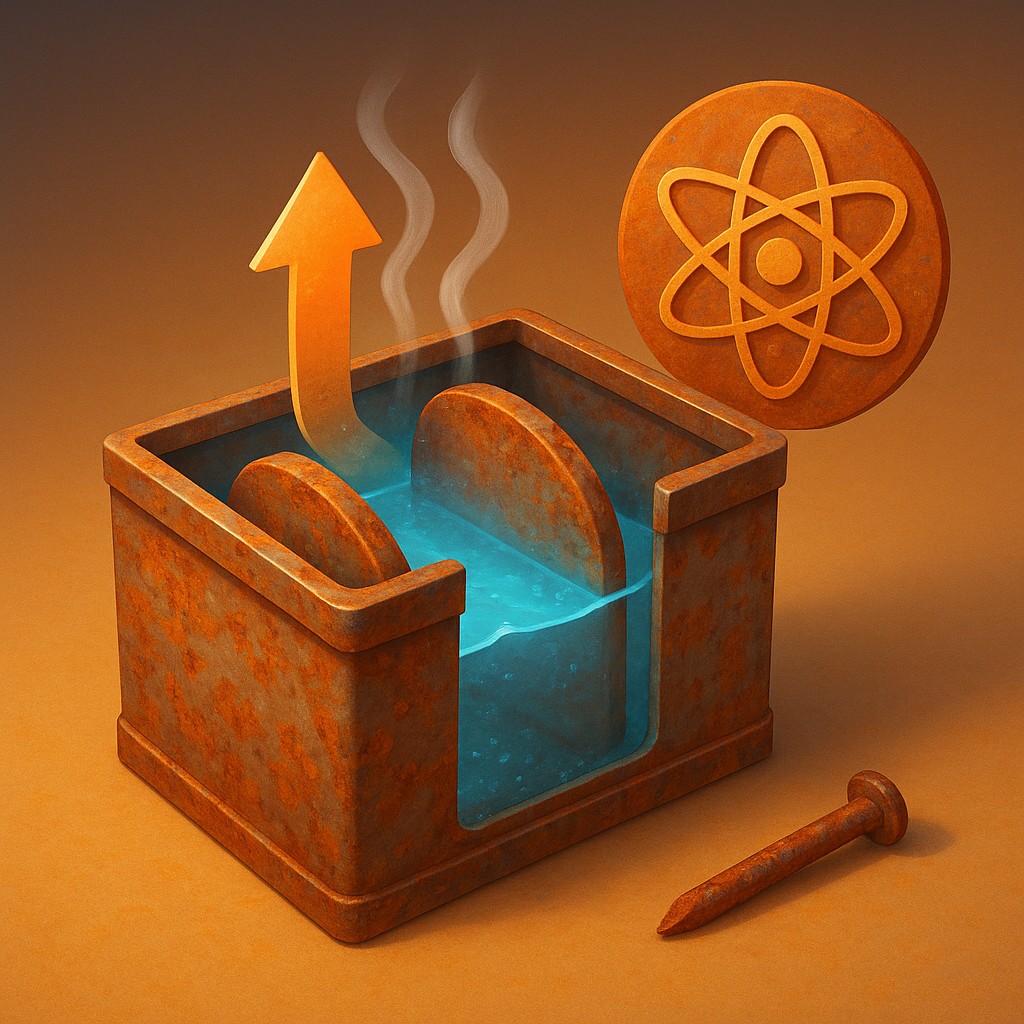
At its heart, an iron-air battery is a masterclass in using common chemistry to solve an uncommon problem. Most batteries are self-contained boxes of expensive chemicals that shuffle ions back and forth. The iron-air battery, however, is much more social; it interacts with the world around it. During the discharge phase, when the grid needs power, the battery literally "inhales" oxygen from the air. This oxygen reacts with a pile of iron pellets submerged in a liquid electrolyte (a water-based solution that conducts electricity). This reaction creates iron oxide, better known as rust. As the iron transforms into rust, it releases a steady stream of electrons that can be funneled out of the battery and into power lines to light up your living room.
When the sun comes back out or the wind picks up, the process simply goes into reverse. Excess electricity from the grid is pumped back into the battery, which forces the oxygen to detach from the iron. The rust is chemically dismantled, turning back into solid metallic iron, and the oxygen is "exhaled" back into the atmosphere. It is a breathing cycle that can be repeated thousands of times without the wear-and-tear issues that plague other battery types. By using the very air we breathe as a primary ingredient, the battery avoids the need to store half of its active materials inside the casing. This reduces costs and weight-to-energy ratios as efficiently as possible.
Why Your Phone Will Never Run on Rust
If this technology is so revolutionary, you might wonder why your next laptop won't be powered by a small block of rusting iron. The reason lies in the trade-offs of physics. Iron-air batteries have low "power density" but high "energy density." In plain English, they are like marathon runners rather than sprinters. They can provide a steady level of power for a very long time, but they are not good at providing a massive, sudden burst of speed. They are also heavy and bulky. While a lithium battery is like a compact, high-performance sports car engine, an iron-air battery is more like a giant, slow-moving cargo ship.
Furthermore, the charging and discharging process is significantly slower than what we expect from consumer electronics. You want your phone to charge in thirty minutes; an iron-air battery prefers to take its time over hours or even days. Because the components are made of iron, water, and air, the system is also quite heavy. Carrying a "rusting" battery in your pocket would feel like carrying a small dumbbell. However, when you are building a storage facility next to a solar farm in the desert, size and weight do not matter nearly as much as cost and longevity. On the grid, the "cargo ship" approach is exactly what we need to get through a cloudy week.
Breaking the Resource Monopoly
One of the most persistent anxieties in the renewable energy sector is the supply chain for rare minerals. Lithium, cobalt, and nickel are not just expensive; they are often concentrated in areas that make global logistics a political headache. Mining these materials is also an intensive process that can leave a significant environmental footprint. This creates a paradox: we are trying to save the environment by using materials that are increasingly difficult and "dirty" to acquire. Iron-air batteries shatter this paradox by leaning on the most abundant and recycled metal on Earth.
Iron is everywhere. It is the backbone of our bridges, skyscrapers, and kitchen appliances. Because the industry for mining and processing iron is already mature and global, the cost of the raw materials for an iron-air battery is roughly one-tenth the cost of those in a lithium-ion battery. This economic shift is the "holy grail" for grid operators. When the storage technology is this cheap, it becomes financially smart to build massive installations that can store energy not just for the four hours of peak demand in the evening, but for 100 hours or more. This bridges the gap between today’s unpredictable renewables and a future of steady, "baseload" green energy.
Comparing the Titans of Energy Storage
To understand where iron-air batteries fit into our future, it helps to see them side-by-side with the current champion of storage. They are not competitors so much as they are teammates with very different skill sets.
| Feature |
Lithium-Ion Batteries |
Iron-Air Batteries |
| Primary Use Case |
EVs, Phones, Short-term grid backup |
Long-duration (multi-day) grid storage |
| Main Ingredients |
Lithium, Cobalt, Nickel, Graphite |
Iron, Water, Atmospheric Oxygen |
| Duration |
1 to 4 hours typically |
100+ hours |
| Raw Material Cost |
High and volatile |
Very low and stable |
| Charge Speed |
Very fast |
Very slow |
| Physical Size |
Compact and light |
Large and heavy |
| Cycle Life |
Decays after 5-10 years of heavy use |
Potentially decades with minimal loss |
The 100-Hour Horizon and Grid Resilience
The most significant metric in the world of iron-air technology is the "100-hour" mark. Why 100 hours? Because that is the magic number required to survive a "Dunkelflaute," a German word used by weather experts and grid planners to describe a period of stagnant weather where there is neither sun nor wind. These events are rare, but they are the nightmare scenario for a 100% renewable grid. If a city relies on wind and solar, a four-day stretch of gray, still weather could lead to total blackouts if the storage system only lasts for four hours.
By deploying iron-air batteries, grid operators can effectively weather-proof the energy supply. These batteries act as a massive safety net. During weeks of high wind and bright sun, they soak up the excess energy that would otherwise go to waste. They sit quietly, holding that energy as solid iron, ready to be "breathed in" when the weather turns sour. This resilience is what allows us to retire old coal and gas plants that currently act as the backup for the world's energy needs. We are essentially replacing fire with rust, a trade that is significantly better for the atmosphere.
Overcoming the Efficiency Gap
If there is a catch to using iron as a battery, it is the "round-trip efficiency." In the battery world, this is the measure of how much energy you get back out compared to how much you put in. Lithium-ion batteries are overachievers, returning about 85% to 90% of the energy you give them. Iron-air batteries are a bit more wasteful, typically hovering around 60% to 80% because some energy is lost as heat during the chemical change from iron to rust and back again. In a world of scarce energy, this would be a dealbreaker.
However, we are moving toward a world of occasional energy abundance. On a very windy day, wind farms often produce more electricity than the grid can actually use, forcing operators to pay them to shut down. In this context, losing 30% of that excess energy in a cheap iron battery is far better than losing 100% of it because you had nowhere to put it. The goal isn't to be perfectly efficient; it is to be economically and environmentally viable on the scale of entire continents. Iron-air batteries don't need to be perfect to be the missing piece of the puzzle.
A Future Built on Abundance
As we look toward the middle of the century, the silhouette of our energy infrastructure is destined to change. Alongside the familiar sight of wind turbines and solar panels, we will see nondescript warehouses and rows of shipping containers filled with nothing more exotic than iron pellets and water. These "iron forests" will be the lungs of the grid, inhaling and exhaling to keep the lights on regardless of the weather. It is a poetic conclusion to the industrial age: the same metal that built the steam engines and railways of the 19th century is now being repurposed to solve the climate crisis of the 21st.
This shift represents a fundamental change in how we think about technology. We often assume that progress requires more complexity, rarer materials, and more exotic physics. Often, however, the most profound breakthroughs come from taking a step back and looking at the basic processes of nature with fresh eyes. By mastering the humble chemistry of rust, we are unlocking the ability to store the wind and the sun in a way that is as sustainable as it is ingenious. The next time you see a rusty nail or a weathered gate, don't just see decay; see the potential for a world powered by the very air we breathe.