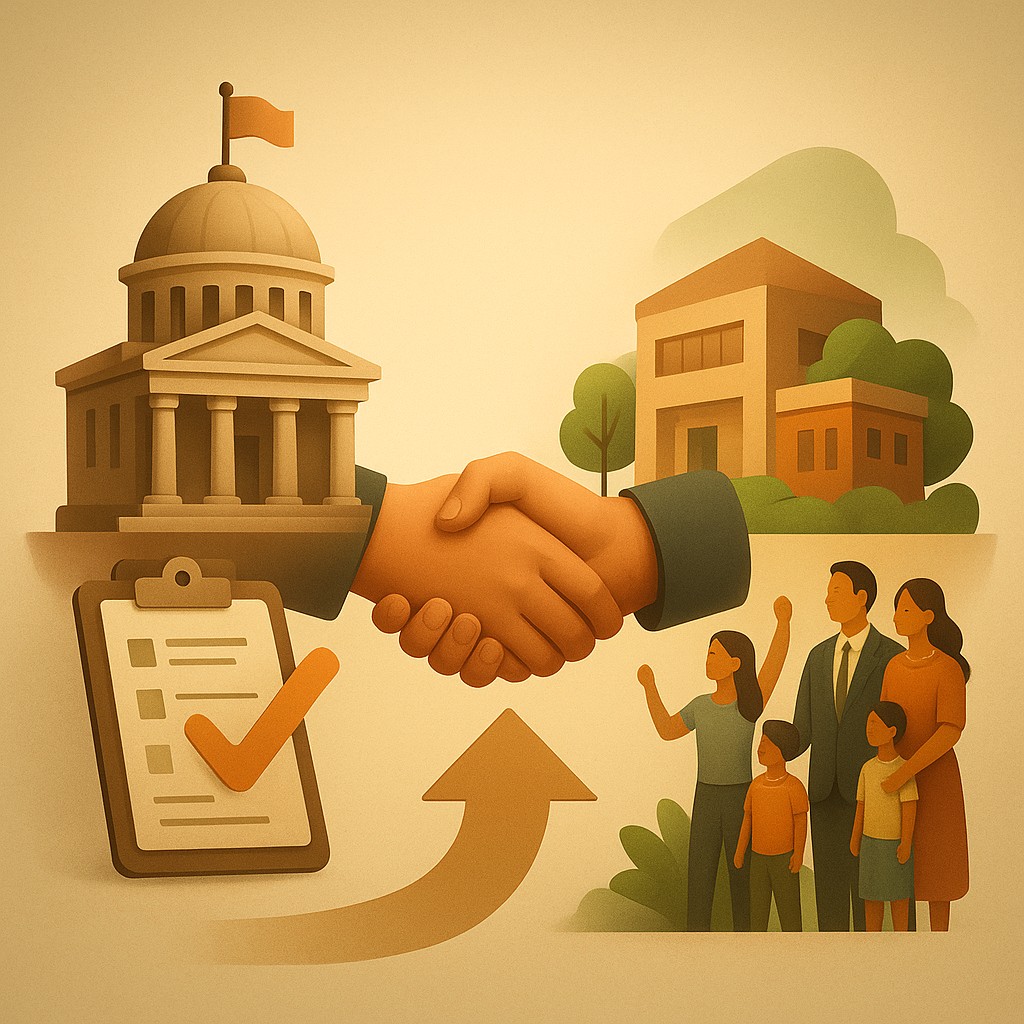
Imagine for a moment that your local government needs to build a new library. For decades, this process was as predictable as a metronome. Officials would draft a list of requirements, open the floor for bids, and almost always choose the lowest price tag. On the surface, this looks like the height of fiscal responsibility. After all, who wants to pay more for a brick wall than necessary? But as the ribbon is cut and the builders drive away, a quiet realization often sets in. The construction company might have brought in outside labor, bought materials from thousands of miles away, and sent the profits to a distant corporate headquarters. This leaves the local economy exactly as they found it: stagnant.
We are currently seeing a quiet but deep revolution in how public money is spent. We are moving away from the "cheapest is best" philosophy toward something much more ambitious. This new approach, often called social value procurement or social credit frameworks for business, treats every taxpayer dollar as a multi-purpose tool. It asks a radical question: if we are going to spend ten million dollars on a library anyway, can we use those same dollars to train twenty local apprentices, lower the city’s carbon footprint, and support minority-owned businesses at the same time? By building these social expectations directly into the legal DNA of a contract, governments are shifting from passive consumers to active architects of local prosperity.
Beyond the Bottom Line: Why Price is a Poor Metric
The traditional "lowest price wins" model is built on a narrow definition of efficiency. In economic terms, this is often a race to the bottom that ignores "externalities." These are the hidden costs or benefits that do not show up on a receipt. If a company wins a contract by paying its workers poverty wages, the government might save money on the building, but it will end up paying more in the long run through social services, healthcare, and lost tax revenue. It is a classic case of being penny-wise and pound-foolish. The new framework seeks to include these missing pieces of the puzzle. It recognizes that a slightly more expensive bid might actually be "cheaper" for the community when you count the economic boost it provides.
Modern purchasing is shifting toward a "Value for Money" (VfM) model that looks at much more than just the bill. Under this lens, a purchasing officer does not just look at the price of the steel; they look at the journey that steel took. They check if the company provides mental health support for its employees or if it has a plan to reach "net-zero" emissions (producing no more greenhouse gases than it removes). By giving a "score" to these social contributions, the government creates a competitive market for kindness and community investment. If a business wants to win the contract, it can no longer just be the cheapest; it has to be the most helpful neighbor.
This transition is increasingly powered by smart computer programs and scoring models. In some areas, social value now accounts for 10% to 30% of the total score in a bid evaluation. This means a company with a higher price tag can actually beat a cheaper competitor if they can prove their work will create more wealth for the local community. It is a powerful system that uses the competitive nature of business to solve social problems that used to be left to underfunded charities or slow government departments.
The Mechanics of Social Scoring in Tenders
To understand how this works in practice, we have to look at the scoring matrix, which is the heart of the modern public tender (the formal bidding process). When a government agency asks for project proposals, it now includes a specific section for social value. This is not just a place for "feel-good" stories; it requires hard data and legal promises. A business might be asked for a detailed plan on how they will hire people from under-represented groups or how they will reduce waste in their supply chain. Each of these promises is given a point value, much like a grade in school.
The difficulty lies in the math of comparison. How do you decide if hiring five veterans who have been out of work is "worth" more than putting solar panels on a warehouse roof? To solve this, many agencies are using standard categories. The United Kingdom, for example, uses a Social Value Model that focuses on five main areas: COVID-19 recovery, narrowing the wealth gap, fighting climate change, equal opportunity, and health and wellbeing. By putting all social goals into these categories, officials can use a structured set of rules to ensure they are being objective rather than just picking a favorite charity.
| Scoring Category |
Typical Metric |
Long-term Impact |
| Local Economic Health |
% of spending within 30 miles |
Keeps money from "leaking" out of the local community. |
| Skills & Education |
Number of paid apprenticeships |
Fixes local skill gaps and lowers unemployment. |
| Environmental Care |
Carbon footprint of shipping |
Helps the city meet its clean-air and climate goals. |
| Social Equity |
Diverse leadership & suppliers |
Removes hurdles for minority and women-owned firms. |
| Wellbeing |
Proof of paying a "Living Wage" |
Reduces the need for public housing and food stamps. |
Navigating the Comparison Trap and Bias
One of the biggest hurdles in these social frameworks is the "apples-to-oranges" problem. If Company A promises to plant 5,000 trees and Company B promises to give free coding classes to local teens, which one should get the 10-point bonus? This is where the risk of personal bias creeps in. If the official likes trees more than coding, the process loses its fairness. To stop this, agencies are using "Weighted Criteria" that prioritize specific outcomes based on what that specific town actually needs. If a town has high youth unemployment but plenty of parks, the scoring system will naturally give more points to the coding classes.
There is also the worry of "social washing," which is like "greenwashing" for social issues. This happens when a company makes big, flashy promises about helping people to win a contract but has no intention of following through once the deal is signed. To prevent this, social value is becoming a legal requirement rather than just a suggestion. If a firm wins a bid because they promised to hire local workers and then brings in outside help anyway, they can face heavy fines or be banned from future bidding. Social "credit" is increasingly treated with the same legal weight as the physical building plans.
Another challenge is the burden this puts on small businesses. A giant global corporation has an entire department just for writing reports and tracking social data. A local family-run construction shop might be doing great things for their community naturally, but they might not have the extra staff to prove it on paper. To keep things fair, governments are beginning to simplify the paperwork for smaller contracts. This ensures the system doesn't accidentally favor the giants who are good at paperwork but less connected to the local area.
The Ripple Effect: From Purchasing to Business Strategy
When the biggest buyer in the world, the government, changes its shopping habits, the entire market pays attention. This shift is forcing companies to rethink how they operate. In the past, a CEO might have seen social responsibility as a "nice extra" or a marketing cost. Now, it is a primary way to make money. If a firm knows it cannot win a billion-dollar construction contract without a strong apprenticeship program, that program is no longer charity; it is a business necessity. This creates a permanent change in how corporations behave, even when they aren't working for the government.
This approach of using spending as a "targeted tool for regional development" also builds a sense of local pride. When people see that a new highway was built by a firm that hires from their neighborhood and uses local gravel, they stop seeing government spending as "wasteful" and start seeing it as an "investment." It creates a positive loop: taxpayer money stays in the community, the community grows stronger, tax revenue goes up, and the government has more to invest. It is a healthy cycle that replaces the old "extractive" model, where wealth was pulled out of small regions and moved to global banking hubs.
We are moving toward a future where a company's "social balance sheet" is just as vital as its financial one. This isn't about political trends; it is about smarter economics. It is about recognizing that every purchase is a chance to strengthen the community. By using clear math and metrics to reward businesses that invest in people and the planet, we are finally teaching the "invisible hand" of the market to be more helpful, more local, and much more human.
Looking Forward: A Smarter Way to Build
The growth of social value procurement is far from finished. As data collection gets better and AI helps predict the long-term effects of social projects, we will likely see "social credit" scores that are very detailed. We might reach a point where a system can calculate the exact future tax savings of a single job placement in a high-crime area. This would allow for a level of financial precision we can only dream of today. The challenge for the next decade will be refining these measures so they are fair, clear, and impossible to cheat, ensuring the benefits truly reach the people who need them most.
As you look around your own city or town, start to wonder about where things came from. The bus you ride, the bridge you cross, and the school your children attend were all "bought" by the public. When we demand that these purchases do more than just provide a service, we are using our collective power. The shift toward social value is a reminder that we don't have to choose between a strong economy and a healthy society. With the right rules and a bit of creative scoring, we can use the pursuit of profit to build a world that actually works for everyone.