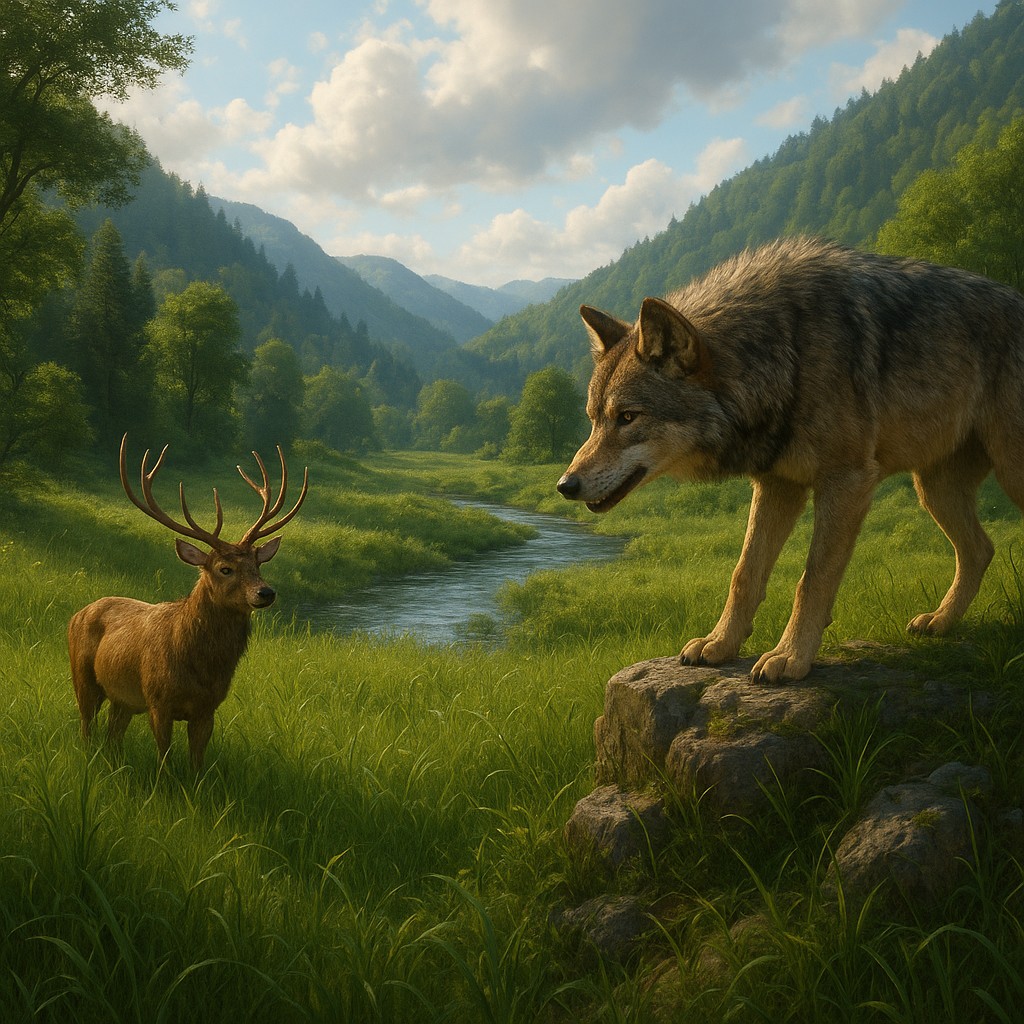
Imagine standing in a lush valley where the grass reaches your waist, the rivers run clear and deep, and the air hums with insects and birdsong. It is easy to look at such a scene and credit the soil or the weather for its health. However, in many of the world’s most vibrant landscapes, the secret architect of this beauty is actually a sharp-toothed hunter prowling the ridges. We often think of nature as a collection of individual species living side by side, but it is more like a high-stakes game of dominoes where every player leans on the next.
When a top predator enters or leaves an ecosystem, it creates a ripple effect that travels all the way down to the tiny microbes in the dirt. Scientists call this a trophic cascade. The word "trophic" refers to food or nutrition, and a "cascade" is a process that flows downward like a waterfall. By simply hunting and moving around, a predator can change the behavior of prey, the growth of plants, and even the physical shape of a river. Understanding this process changes how we see the world, shifting our focus from single animals to the invisible threads that tie an entire environment together.
The Puppet Masters of the Food Web
To understand how a hunter can save a forest, we have to look at the flow of energy. In a simple food chain, there are producers (plants), primary consumers (plant-eaters like deer), and secondary consumers (predators like wolves or lions). For a long time, many people believed in "bottom-up" ecology. This theory suggests that sunlight and rain determine how many plants grow, which decides how many deer can survive, which finally sets the number of wolves. While this is true in a basic sense, it ignores the powerful "top-down" influence that predators exert.
Predators act as ecosystem managers. Without them, plant-eaters tend to overpopulate and stay in one place too long, eating every green sprout until the land becomes a wasteland. When a predator is introduced, it creates what ecologists call a "landscape of fear." This does not mean the prey lives in constant terror, but rather that they become much more careful about where they spend their time. They avoid deep valleys or thickets where they could be easily cornered, which gives the plants in those specific areas a much-needed break from grazing.
How a Wolf Can Move a River
The most famous modern example of a trophic cascade took place in Yellowstone National Park. In the early 20th century, wolves were completely removed from the park, and for decades, the ecosystem suffered. The elk populations exploded because no one was keeping them in check. They spent their days lounging by the rivers, munching on young willow and aspen shoots until those trees were nearly extinct in the area. Without tree roots to anchor the soil, the riverbanks began to crumble, and the water became muddy and shallow.
When wolves were brought back in the mid-1990s, the change was almost miraculous. The wolves began to hunt the elk, but more importantly, they changed how the elk behaved. The elk stopped hanging out in open valleys and started moving around more to stay safe. Because the elk were no longer eating every sapling in sight, the willows and aspens began to grow tall. Within a few years, some trees were high enough that the elk could no longer reach the top branches. This forest regrowth set off a spectacular chain reaction across the park.
As the trees grew, birds returned to nest in the branches. Beavers, who eat willow and use it for their dams, moved back in too. Beaver dams create ponds that provide homes for otters, muskrats, frogs, and fish. Even more surprisingly, the growing trees stabilized the riverbanks with their roots. This caused the rivers to stop wandering across the landscape and become narrower and deeper. The presence of a single predator at the top of the food chain had physically reshaped the geography of the American West.
A Comparison of Ecosystem States
To see the difference between a system with and without a top-down regulator, it helps to look at the specific outcomes for different parts of the environment. The table below shows the typical shifts that happen during a trophic cascade.
| Ecosystem Component |
Without a Top Predator (System Collapse) |
With a Top Predator (Healthy Cascade) |
| Plant-Eater Population |
High and stays in one spot, leading to overgrazing. |
Controlled and mobile, reducing pressure on plants. |
| Plant Variety |
Low; young trees and sensitive plants are eaten away. |
High; forests and grasslands recover and diversify. |
| Soil Stability |
Weak; heavy grazing leads to erosion and dust. |
Strong; root systems anchor the earth. |
| Water Systems |
Shallow, wide, and filled with silt. |
Structured, cooled by shade, and clearer. |
| Small Animal Life |
Fewer places for birds and mammals to live. |
Diverse habitats in regrown thickets and forests. |
The Indirect Benefits of the Messy Eater
A predator’s influence is not just about what they eat, but also what they leave behind. Think of a predator as a provider for many "uninvited" guests. When a wolf or a mountain lion kills an elk, they rarely finish the whole thing. The leftovers provide a massive boost of protein for scavengers like grizzly bears, bald eagles, ravens, and wolverines. In regions with harsh winters, these carcasses can be the difference between life and death for species that cannot hunt large prey themselves.
Furthermore, as these kills break down, they return vital nutrients like nitrogen and phosphorus to the soil in concentrated "hotspots." This localized fertilizer leads to even stronger plant growth, creating a cycle of life that feeds back into the system. It is a messy, sometimes violent process, but it fuels the diversity of the landscape. Even insects benefit: hundreds of species of beetles and flies depend on the remains of a predator’s meal to survive and reproduce.
Why We Cannot Simply "Add Predators" to Every Problem
It is tempting to see the trophic cascade as a magical fix for any dying habitat. If a forest is struggling, why not just bring in some tigers? Unfortunately, nature is more complex than a simple diagram. The success of a trophic cascade depends heavily on local conditions, such as the climate, the size of the habitat, and the presence of other species. For instance, if a landscape is already too damaged or if there is not enough space for predators to roam, reintroducing them might not work.
There is also the human side to consider. Predators do not respect property lines, and their return can cause serious conflict with farmers and ranchers who worry about their livestock. Successful ecological restoration requires balancing the needs of the wild with the needs of the people living nearby. Science shows that for a cascade to be beneficial, the entire community must be managed as a whole. This means looking at water rights, hunting rules, and land use policies alongside the biology of the animals.
Small-Scale Cascades in Your Own Backyard
Trophic cascades are not just for giant national parks; they happen at every level, including in the microscopic world and in small suburban gardens. Consider a garden overrun by aphids, the tiny green bugs that suck the life out of rose bushes. If you use a pesticide to kill the aphids, you might also kill the ladybugs. However, if you encourage ladybugs (the top predators of the garden world) to move in, they will control the aphids. This allows the plants to flourish, which in turn provides more nectar for bees and butterflies.
In the ocean, sea otters provide a classic example. Sea urchins love to eat kelp, the giant underwater "trees" that form massive forests in the Pacific. Without sea otters to eat the urchins, the urchins would mow down the kelp until nothing was left but a "urchin barren" of rocks. By keeping the urchin population in check, otters allow the kelp to grow. This provides a nursery for hundreds of fish species and helps the ocean absorb carbon dioxide from the air. Whether it is a wolf in the woods or an otter in the waves, the principle is the same: the presence of a hunter protects the home of many.
Correcting the Myth of the "Cruel" Predator
For a long time, humans viewed predators as villains, pests, or rivals that needed to be wiped out to keep the world safe. We saw them as a negative force that only took away from nature. The study of trophic cascades has flipped this story on its head. We now understand that predators are actually protectors. They are the guardians of biodiversity, ensuring that no single species becomes so dominant that it destroys the environment for everyone else.
Instead of seeing a wolf as a killer, we can see it as a forest-builder. Instead of seeing a shark as a monster, we can see it as a keeper of the coral reefs. This shift in perspective is vital for modern conservation. It teaches us that "saving" an environment is not just about protecting pretty flowers or cute deer; it is about respecting the complex, sometimes sharp-edged balance of the entire web. When we protect the top of the food chain, we are quite literally protecting the ground we walk on.
The story of the trophic cascade is a powerful reminder that we are never truly alone in nature. Every creature, no matter how fierce or how small, plays a part in a much larger dance. When you look out at a beautiful forest or a sparkling stream, remember that its health might just depend on the silent pawprints of a hunter you may never see. By embracing these interconnected systems, we can work toward a future where both nature and humanity thrive in a careful, beautiful balance. There is a quiet majesty in the way life regulates itself, and the more we learn about it, the more we can appreciate the wild world in all its tooth-and-claw glory.