Imagine trying to run a global shipping company where every single employee, from the CEO to the night janitor in a tiny regional office, had to attend every meeting just to decide how to deliver one package. If a customer asked for a single stamp, the legal department, the entire truck fleet, and the software team would all have to stop working to weigh in. It would be an economic nightmare of wasted time and a total disaster of wasted breath. Yet, for years, this is exactly how the world’s most famous Artificial Intelligence models worked. When you asked an older AI "What is the capital of France?", every single mathematical connection in its massive digital brain fired at once to give you the answer.
This "dense" approach worked fine when models were small. But as AI grew to include billions or even trillions of parameters (the tiny settings that determine how it thinks), the electricity bills became astronomical. We hit a wall where making a model smarter meant making it bigger, but making it bigger made it too heavy and expensive to actually use. To fix this, developers created a concept called "Mixture of Experts" (MoE). It is a structural revolution that allows a model to grow to a massive size while only using a small, specialized fraction of its power for any single request. It is the difference between a panicked mob trying to shout an answer and a well-organized library where one knowledgeable clerk points you to the exact book you need.
The Strategy of Working Smarter, Not Harder
In the early days of the current AI boom, the philosophy was that bigger is always better. If a model with 10 billion parameters was good, one with 100 billion was ten times better. This held true for a while, but it eventually hit an efficiency wall. In a standard dense model, every time the AI generates a single word, the computer has to run a calculation for every single parameter in the system. If you have a 175-billion parameter model, that means 175 billion tiny math problems just to get from the word "The" to the word "cat." This is why giant AI models require massive server farms and enough electricity to power small cities.
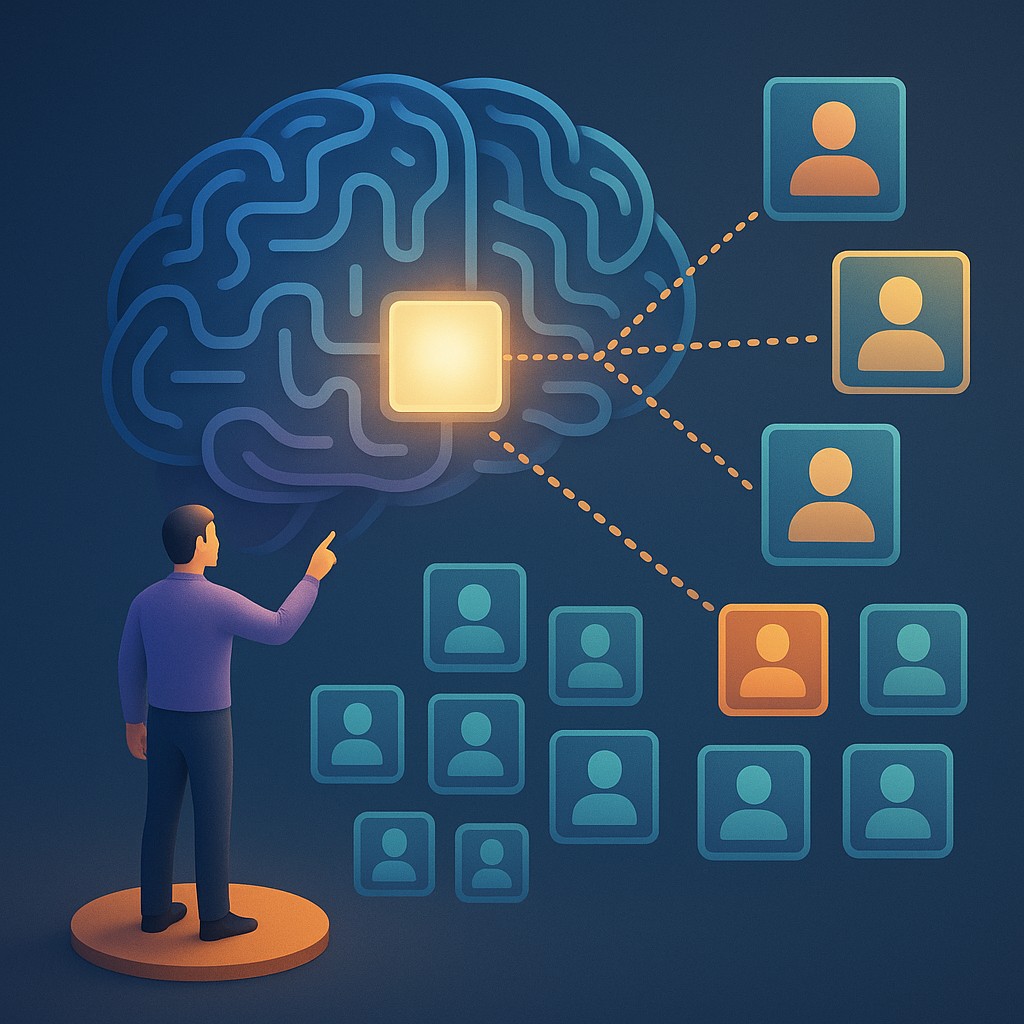
Mixture of Experts changes the game by introducing "sparsity." Instead of one solid block of interconnected neurons that all fire at once, an MoE model is broken down into smaller, specialized units called experts. Think of it like a medical clinic. You dont need a foot doctor, a heart surgeon, and a brain surgeon to all look at your stubbed toe; you only need the person who knows feet. By keeping most of the "experts" in the model switched off and only activating the relevant ones, we can have a model that "knows" as much as a 600-billion parameter giant but only uses the energy of a 30-billion parameter model to answer a question.
This design changes the relationship between a model’s knowledge and its cost. In a dense system, cost and knowledge are tied together, rising and falling in sync. In an MoE system, they are separated. You can add more experts to increase the model’s total knowledge without significantly increasing the electricity needed to generate a response. This allows AI to become more versatile and nuanced without becoming a financial burden that only the world's richest corporations can afford.
Meet the Router: The Brain Behind the Brain
To make this system work, you need a way to decide which experts to call. This is the job of the "Gating Network," or more simply, the Router. Every time you type text (which the AI sees as a series of numerical "tokens"), the Router looks at that token and decides which experts are best equipped to handle it. It acts like a high-end hotel concierge who hears "I'd like a medium-rare steak" and immediately calls the chef rather than the pool boy or the valet. The Router is actually a tiny neural network itself, trained specifically to recognize which parts of the larger model are the most accurate for different types of information.
The magic happens in how the Router divides the work. In most modern MoE setups, for every token the model processes, the Router picks only the "Top-2" experts from a pool of perhaps 16 or 64. The input goes to those two specialists, their results are combined, and the rest of the experts stay in a state of digital sleep. This means that while the model has a massive total capacity, the "active" part is lean and fast. This selectivity is why these models feel so snappy and responsive, even though they are technically much larger than the ones we used just a few years ago.
However, training a Router is a delicate balancing act. If the Router decides early on that one specific "expert" is slightly better than the others, it might start sending all the traffic to that one specialist. This leads to a "lazy" model where one part is overworked while the others never learn anything. Developers use mathematical tricks, like adding random "noise" or "load-balancing" penalties, to force the Router to give every expert a chance to learn during training. This ensures the model develops a wide range of skills rather than just relying on a single "star" sub-network.
The Memory Tax of Big Thinking
While MoE is a miracle for saving energy and speeding up text generation, it does involve a trade-off called the "memory footprint." Even though you are only using a fraction of the model at any one time, you still have to store the entire thing in the computer's memory (RAM or VRAM). Because an MoE model has dozens of experts, the total file size is much larger than a dense model of the same power. If a dense model is a single tool like a hammer, an MoE model is a 500-pound toolbox. Even if you only need the hammer right now, you still have to haul the entire toolbox to the job site.
This creates a hardware challenge. To run a massive MoE model, you need a lot of video memory (VRAM) spread across many expensive graphics cards (GPUs). This is why you cannot easily run the most advanced versions of these models on a home laptop yet. The "active" parameters are small enough for a laptop to handle the math, but the "total" parameters are too big to fit in the available storage. This is a primary reason why AI companies have massive hardware requirements even as their software becomes more efficient.
| Feature |
Dense Model |
Mixture of Experts (MoE) |
| Activation |
Every part fires for every prompt. |
Only selected "experts" fire. |
| Energy Use |
Very high; grows as the model grows. |
Much lower; depends on active parts. |
| Storage Needs |
Moderate; you only store what you use. |
Very high; must store all experts. |
| Speed |
Slows down as the model gets bigger. |
Very fast, regardless of total size. |
| Specialization |
General knowledge spread thin. |
Deep focus in specific units. |
| Complexity |
Simple to design and train. |
Harder to balance and fine-tune. |
Why Sparsity is the Secret to Intelligence
If you look at the human brain, you will find it is the ultimate "sparse" system. You do not use the part of your brain that moves your legs while you are trying to remember the lyrics to a song. If your brain were "dense" like old AI models, every time you smelled a flower, the part of your brain that calculates taxes and the part that moves your thumb would also fire at full intensity. You would overheat and burn out in seconds. Evolution discovered millions of years ago that intelligence requires selectivity; you only activate the circuits you need for the task at hand.
By adopting MoE, AI researchers are finally moving closer to this biological reality. This shift toward "sparse" activation is what allowed recent models to jump from being "pretty good" at writing poetry to being "expert-level" at coding, law, and medical diagnosis all at once. By having specialized experts for different languages or technical fields, the model avoids "interference," where learning how to write computer code might accidentally make it worse at writing Italian sonnets. The experts can stay in their own lanes, mastering their domains without getting in each other's way.
This shift also opens the door for "Personal AI" in the future. Imagine a model where the Router doesn't just choose between generic experts, but picks experts tuned specifically to your life. One expert might be trained on your professional writing style, while another knows your family's medical history. Because the MoE system only activates what it needs, you could have a vast "library of you" that is incredibly deep but still runs efficiently on a phone.
The Future of Focused Machines
Despite the complex math, the core lesson of the Mixture of Experts design is something we can all relate to: the most important part of being smart is knowing what to ignore. In a world drowning in data, we don't need machines that try to think about everything at once; we need machines that can focus. MoE represents the transition of AI from a brute-force engine into a refined, modular system that mimics the elegance of natural thought.
As these models evolve, the "memory tax" will likely drop as we find better ways to compress data and build specialized hardware. We are entering an era where AI will not be defined by how much electricity it consumes, but by how cleverly it routes information. When you use a modern AI and it gives you a fast, brilliant answer, remember that behind the scenes, a tiny Router just performed a silent miracle of organization, waking up just the right experts to help you while letting the rest of the colossal brain sleep in peace.
The next time you face a massive project or a mountain of information, take a page out of the AI developer's book. You don't need to fire every neuron in your brain at once to solve a problem. Efficiency isn't just about doing more; it is about having a structure that ensures only the "experts" in your mind are doing the heavy lifting. By embracing the power of focus, we can navigate a complex world with the same grace and speed as the most advanced digital minds.