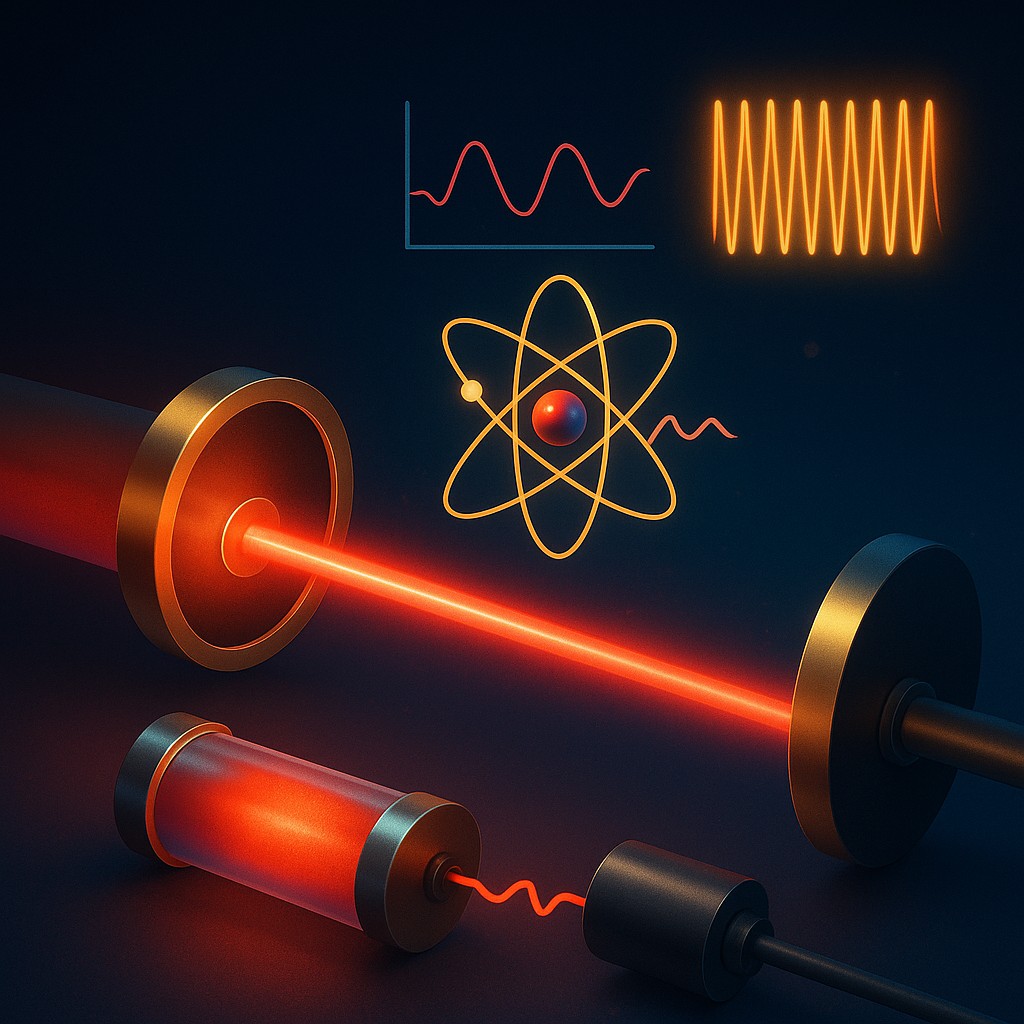
A laser can slice steel, scan groceries, measure the distance to the Moon, and entertain your cat with the same smug red dot. That range sounds like science fiction, but it is really a story about discipline - getting light to stop behaving like a chaotic crowd and start acting like a perfectly synchronized marching band.
Most light sources are basically loud parties. A light bulb, a candle, even the Sun all send out waves of many colors, in many directions, and out of step with each other. A laser, by contrast, is light with manners. It is unusually pure in color, unusually well aligned in direction, and unusually coordinated in timing.
To see how lasers pull off this "light with manners" trick, we will start with a few simple ideas about atoms and waves, then put together the three key parts of a laser. Along the way, we will clear up a couple of myths (no, lasers are not magically "hot" by default), and you will be able to explain, in plain English, how a device turns random energy into a tight, powerful beam.
Light as a wave, light as a packet, and why “in step” matters
Light is electromagnetic radiation, which is a way of saying it is a ripple in electric and magnetic fields moving through space. Picture it like waves on a pond, except the pond is the universe and the wave is invisible unless it hits your eyes or a sensor. Every light wave has a wavelength (which ties to color) and a frequency (how fast it wiggles). Red light has a longer wavelength than blue light, so it wiggles less often.
Light also behaves like particles, called photons, which are packets of energy. You can think of the wave and the photon as two useful ways to describe the same phenomenon.
Now for a key word lasers care about: phase. Phase tells you where you are in the wave cycle, like whether a sine wave is at a peak, a trough, or somewhere in between. When waves are in phase, their peaks line up with peaks, and they add together to make a stronger wave. When waves are out of phase, they can cancel each other, like two people pushing a swing in opposite rhythms.
Most everyday light is a jumble of waves with random phases. That is why a flashlight spreads out and does not stay razor-thin across the room. A laser produces light that is far more coherent, meaning the waves are much more "in step" over time and across the beam. Coherence is not just a neat trait, it is what lets lasers stay narrow, focus tightly, and do precise things like reading a DVD or measuring tiny distances.
The atomic “energy ladder” that makes laser light possible
Atoms are not tiny solar systems, but they do have set energy levels for their electrons. Think of an atom as having a few allowed rungs on an energy ladder. An electron can sit on one rung or another, but not in between. When an electron drops from a higher rung to a lower one, the atom releases energy, often as a photon of light.
The photon’s color is set by the energy difference between those rungs. A big drop gives a higher-energy photon, which is bluer. A smaller drop gives a lower-energy photon, which is redder. This is why different materials glow in different colors, and why a laser’s color is tied to what it is made from.
There are two main ways an excited atom can release a photon. The first is spontaneous emission, where the atom relaxes on its own and emits a photon in a random direction with a random phase. That is what happens in most glowing things, from neon signs to fireflies. The second way is the one that makes lasers special: stimulated emission.
Stimulated emission, or “one photon convinces another atom to copy it”
Stimulated emission is the laser’s signature move, and it is delightfully copycat. Imagine an atom with an electron sitting on a higher energy rung, ready to drop. If a photon passes by with the exact energy difference between the rungs, it can trigger the electron to drop right then. When that happens, the atom emits a second photon.
Here is the magic: that new photon is not random. It matches the incoming photon’s:
- Color (wavelength)
- Direction
- Phase (timing in the wave cycle)
- Polarization (the orientation of the wave’s electric field, in many cases)
So one photon arrives, and two photons leave, marching together like synchronized swimmers who also happen to be light. If you set up a situation where stimulated emission happens repeatedly, you get amplification. That is what "LASER" literally means: Light Amplification by Stimulated Emission of Radiation.
A common misconception is that lasers create light by "heating things up." Some lasers use electrical discharge or pump energy in, but the laser light itself comes from controlled electron transitions, not from the material glowing because it is hot. A hot object emits a wide range of colors, like a toaster coil, while laser light is much narrower in color because it is tied to specific energy jumps.
The three ingredients every laser needs (and what each one really does)
Even though lasers come in many forms, most share three essential pieces: a gain medium, a pumping method, and an optical cavity. Think of it like making a choir: you need singers (gain medium), a way to energize them (pump), and a concert hall that encourages harmony (cavity).
The gain medium: where light gets amplified
The gain medium is the material whose atoms or molecules perform stimulated emission. It can be a crystal (like ruby), a gas (like helium-neon), a semiconductor (laser diodes), or even a fiber doped with rare-earth ions (fiber lasers).
The medium matters because it sets which energy rungs are available, and that sets the wavelength(s) the laser can produce. It also affects how efficiently the laser can amplify light and how much power it can handle. Importantly, the gain medium does not automatically lase just because it exists. It has to be put into a special population condition.
Pumping: giving electrons a reason to climb
To get stimulated emission, you need many atoms in an excited state, ready to be triggered. In normal conditions, more atoms sit in the lowest energy state because nature likes the ground state. A laser must create a population inversion, meaning more atoms are in an excited state than in the lower state involved in the laser transition.
How do you do that? You pump energy in. Pumping can be:
- Optical: shining a bright lamp or another laser into the medium
- Electrical: using current, common in laser diodes and gas lasers
- Chemical: energy comes from a chemical reaction in some high-power systems
Population inversion sounds technical, but it is just bookkeeping for atoms - you are stacking the deck so a passing photon is more likely to trigger stimulated emission than be absorbed.
The optical cavity: the “photon ping-pong” amplifier
Even with a pumped gain medium, you need a way to get repeated stimulation. That is where the optical cavity comes in, usually two mirrors facing each other around the gain medium. One mirror is highly reflective, and the other is partially reflective, letting some light escape as the usable beam.
Photons bounce back and forth through the medium, triggering more stimulated emission each pass. This feedback greatly increases amplification, and it also selects which wave patterns, or modes, can survive. Only light that "fits" the cavity conditions builds up strongly, which is a big reason laser light is so clean and directional.
When the amplification from the medium exceeds the losses in the cavity, the laser crosses threshold and begins lasing. Below threshold, it might glow a bit like a weak lamp. Above threshold, it becomes a laser in the proper sense, with a big jump in coherent output.
How lasers become narrow, bright beams (without supernatural help)
People often say lasers are "perfectly parallel." In reality, every beam spreads out eventually because diffraction is the universe telling us, "Nice try." But lasers can have extremely low divergence, meaning they spread very slowly compared to a flashlight.
This happens because:
- The cavity favors certain directions. Light traveling along the mirror axis gets reinforced; off-axis light tends to leak away or fail to resonate.
- Coherence helps focusing. When waves are aligned, you can focus them into a much smaller spot. A messy wavefront will not cooperate.
- The output is often spatially filtered. Many laser designs naturally encourage the most stable spatial mode (often the "Gaussian" mode), which has a smooth profile and tight divergence.
Brightness can be misleading. A low-power laser pointer can seem painfully bright because your eye is sensitive to narrow-band light and because the beam stays concentrated. But the total power might be only a few milliwatts, less than some LED flashlights. The difference is concentration and direction, not necessarily raw energy.
A quick tour of common laser types (and what makes them different)
Lasers come in many flavors, and each solves the "gain medium + pump + cavity" puzzle in a different way. Here is a compact comparison to help you keep them straight:
| Laser type |
Gain medium |
Typical pump |
Common wavelength(s) |
What it’s great at |
| Helium-neon (HeNe) |
Gas mixture |
Electrical discharge |
632.8 nm (red) |
Stable, clean beam for labs and alignment |
| Diode laser |
Semiconductor junction |
Electrical current |
Many, often 405-1550 nm |
Compact, efficient, everywhere (pointers, telecom) |
| Nd:YAG |
Crystal doped with neodymium |
Optical (lamp/diode) |
1064 nm (IR), also 532 nm (green via doubling) |
High power, industrial cutting, medical |
| CO₂ laser |
Gas (CO₂ mix) |
Electrical discharge |
10.6 μm (far IR) |
Cutting and engraving, strong interaction with many materials |
| Fiber laser |
Doped optical fiber |
Diode pumping |
Often 1060-1100 nm |
Efficient, high-quality beams, robust for industry |
The details vary, but the theme stays the same: energize atoms (or semiconductor carriers), encourage stimulated emission, and keep photons bouncing until the system reaches threshold.
Continuous beams vs pulses: the laser can “blink” on purpose
Some lasers emit a steady beam, called continuous-wave operation. Others are designed to produce pulses, sometimes extremely short ones, down to femtoseconds (that is 0.000000000000001 seconds, a time interval so small it is basically bragging).
Pulsed lasers are useful because they can deliver enormous peak power even if the average power is moderate. Imagine tapping a nail with a hammer versus leaning on it with your hand. Same tool, wildly different effect. Techniques like Q-switching and mode-locking control how energy builds up in the cavity and then releases in a burst.
A misconception is that a pulsed laser must be "stronger" than a continuous one. It depends on what you mean: peak power can be huge, but the average energy delivered over time might be similar or even lower. The choice is about the job: delicate surgery, precise measurement, or blasting material into plasma all prefer different pulse styles.
Common myths and the calmer, truer story
Lasers have a reputation from movies, where they are either silent death rays or conveniently visible beams in smoky corridors. Let us tidy up a few ideas.
Myth: Laser beams are always visible in midair
Usually, you cannot see a beam unless light scatters off dust, fog, or smoke into your eyes. In clean air, a laser beam is mostly invisible from the side. What you see clearly is the spot where it hits something.
Myth: Lasers are automatically burning-hot
Heat depends on power, focus, wavelength, and what you shine the beam on. A classroom pointer will not cut metal. A high-power industrial laser will, because it delivers enough energy per area and the material absorbs that wavelength well.
Myth: Lasers are perfectly one color and perfectly parallel
Real lasers have a finite linewidth, not an infinitely pure single wavelength, and they diverge a little due to diffraction. They are just far more orderly than typical light sources.
Myth: A laser is “just a bright flashlight”
A flashlight is incoherent and broad in spectrum. A laser is coherent and often narrow in spectrum, which changes everything about focusing, interference, and precision uses. Same category (light source), very different personality.
Putting it all together: a laser in one mental picture
If you want a single memorable image, use this: a laser is a photon copy machine inside a mirror hallway. The gain medium provides atoms with electrons perched on higher rungs. Pumping keeps refilling those higher rungs so the copy machine does not run out of ink. The mirror hallway makes photons pass through again and again, so copies trigger more copies, until a tidy, synchronized wave builds up. One mirror then politely lets a fraction escape as the beam, like a bouncer allowing a controlled flow of extremely well-behaved photons.
Once you have that picture, the details become variations on a theme. Different media have different rungs, different pumps refill them differently, and different cavities shape which waves thrive. But the core logic remains: population inversion plus stimulated emission plus feedback equals laser light.
A closing challenge: start noticing lasers in the wild
The next time you scan a barcode, send data through fiber optics, use a laser rangefinder, or watch a surgeon do impossibly precise work, you will know the secret is not "mystery energy." It is choreography. A laser takes the unruly potential of atoms and turns it into coordinated light, and that coordination is what makes it powerful, precise, and frankly a bit beautiful.
If you can explain stimulated emission and why mirrors matter, you already understand the heart of how lasers work. From here, you can explore fun rabbit holes: why some lasers are infrared and invisible, how green lasers often start as infrared, or how ultra-short pulses let scientists watch chemistry happen in real time. Light is everywhere, but lasers are what happens when we teach light to keep time.