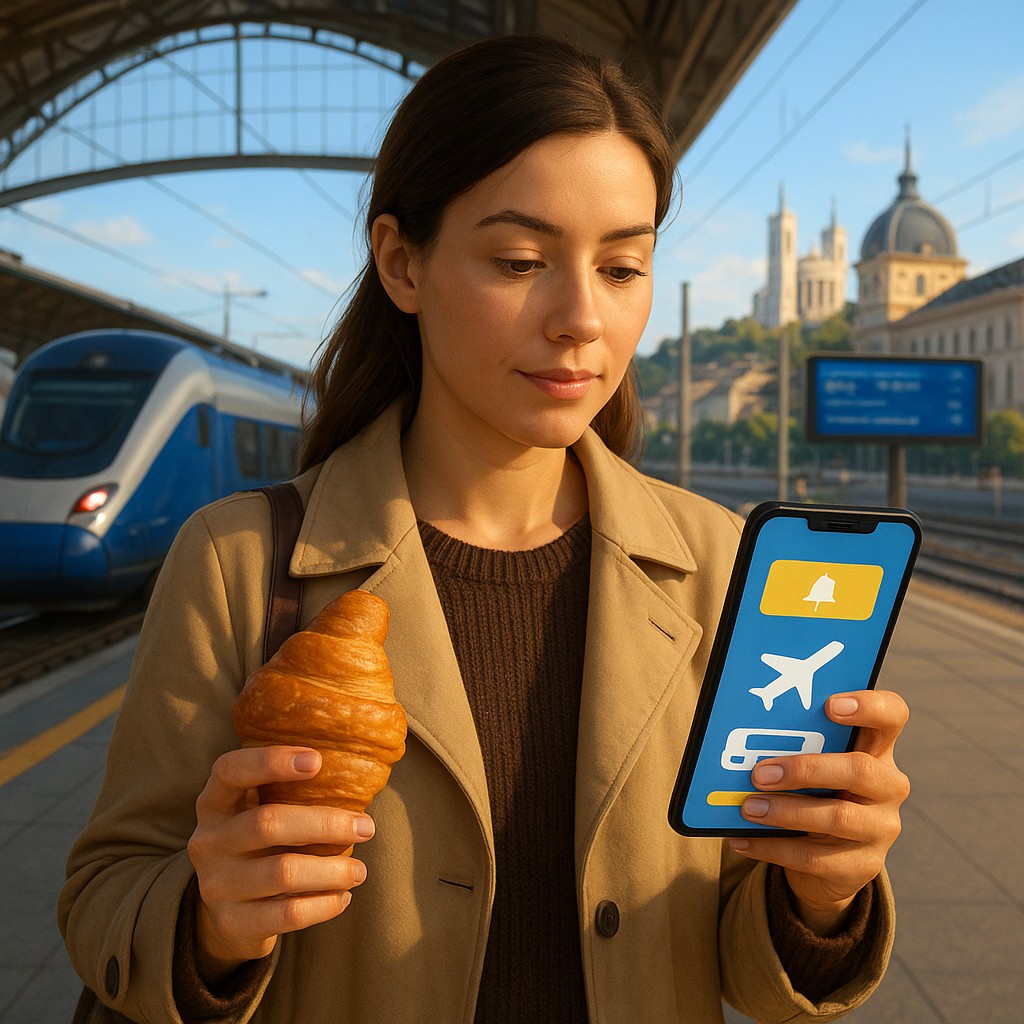
Imagine standing at a train station in Lyon, France, with a croissant in one hand and your phone in the other. Your train to Paris is running forty minutes late due to a signaling problem. Normally, this would trigger a specific kind of travel panic. You have a flight leaving from Charles de Gaulle airport shortly after the train arrives. Missing that connection usually means hours of arguing with customer service, paying huge rebooking fees, and potentially sleeping on a cold linoleum floor. In today’s travel world, your train ticket and your plane ticket belong to two different legal universes that do not speak the same language.
However, the way we move across the globe is changing. Instead of managing a digital stack of separate PDF attachments and confirmation codes, imagine your entire journey exists as a single, living digital file. Because your train and your flight are tied together by a unified "intermodal" contract (a single agreement covering different types of transport), the airline knows your train is late before you even start to worry. By the time you finish your croissant, a notification pops up: your flight has been pushed to a later slot, or you have been automatically rebooked on the next connection, all without you lifting a finger. This is the promise of intermodal booking, a system that treats the transition between a train, a plane, and a shuttle not as a series of separate handoffs, but as one continuous trip.
The Friction of Fragmented Travel
To understand why this digital shift is so radical, we first have to look at the invisible walls that currently define our trips. Today, most international travel is "segmented." When you book a trip that involves a flight and a train, you are essentially signing two or three completely separate legal contracts. The airline is responsible for getting you from Point A to Point B, and the rail company is responsible for Point B to Point C. If the first leg fails, the rail company typically does not care; they see you as a "no-show," and your ticket becomes a useless piece of digital paper.
This disconnected system creates a massive "risk tax" for the traveler. We pay this tax by booking three-hour layovers we don't actually need just to give ourselves a safety buffer. We pay it through travel insurance or the mental energy required to juggle different apps, refund policies, and liability rules. Because these companies don’t share data in real time, the burden of staying connected falls entirely on the passenger. You are the human bridge trying to hold two massive, uncoordinated industries together. Intermodal booking aims to break down that bridge by creating a shared digital language between different ways to travel.
One Token to Rule the Itinerary
The heart of these new international trials is a concept called "One Order" or a "single digital token." In the old system, your booking was a collection of different records: a Passenger Name Record (PNR) for the flight, an e-ticket number, and perhaps a separate QR code for a bus or train. In the new intermodal framework, all of these are combined into a single digital ledger, or master record. Think of it like a smart contract. Instead of having a "ticket," you have a "right to travel" from your start to your final destination, regardless of which vehicle is carrying you at any given moment.
This token is dynamic. Because it sits on a shared record that both the airline and the rail operator can access, it acts as a "single source of truth." When the train leaves the station, the record updates. If that train is delayed, the system reflects that status across the entire network immediately. This allows for "proactive service," where the company fixes the problem before you ask. Instead of showing up at the airport gate breathless only to find you've missed your flight, the system calculates the delay in real time. It can then offer you a seat on a later flight or even suggest a different route entirely, such as a different train to a different airport, all while keeping your original booking valid.
Collaborative Data vs. Competitive Secrecy
The biggest hurdle to this seamless future isn't the technology; it is the willingness of giant organizations to share their data. Historically, airlines and state-owned rail authorities have guarded their information like crown jewels. They use different software, different security rules, and different ways of defining a "successful" trip. To make intermodal booking work, these companies must enter into deep data-sharing agreements. This means a private airline must allow a state-owned railway to see a portion of its passenger data, and vice versa.
This level of transparency requires trust and standardized APIs (Application Programming Interfaces), which are sets of rules that allow different computers to talk to each other without human help. Recent initiatives led by the International Air Transport Association (IATA) and the International Union of Railways (UIC) are focused on building these digital "pipelines." They are moving away from old, rigid ticketing systems toward "Modern Airline Retailing," which looks much more like Amazon or Uber: a flexible, customer-focused order that can be changed on the fly.
Comparing Traditional Travel to New Intermodal Systems
| Feature |
Segmented Travel (Current) |
Intermodal Booking (Emerging) |
| Contract Type |
Multiple separate contracts per leg |
Single unified 'Trip' contract |
| Delay Handling |
Traveler must fix problems manually |
Automated rebooking and adjustment |
| Data Sharing |
Isolated silos; no shared visibility |
Real-time sync via a shared record |
| Missed Connections |
Passenger usually bears the cost/risk |
Carrier provides a protected connection |
| Carbon Focus |
Favors short flights for convenience |
Encourages rail for the first or last leg |
| Digital Asset |
Multiple PDFs, QR codes, and PNRs |
A single, dynamic digital token |
Saving the Environment with High-Speed Rail
Beyond making life easier, there is a major environmental reason for intermodal booking. Short flights (trips under 500 miles) are some of the most polluting ways to travel because a huge amount of fuel is burned during takeoff and landing. Many governments, particularly in Europe, are trying to discourage these short hops in favor of high-speed rail. However, travelers are often hesitant to take the train for the first leg of an international trip because of "connection anxiety."
If a traveler knows that their train journey from Lyon to Paris is legally and digitally "protected" just like a connecting flight, they are much more likely to choose the train. Intermodal booking turns the train into a "virtual flight." In the booking system, the rail segment looks just like another flight number. This allows airlines to stop flying unprofitable, high-emission short routes and instead partner with rail providers to bring passengers to their long-distance hubs. It is a rare win-win situation: the airline reduces its carbon footprint, and the passenger gets a more spacious, scenic train ride without the fear of being stranded.
Addressing Privacy Concerns
A common worry about intermodal booking is that it requires a central authority, like a global "Travel Police," to track your every move. People fear that if all their travel data is in one token, they are losing privacy. In reality, the system is built around "need-to-know" data sharing. The train conductor doesn't need to know where you are flying after the train ride; they only need to know that your digital token is valid for the Lyon-to-Paris trip.
The magic happens in the background, where systems communicate via encrypted tokens rather than sharing your entire personal profile. This often uses decentralized identity frameworks, where you own your "traveler identity" and only grant temporary access to specific providers for the duration of the trip. The goal isn't to track you more, but to make the data you've already provided work better for you. It replaces the "check-in" process (proving who you are at every stop) with a "validation" process, where the system recognizes your token and opens the gate.
The Future of "Door-to-Door" Travel
As these trials expand, the definition of a "ticket" will grow even further. Why stop at planes and trains? The logic of a unified digital token can easily include airport shuttles, city subways, and even ride-sharing services like Uber or Lyft. Imagine booking a trip from your house in Austin, Texas, to a hotel in Tokyo. Your single digital token would cover the Uber to the airport, the flight to Japan, the high-speed train into the city, and the final subway ride to your hotel.
This is the "holy grail" of travel: a door-to-door itinerary where all the complicated logistics are hidden from the user. We are moving toward a future where travel is sold as a utility rather than a single product. Just as your phone switches between Wi-Fi and cellular data without you noticing, your journey will switch between car, rail, and air. The digital record ensures that if any part of that chain breaks, the rest of the chain adjusts to catch you.
The shift toward intermodal booking is more than just a tech upgrade; it is a fundamental redesign of how we move. By removing the administrative headaches of travel, we can focus on the actual purpose of the journey: exploration and connection. As these digital tokens become the global standard, the fear of a missed connection will become a thing of the past. You can look forward to a day when your only responsibility is to show up, scan once, and let the system carry you to the other side of the world.