When we think of infectious diseases, we usually imagine tiny intruders with a plan. Bacteria are like small, self-contained cities equipped with their own metabolic machinery and reproductive blueprints. Viruses are a bit more minimalist, acting like high-tech burglars that hijack a cell’s manufacturing plant to print copies of their own genetic code. In both cases, the "enemy" relies on nucleic acids, such as DNA or RNA, to pass on instructions for survival and expansion. These are the traditional rules of biological warfare, and for over a century, scientists believed that without genetic material, an infection simply could not exist.
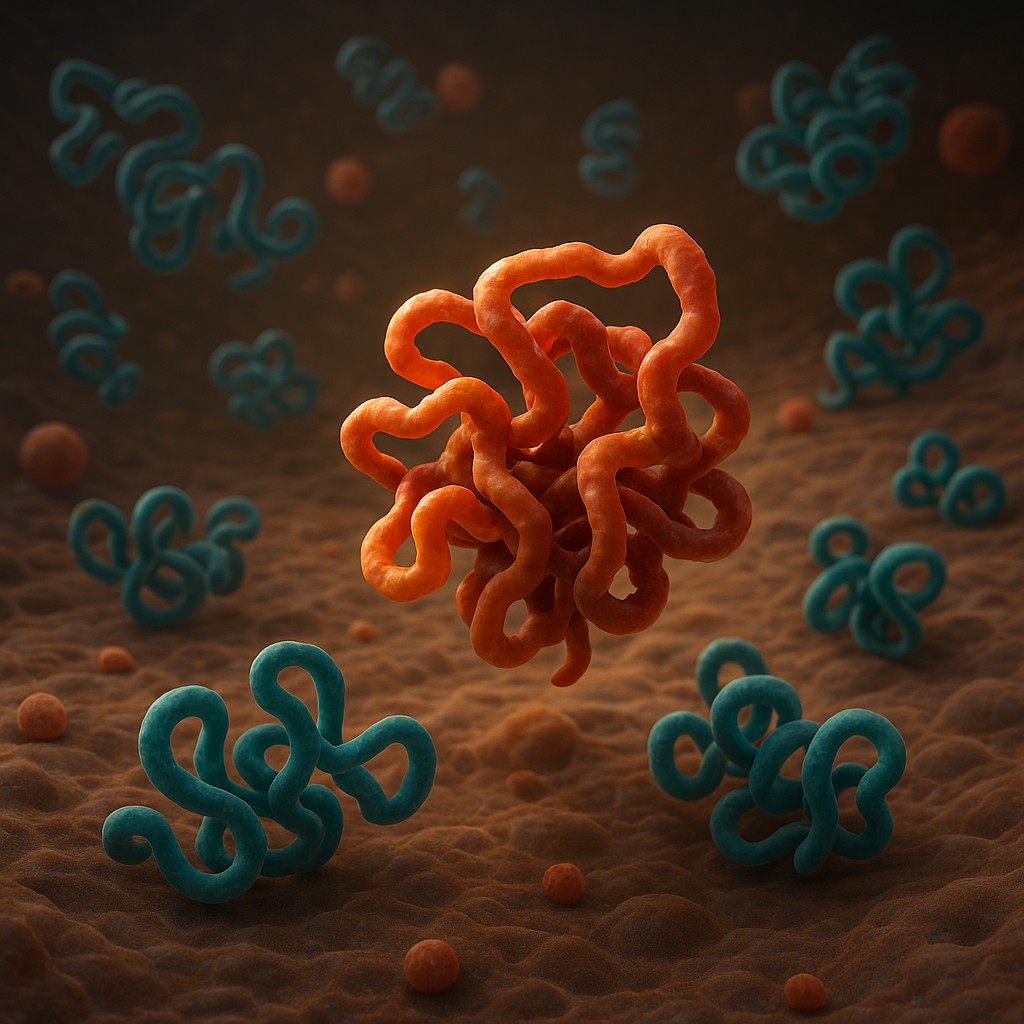
Then along came the prion. A prion is not a creature, a cell, or even a piece of genetic code. It is a protein, a single molecule that should be a harmless, functioning part of your nervous system. However, this particular protein has been folded into a "corrupted" shape. Unlike a virus that needs to replicate its genome, the prion simply exists as a template for disaster. When it encounters a healthy colleague-a normal protein with the exact same chemical makeup-it forces that healthy protein to snap into the corrupted shape as well. This creates a cascade of misfolding that spreads through the brain like a devastating rumor, turning functional tissue into a riddled, sponge-like wasteland. It is perhaps the most unsettling "zombie" story in nature, occurring at a molecular level where our standard medical defenses are almost completely useless.
The Architecture of a Molecular Traitor
To understand why a prion is so dangerous, we have to look at how proteins are made. In your body, proteins are the ultimate doers. They carry oxygen, build muscle, and facilitate the electrical signals that allow you to think. A protein’s function is entirely determined by its shape, much like how a key only works if it is cut in a specific pattern. These shapes are formed through a process called folding, where a long chain of amino acids twists into a complex three-dimensional structure. Usually, the body has "chaperone" molecules that ensure every protein folds correctly, because a "misfolded" protein is usually just broken junk that the cell’s waste management system quickly identifies and destroys.
Prions are different because their misfolded state is exceptionally stable and "contagious." The normal version of the protein, known as PrPC, is found on the surface of cells throughout the body, though it is most concentrated in the brain. Scientists still aren’t 100 percent certain what the healthy version does, though it likely plays a role in protecting nerves or signaling between cells. When this protein flips into the infectious prion form, known as PrPSc, it becomes incredibly tough and resistant to the enzymes that normally clean up cellular trash. Instead of being recycled, these corrupted proteins clump together in the brain, forming sticky plaques that eventually kill the neurons around them.
The Domino Effect of Template Misfolding
The most terrifying aspect of a prion is its method of "reproduction." Since it has no DNA, it cannot breed in any sense we understand. Instead, it uses a process called templated misfolding. Imagine you are in a room full of people wearing blue shirts, all standing in a specific, relaxed posture. Suddenly, an intruder walks in wearing a red shirt, standing with its arms locked in a rigid, aggressive pose. This intruder doesn't touch anyone or shout; it simply stands there. However, anyone who looks at the intruder feels a strange, irresistible compulsion to mimic that rigid pose and change their shirt color to red. Now you have two "red shirts." When they stand near others, the effect multiplies.
This is essentially what happens in the brain. The infectious prion (the red shirt) acts as a physical template. When it bumps into a normal protein, it provides a surface that coaxes the normal protein to unfold and re-snap into the infectious shape. This isn't a chemical reaction that consumes energy or requires a biological factory. It is a physical transformation. This creates a chain reaction where one prion becomes two, two become four, and eventually, the brain is filled with these "red shirts" that refuse to budge. Because the body doesn't recognize these as foreign invaders-they are, after all, made of the body's own amino acids-the immune system often remains tragically silent while the damage unfolds.
Why Standard Sterilization Fails
If you go to a hospital for surgery, you trust that the scalpels and tools are clean. Most pathogens are easily dispatched by an autoclave, which is essentially a high-pressure steam oven that cooks bacteria and viruses until their DNA and proteins fall apart. But prions are the "tardigrades" of the molecular world. Because they are already folded into an extremely tight, stable, and "dried out" configuration, they are incredibly resistant to heat, radiation, and even standard chemical disinfectants like alcohol or formaldehyde. In fact, some studies have shown that standard boiling or even moderate baking doesn't bother them at all.
Prions have been known to survive on metal surfaces for years, retaining their ability to infect. This has led to specialized protocols in medical settings. If a patient is suspected of having a prion disease, the surgical instruments often have to be discarded entirely or subjected to extreme chemical baths-like concentrated bleach or sodium hydroxide-combined with higher-than-normal heat for extended periods. This resilience challenges our traditional definition of "life." While the prion isn't alive, its ability to remain infectious despite harsh environmental conditions makes it more persistent than almost any living microbe.
Navigating the Spectrum of Prion Disorders
While all prion diseases follow the same misfolding logic, they arrive in humans and animals through different paths. Human prion diseases are collectively known as Transmissible Spongiform Encephalopathies (TSEs), a name that describes the sponge-like holes, or vacuoles, they leave in the brain. They are generally categorized into three types: sporadic, genetic, and acquired. The distinction is vital because it explains why these diseases are so rare and why you generally don't need to worry about catching them from a sneeze or a handshake.
| Type of Prion Disease |
Primary Cause |
Examples |
| Sporadic |
A normal protein randomly misfolds for no apparent reason. |
Sporadic Creutzfeldt-Jakob Disease (sCJD) |
| Genetic |
A mutation in the PRNP gene makes the protein more likely to misfold. |
Fatal Familial Insomnia, Gerstmann-Straussler-Scheinker |
| Acquired |
Exposure to infected tissue via food or medical procedures. |
Kuru, Variant CJD (Mad Cow), Iatrogenic CJD |
Sporadic CJD is the most common form, though "common" is a relative term as it only affects about one in a million people per year. In these cases, it seems the person simply had a stroke of terrible molecular luck. A single protein in their brain flipped into the wrong shape by sheer chance, and the domino effect began. Genetic forms are even rarer, passed down through families who carry a specific typo in their DNA that makes their PrP protein "wobbly" and prone to snapping into the wrong shape once they reach middle age.
The "acquired" category is what usually makes the headlines. This includes the infamous Mad Cow Disease (Bovine Spongiform Encephalopathy) which can jump to humans who eat contaminated beef containing nerve tissue. There is also Kuru, a disease found in the Fore people of Papua New Guinea which was spread through ritualistic cannibalism of deceased relatives. Because these diseases generally require the consumption of or direct contact with infected brain or spinal tissue, they do not spread through casual contact. You cannot catch a prion the way you catch a cold.
The Nightmare of Fatal Familial Insomnia
Perhaps the most haunting example of the prion's power is a disease called Fatal Familial Insomnia (FFI). This is a genetic prion disease that targets the thalamus, the part of the brain that acts as a switchboard for sensory information and, crucially, regulates sleep. In people with the FFI mutation, the prions begin to accumulate in the thalamus during middle age. As the tissue is destroyed, the patient loses the ability to enter deep sleep.
This isn't just common tiredness or a bad night's rest. It is a total biological lockout from the sleep state. Over several months, the lack of sleep leads to hallucinations, rapid weight loss, and dementia. Because the prions are the body's own proteins gone wrong, there is currently no way to scrub them out or stop the chain reaction once it begins. Eventually, the body simply gives out from the sheer physical toll of permanent wakefulness. FFI is an extreme reminder that your entire experience of reality, including the ability to rest, depends on a few specific proteins maintaining their proper three-dimensional geometry.
Confronting the Scientific Mystery
The existence of prions forced a massive shift in biological thinking. When Stanley Prusiner first proposed in the 1980s that an infectious agent could exist without DNA, he was met with significant skepticism, if not outright mockery. The "Central Dogma" of biology stated that information flows from DNA to RNA to protein. The idea that a protein could replicate itself by simply changing the shape of its neighbors seemed like heresy. Prusiner's eventual Nobel Prize was a testament to how much the prion challenged our fundamental understanding of life and disease.
Scientists are now looking at more common neurological disorders, such as Alzheimer's and Parkinson's, through the lens of the "prion-like" mechanism. While Alzheimer's is not infectious in the way CJD is, it involves the accumulation of misfolded proteins, specifically amyloid-beta and tau, that seem to spread through the brain by seeding other proteins to misfold. If we can figure out exactly how to stop a prion protein from recruiting its neighbors, we might unlock the key to stopping a wide range of neurodegenerative diseases that affect millions of people.
Moving Toward a Future of Protection and Cure
Despite their frightening reputation, prions are giving us a map of the brain's most secret vulnerabilities. Current research is focusing on "gene silencing," where scientists try to prevent the body from making the normal PrP protein entirely. Since you can't have a "red shirt" epidemic if no one is wearing a shirt at all, the hope is that by reducing the "fuel" (the healthy proteins), we can stop the fire (the misfolding cascade) before it spreads. Early trials in animal models have shown that organisms can survive and function quite well even without much PrP protein, which provides a glimmer of hope for future human treatments.
You should walk away from this topic feeling a sense of awe at the complexity of your own biology. Your body is a masterpiece of precision engineering, where trillions of proteins are folding into the exact right shapes every second to keep you breathing, thinking, and reading. While the prion represents a rare and village glitch in that system, it also highlights the incredible resilience of the human form. Nature is full of mysteries that defy the rules, and by studying the zombies of the protein world, we are learning more than ever about what it means to be alive, healthy, and human.