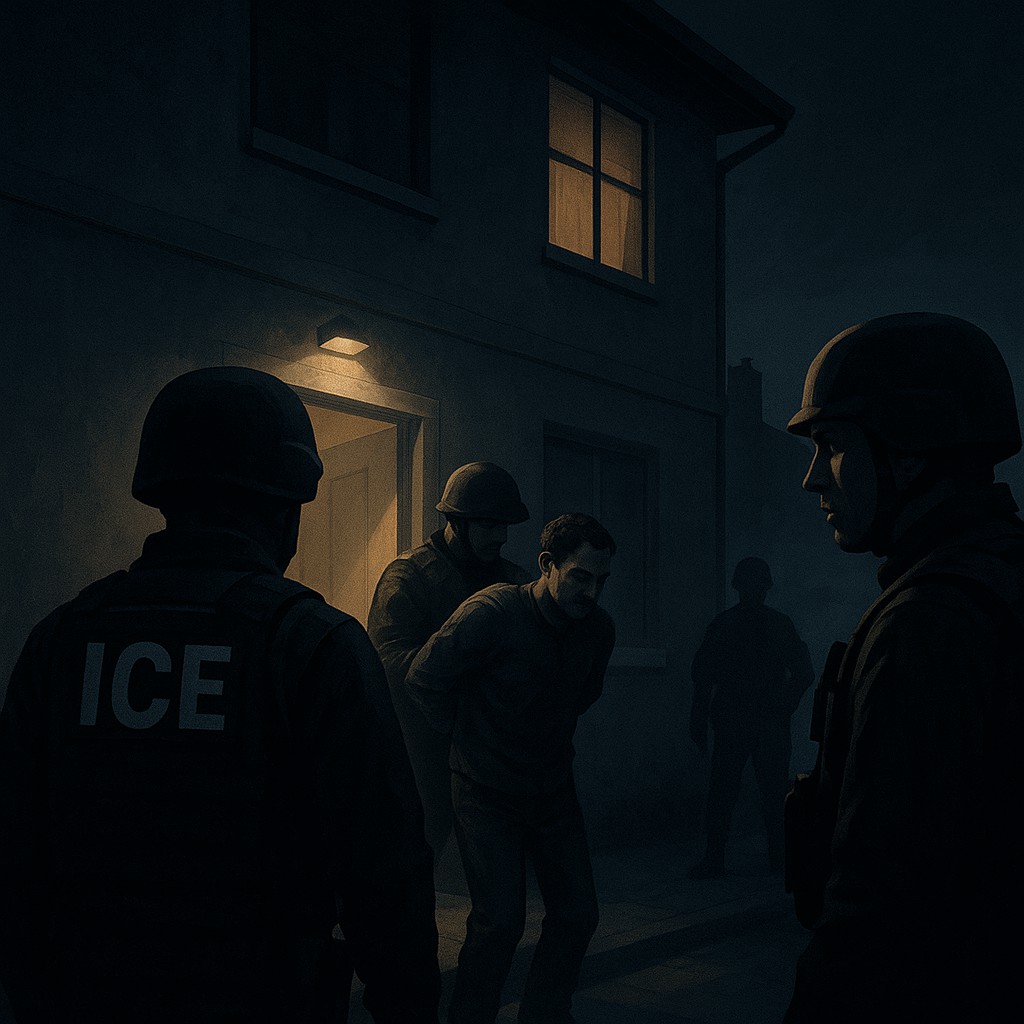
In the middle of the night, a heavy knock echoes through a quiet apartment complex. For some, this sound means safety - the arrival of help during a crisis. For millions of others in the United States today, that same sound marks the sudden and terrifying end of a life built over decades. Immigration and Customs Enforcement, better known as ICE, has evolved from a relatively obscure administrative office into the absolute center of the most heated, emotional political debate in modern American history. The air is thick with tension, fueled by nightly news reports of massive raids, armored vehicles on suburban streets, and a war of words that has reached a boiling point.
When people use the word "Gestapo" to describe a modern American law enforcement agency, they aren't just tossing out a casual insult. They are calling on the dark shadow of the Geheime Staatspolizei, the secret police of Nazi Germany, to suggest that ICE has changed from a civil service into a tool of state terror. This comparison has exploded in popularity following high-profile tactical operations in cities like Minneapolis, where the lines between immigration enforcement and combat operations seemed to blur. To understand why this is happening, we have to look closely at how ICE functions, the recent tragedies that have sparked national outrage, and the complex legal reality that keeps the agency running despite widespread condemnation.
The Birth and Evolution of the Enforcement Machine
To understand ICE today, we have to realize it is actually a relatively young organization. It wasn't handed down by the Founding Fathers but was instead born out of the chaos and fear following the September 11 attacks. Created in 2003 as part of the Department of Homeland Security, ICE was designed to merge the investigative and enforcement branches of the old immigration service with the U.S. Customs Service. The original goal was broad: stop terrorism, prevent smuggling, and manage the deportation of people who violated immigration laws. For its first decade, ICE worked mostly in the background of American life, focusing on border security and non-citizens with criminal records.
However, "mission creep" over the last several years has fundamentally changed the agency’s public image. What used to be a focus on specific individuals with serious criminal records has expanded into a wider mandate that often targets anyone without legal status, regardless of their history or how they contribute to their community. This shift from "surgical" arrests to "broad" enforcement is where the controversy begins. When an agency moves from arresting specific criminals to conducting mass sweeps in residential neighborhoods, public perception shifts. To those living in targeted communities, it stops looking like a police force and starts looking like an occupying army.
This tactical shift has come with a change in gear and tone. Today, ICE agents often deploy in "Special Response Teams" that are hard to tell apart from military units, wearing tactical vests, carrying heavy weaponry, and sometimes wearing face masks. While the Department of Homeland Security argues this equipment is necessary to keep officers safe, critics argue that the "militarized" look is intentionally meant to intimidate. This visual similarity to paramilitary groups is one of the main reasons the "Gestapo" label has gained so much traction among activists and even high-ranking politicians.
The Triggering Events of the Modern Crackdown
The heated rhetoric reached a breaking point following a series of tragic incidents in early 2026, most notably a fatal shooting during an ICE operation in Minneapolis. In this specific event, two U.S. citizens were killed during a chaotic enforcement action, an incident that sent shockwaves through the country. The Department of Homeland Security maintained that the officers were acting within their authority and responding to threats, but for many, this was the final straw. The idea that a civil agency could accidentally kill citizens while hunting for non-citizens suggested a lack of oversight and a "shoot first, ask questions later" mentality that many found unacceptable in a democracy.
Following these shootings, prominent political figures, including Minnesota Governor Tim Walz, began using much sharper language, with some explicitly drawing parallels to the Gestapo. The DHS was quick to fire back, calling such talk "dangerous" and claiming that it puts the lives of federal agents at risk. They pointed to a sharp rise in assaults on ICE officers and argued that the agency is simply following the laws passed by Congress. This back-and-forth has created a feedback loop: the more aggressive the enforcement becomes, the more radical the opposition grows, which in turn leads the agency to become even more defensive and aggressive.
The tension isn't just in the streets; it has moved into the digital and legal worlds as well. We are seeing more "cyberstalking" cases where people are being prosecuted for threatening ICE supporters or "doxing" - releasing private information - about agents online. This highlights a deeply fractured society where one side sees ICE as the last line of defense for national sovereignty and the other sees it as a rogue agency violating basic human rights. The middle ground has essentially vanished, replaced by a battlefield of polarized beliefs and very real, physical consequences for those caught in the crossfire.
Comparing Tools of State Power
When looking at the "Gestapo" comparison, it is helpful to examine the specific behaviors people are pointing to. While the historical Gestapo was a uniquely evil organization responsible for the Holocaust, the modern use of the term usually refers to certain police behaviors that bypass traditional civil liberties. Those who use the comparison point to "administrative warrants," which do not require a judge’s signature, the use of unmarked vehicles, and the practice of detaining people without letting them speak to a lawyer right away.
On the other hand, defenders of the agency note that ICE must follow federal law, is overseen by Congress, and is subject to the court system - checks and balances the Gestapo never had to deal with. They argue that the comparison is an insult to the victims of actual totalitarian regimes. To clarify the different perspectives, the following table breaks down the primary arguments used by both critics and supporters of the agency.
| Feature of Concern |
Why critics say it's "Gestapo-like" |
How the Government/DHS defends it |
| Tactical Appearance |
Using masks, heavy armor, and high-powered rifles intimidates civilians. |
Essential for officer protection in high-risk environments and unpredictable raids. |
| Warrant Process |
Use of administrative warrants signed by ICE officials rather than neutral judges. |
Standard immigration law procedure that allows for efficient processing of civil violations. |
| Broad Mandate |
Targeting "low priority" people with no criminal records alongside dangerous felons. |
The law does not grant immunity to any non-citizen; all violations must be addressed equally. |
| Community Impact |
Creating a climate of fear that keeps people from going to school, work, or hospitals. |
Fear acts as a deterrent that encourages people to leave on their own and respect border laws. |
| Intelligence Gathering |
Using facial recognition and massive databases to track people across state lines. |
Modern technology is required to find people who are actively hiding from federal authorities. |
The Legal Gray Zone and the Fourth Amendment
One of the most confusing things for the average person to grasp is how ICE can do things that "regular" police can't. If a local police officer wants to enter your home, they generally need a warrant signed by a judge based on "probable cause" - good evidence that a crime has been committed. ICE, however, often operates in a "civil" rather than "criminal" legal framework. Immigration violations are technically civil matters. This sounds less serious, but it actually gives the government certain advantages. Because it is a civil matter, the constitutional protections that apply to criminal defendants, like the right to a government-funded lawyer, don't always apply the same way.
Furthermore, there is the "100-mile border zone" rule. The Supreme Court has historically allowed federal agents much broader powers to search and seize property without warrants within 100 miles of any U.S. border or coastline. Since this zone includes about two-thirds of the American population and most major cities, ICE effectively has expanded powers in the places where most people live. This creates a "gray zone" where the Fourth Amendment protection against unreasonable searches and seizures feels much thinner than it does in the middle of the country.
This legal flexibility is exactly what makes critics so nervous. When a law enforcement agency has the power to identify, track, and detain people with less oversight from a judge than a local patrol officer, the potential for abuse increases. Even if the vast majority of agents are trying to do their jobs professionally, the system itself lacks the "checks and balances" that most Americans take for granted. This perceived lack of accountability is the fuel for the fire that leads to the "secret police" labels we see in the headlines today.
Beyond the Rhetoric: What the Future Holds
The current state of immigration enforcement in the U.S. is not a static situation; it is a rapidly evolving crisis of national identity. Recent polling shows a sharp drop in support for aggressive immigration efforts following the Minneapolis incidents, suggesting that the public's appetite for "zero tolerance" has its limits when the cost is human life and community stability. We are seeing a growing movement to "Reform ICE" or even abolish it entirely, countered by a fierce defense from those who believe any softening of enforcement is an invitation to lawlessness.
What is perhaps most certain is that the rhetoric will continue to escalate. As long as ICE operations remain high-visibility and high-impact, the comparisons to historical authoritarian regimes will persist. The tragedy of the Minneapolis shootings acted as a catalyst, turning a policy debate into a moral crusade for many Americans. Whether the agency can undergo a transformation that restores public trust, or whether it will continue down a path of increasing militarization, is the question that will define the next decade of American law enforcement.
As you follow the news and form your own opinions, remember that the "ICE vs. Gestapo" debate is about more than just immigration. It is a fundamental argument about the nature of power in a free society. It asks us how much authority we are willing to give the government in exchange for security, and what happens when that authority begins to mirror the very things we once fought against. Your understanding of these nuances makes you a more informed citizen, capable of looking past slogans to the complex human reality of the law. Keep asking questions, keep looking for the "why" behind the headlines, and never lose sight of the fact that behind every policy is a person whose life is being changed forever.