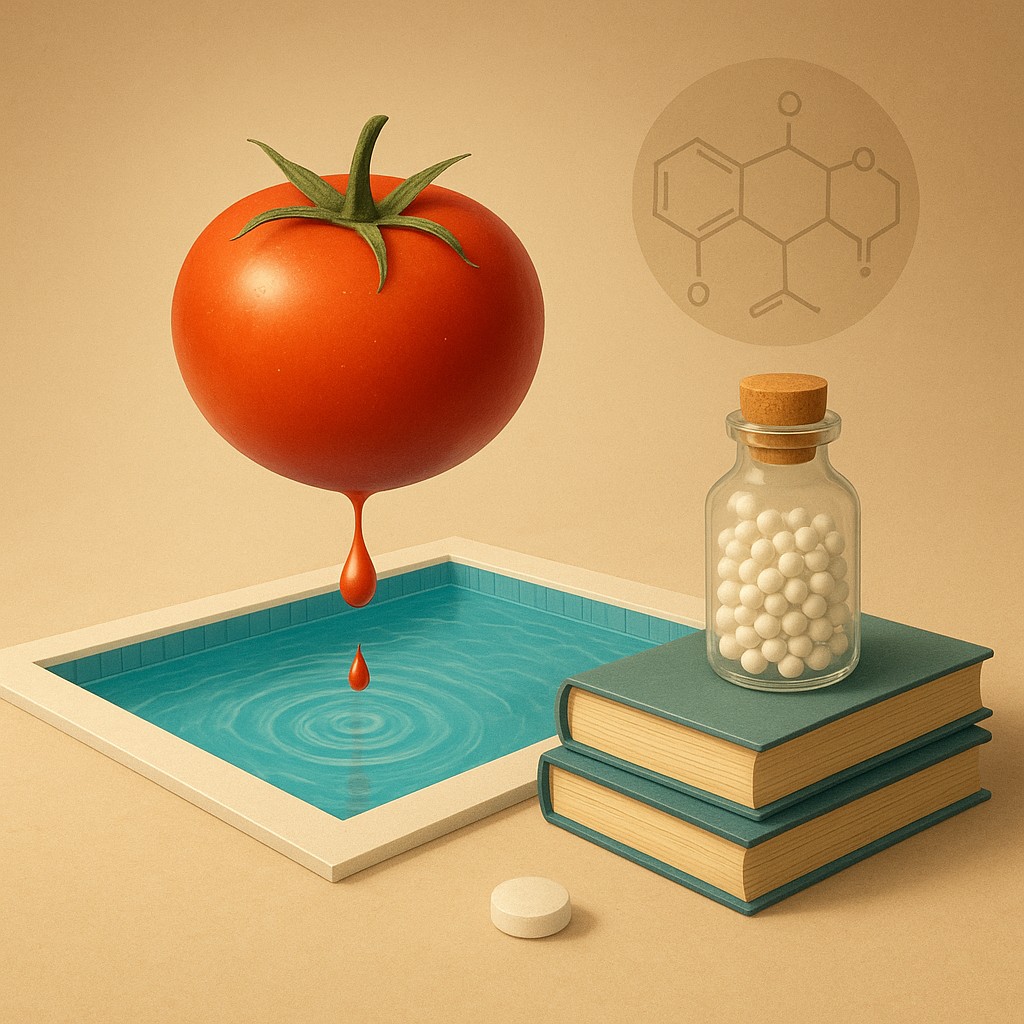
Imagine for a moment that you want to make tomato soup, but with a strange twist. Instead of putting several tomatoes into your pot, you take just one drop of juice and pour it into an Olympic-sized swimming pool. After stirring the pool water vigorously, you take a single drop of that mixture and pour it into a second Olympic pool filled with pure water. You repeat this process dozens of times until, mathematically speaking, not a single trace of the original tomato remains. According to the principles of homeopathy, this final "soup" wouldn't just taste like tomato; it would be the most potent, concentrated tomato soup you’ve ever had.
This approach seems to defy everything we know about cooking, yet it sits at the heart of a fascinating debate that has lasted over two centuries. Understanding homeopathy isn't just about looking at tiny sugar pills; it’s about exploring the boundary between modern chemistry and a worldview where invisible energy matters more than physical substance. It is a journey that takes us from late 18th-century laboratories to the aisles of our modern pharmacies, forcing us to ask how we define a medicine's effectiveness and how we tell the difference between science and belief.
The Foundations of an 18th-Century Revolutionary Idea
To understand where this practice comes from, we have to go back to the late 1700s and a German doctor named Samuel Hahnemann. At the time, conventional medicine was, frankly, terrifying. Doctors routinely used bloodletting, violent laxatives, or massive doses of mercury that often killed the patient faster than the disease. In this era of "heroic medicine," Hahnemann searched for a gentler alternative. He formulated the principle Similia Similibus Curentur, or "like cures like." He believed that a substance that causes symptoms in a healthy person could cure those same symptoms in a sick person.
However, Hahnemann soon realized that giving toxic substances in normal doses - even following his "like cures like" rule - remained dangerous. To reduce the toxicity, he began diluting his remedies more and more. This is where homeopathy took a unique turn: instead of losing its strength by being watered down, Hahnemann was convinced the substance became more powerful, provided it was shaken in a specific way. He called this process "potentization." To him, the remedy didn't work through a chemical reaction, but through a "vital force" - a kind of spiritual energy capable of interacting with the patient's soul.
This vision is based on vitalism, an old theory suggesting that living beings are powered by a non-physical force distinct from the laws of physics and chemistry. In Hahnemann’s world, illness wasn't caused by bacteria or viruses, but by an imbalance in this vital force. The homeopathic remedy, stripped of its physical matter through dilution but charged with energy through movement, was supposed to restore inner harmony. This is a fundamental departure from modern medicine, which relies on measurable interactions between molecules.
The Mathematical Ritual of Extreme Dilutions
Making a homeopathic remedy follows a strict protocol of repeated dilutions. Two scales are generally used: the decimal scale (X or D) and the centesimal scale (C or CH). To create a "1CH" solution, you take one part of the active ingredient (the mother tincture) and mix it with 99 parts of a solvent, usually water or alcohol. You then shake the bottle energetically, a step called "succussion." To get to 2CH, you take one part of that 1CH solution and mix it again with 99 parts of solvent, and so on.
The problem - or the magic, depending on your perspective - shows up very quickly. As the number in front of the "CH" goes up, the amount of the original substance drops exponentially. To visualize this, we look to Avogadro’s number, a fundamental constant in chemistry that defines the number of molecules in a specific amount of matter. Simply put, beyond a dilution of 12CH, the statistical probability of there being even a single molecule of the original substance left in the bottle is practically zero. Yet, many common remedies are sold at 30CH or higher.
| Dilution Level |
Ratio of Substance |
Visual Analogy |
| 1 CH |
1 to 100 |
One drop in a small liqueur glass. |
| 3 CH |
1 to 1,000,000 |
One drop in a large 100-liter bathtub. |
| 6 CH |
1 to 1,000,000,000,000 |
One drop in a volume of water equal to 20 Olympic pools. |
| 12 CH |
1 to 10^24 |
One drop in all the oceans on Earth combined. |
| 30 CH |
1 to 10^60 |
One drop in an ocean that would fill the entire solar system. |
At 30CH, you would need to consume a mass of sugar pills equal to several billion Earths to have a statistical chance of ingesting a single molecule of the original plant or mineral. This is why scientists often call these remedies "highly pure placebos." Supporters of homeopathy explain this through "water memory" - the idea that water retains an electromagnetic or structural imprint of a substance even after it is physically gone. However, despite many attempts, no robust study has ever proven that water has such a long-term memory.
The Common Confusion Between Herbs and Pills
It is very common to confuse homeopathy with herbal medicine (phytotherapy), but these two approaches are radically different - and almost opposite in how they work. Herbal medicine is a form of biochemistry: it uses plant extracts that contain real active ingredients, like alkaloids or terpenes. When you drink chamomile tea or take valerian capsules, specific molecules enter your bloodstream, interact with your cells, and cause a measurable biological reaction. It follows the same principle as conventional medicine, just using natural sources.
Homeopathy, on the other hand, relies on the absence of these molecules. If you buy an arnica cream in an herbal shop, you will find an actual concentration of arnica flowers in it. If you buy "Arnica 15CH" at a homeopathic pharmacy, you are buying sugar that has been sprayed with a solution where the arnica disappeared long ago through dilution. In one case, the effect depends on the dose (the more you use, the stronger it is), while in the other, the claim is that the less you have, the more powerful it becomes.
This distinction is vital for patient safety. Herbal supplements can have side effects or react poorly with other medications because they contain active chemicals. Homeopathic products, because of their extreme dilution, are generally considered physically harmless because they contain nothing but sugar and water. The risk doesn't come from the pill itself, but from relying on it alone to treat serious illnesses that require proven medical intervention.
Shaking and the Memory of the Solvent
The process of "succussion" - vigorous shaking - is what separates a simple chemical dilution from a homeopathic preparation. For Samuel Hahnemann, shaking the bottle wasn't just mechanical mixing; it was an act that "awakened" the spiritual properties of the substance. He recommended striking the bottle against a firm but elastic object, like a leather-bound Bible or a saddle pad. Without this step, the remedy would just be a useless, diluted solution. Here, we move into metaphysical explanations rather than molecular ones.
A modern idea used to try and save this concept is the theory of "nanobubbles" or changes in how water molecules bond. Some researchers have suggested that the shaking creates shockwaves that permanently reorganize the water molecules. However, physics tells us that the bonds between liquid water molecules break and reform billions of times every second. Trying to keep a stable "memory" of a substance in room-temperature water would be like trying to write a lasting message on the surface of a lake during a storm using only your finger.
Despite the lack of physical evidence, the appeal of this "energy" explanation remains strong. It adds a sense of mystery and personal care to healing that modern medicine sometimes lacks, as the latter can feel cold or mechanical. Homeopathy offers a story where the remedy is "informed" by nature and where the connection between the practitioner and the patient is central. This psychological and ritual dimension likely explains why so many people feel better after taking these remedies, even if the bottle statistically contains no active ingredients.
The Paradox of the Placebo Effect and Perception
If we follow the laws of physics and chemistry strictly, homeopathy shouldn't work any better than a sugar pill. Yet, many people swear by it. This is where one of the most fascinating phenomena in medicine comes in: the placebo effect. This isn't just "in your head"; it is a real physical response from the brain. The simple belief that you are receiving treatment, combined with a kind practitioner's attention and the ritual of taking medicine, triggers the release of endorphins and dopamine. This can reduce pain and improve your sense of well-being.
Furthermore, our minds are naturally wired to see cause-and-effect even where there is only coincidence. Many conditions people use homeopathy for - like the common cold, seasonal allergies, or fluctuating chronic pain - tend to get better on their own over time. If you take a homeopathic remedy just as your cold starts to clear up, you’ll credit the remedy, even though your immune system did all the work. This is called "regression to the mean": after symptoms peak, your health naturally returns to its normal level.
It’s also important to note the legal side of these products. In many countries, homeopathic remedies have a simplified registration status. Unlike conventional drugs, they often don't have to prove they work through rigorous clinical trials to be sold, as long as they are diluted enough to be considered harmless. This creates a gray area where a consumer might think a product has been scientifically validated for a specific illness, when it has actually only been cleared for safety - meaning it isn't toxic.
Cultivating an Informed View of Health
Learning to tell the difference between real biological actions and "energy" concepts is a vital skill in a world flooded with wellness information. By understanding that homeopathy is based on a philosophy of vital force and extreme dilution rather than biochemistry, you become a smarter healthcare consumer. This doesn’t necessarily mean rejecting every alternative care option, but it allows you to know exactly what you are putting in your body and what results are realistic to expect. Science doesn't ask for blind faith; it invites us to test, measure, and stay curious while keeping our feet on the ground.
Always hold onto that intellectual curiosity and the desire to understand the "how" behind promises of healing. Human biology is a miracle of complexity, and our ability to study molecules and their interactions has allowed us to achieve unprecedented medical breakthroughs. By staying informed and looking critically at ancient belief systems, you empower yourself to make decisions that respect both your health and the fascinating realities of physics. May you always find the balance between a welcome open mind and the scientific rigor needed to navigate toward a healthy, balanced life.