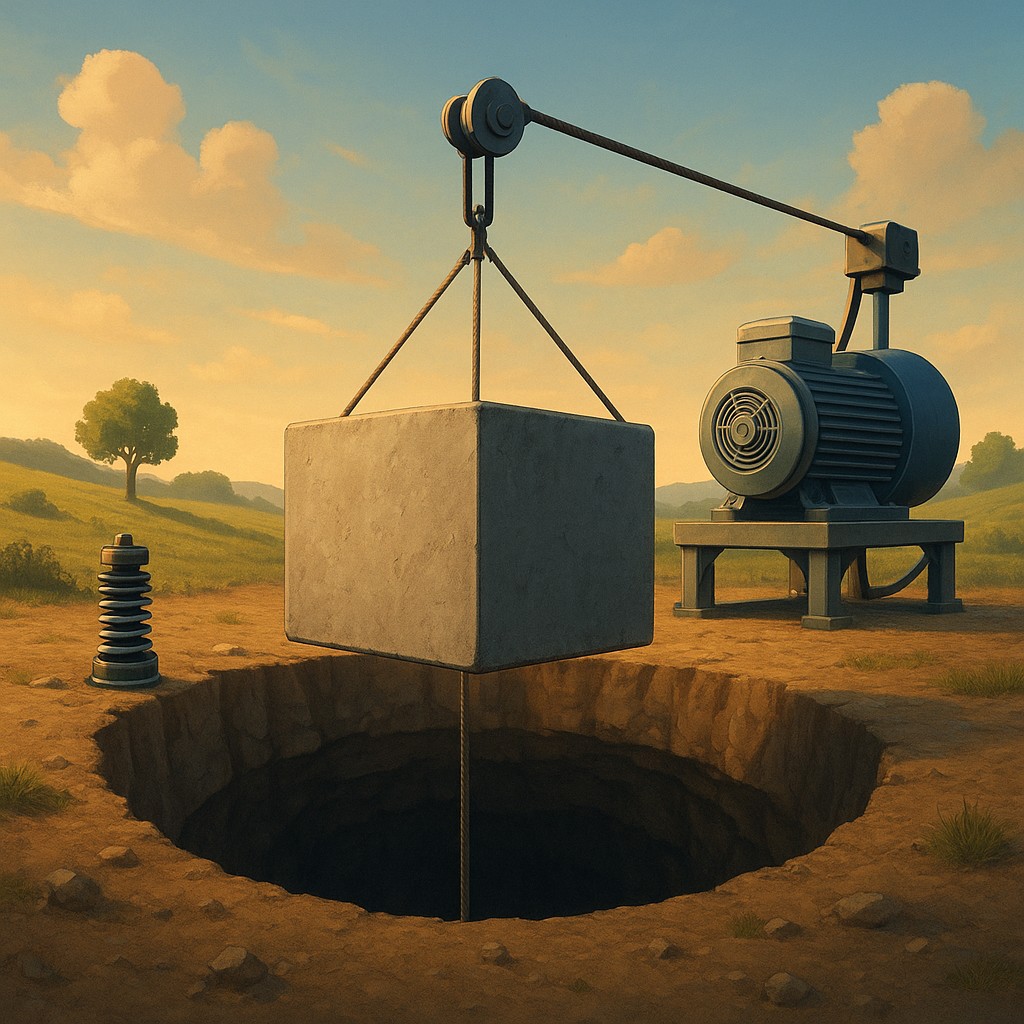
Imagine standing at the edge of a massive, dark, abandoned mine shaft in the middle of a quiet field. For decades, this hole in the ground provided minerals, acting as a site of grueling labor until the resources finally ran dry and the site fell silent. But today, something strange is happening. Instead of cranes pulling ore out of the earth, massive electric motors are hoisting thousand-ton concrete blocks toward the surface. No fuel is burning and no smoke rises into the air. This is a battery, but not the kind found in a phone or a car. It is a machine that uses the simplest, most reliable force in the universe to solve our modern energy crisis.
The problem with moving to a greener world is not a lack of power, but a lack of timing. The sun is an incredible energy source, but it has the inconvenient habit of setting every evening. Wind is powerful, but it often blows hardest while everyone is asleep and the lights are off. Because our electrical grid is a delicate balancing act where supply must perfectly match demand every second, we often have to "curtail" or throw away perfectly good renewable energy simply because we have nowhere to store it. This is where the gravity battery comes in, turning old, forgotten mine shafts into massive "jars" of preserved sunlight and wind power.
The Physics of Potential Energy
To understand how a block of concrete can act like a lithium-ion battery, we have to revisit high school physics, specifically the concept of potential energy. When you lift an object off the ground, you are doing "work" against the pull of gravity. That work doesn't just vanish; it is stored inside the object as gravitational potential energy. The higher you lift the object and the heavier it is, the more energy it holds. This is the exact same principle as a grandfather clock that uses falling weights to move its hands, only scaled up to the size of a city's power grid.
In a gravity battery system, we use extra electricity from wind turbines or solar panels to run a winch. This winch pulls a massive weight, often a block made of concrete or ultra-dense material, to the top of a vertical shaft. At this point, the energy is "stored." It can sit there for a minute, a day, or a month without losing a single drop of power. Unlike chemical batteries which slowly leak their charge over time (a tray nicknamed "self-discharge"), a block of concrete held at a height is a perfectly stable reservoir. As long as the rope doesn't break and the block doesn't fall, that energy is ready and waiting for the exact moment the sun goes down or the wind stops blowing.
When the grid needs more power during the evening rush hour, the system flips a switch. The winch becomes a generator. As the heavy block is slowly lowered back down the shaft, its weight pulls on the cable, spinning the motor in reverse. This mechanical rotation creates an electromagnetic field that pushes electrons back onto the grid. By the time the block reaches the bottom, the potential energy has been converted back into the electricity needed to run a toaster, charge a laptop, or light up the streets. It is a beautifully simple loop that avoids the complexities of chemistry in favor of the raw geometry of the Earth.
Why Chemistry Struggles with the Grid
It is tempting to ask why we do not just build more massive lithium-ion battery farms to solve this problem. After all, smartphone batteries are incredible, and electric vehicles prove that chemical storage is getting better every year. However, the requirements for a national power grid are very different from the needs of a handheld device. Chemical batteries are picky, sensitive, and a bit temperamental. They do not like being too hot or too cold, and every time you charge and discharge them, their delicate internal structures wear down just a little bit.
This wear and tear means that after a few thousand cycles, a chemical battery starts to lose its capacity. Eventually, it has to be replaced, which creates a massive recycling headache and requires the constant mining of rare metals like lithium, cobalt, and nickel. Furthermore, chemical batteries carry a risk of "thermal runaway," an engineering term for a fire that is nearly impossible to put out. While these risks are manageable for a car, scaling them up to store enough power for an entire state introduces significant safety and environmental hurdles.
| Feature |
Lithium-Ion Batteries |
Gravity Batteries |
| Lifespan |
10 to 15 years before replacement |
35 to 50 years (mechanical parts only) |
| Environmental Impact |
High (lithium/cobalt mining) |
Low (concrete, steel, or recycled soil) |
| Efficiency |
High (85-95%) |
Medium to High (75-85%) |
| Safety Risk |
Fire and chemical leaks |
Purely mechanical (cable failure) |
| Best Use Case |
Short-term, portable storage |
Long-term, grid-scale storage |
As the table shows, the gravity battery is the "tortoise" to the lithium battery's "hare." It might not be as compact or as highly efficient, but it is remarkably durable. A concrete block does not care if it is 110 degrees outside or well below freezing. It does not lose capacity if used three times a day for thirty years. Once the infrastructure is built, the operating costs are incredibly low because you are essentially just maintaining a very large elevator. This makes gravity storage a prime candidate for "long-duration" storage, the kind that keeps the lights on for days when a storm prevents the sun from shining.
Reimagining the Scars of Industry
One of the most clever aspects of the current gravity battery movement is where these systems are being built. Usually, when a mine closes, it becomes a liability for the local community. It is a scar on the landscape that requires expensive monitoring to ensure it doesn't collapse or pollute the groundwater. However, for a gravity battery engineer, a deep, pre-drilled vertical shaft is a gold mine of a different sort. Drilling a hole half a mile deep is one of the most expensive parts of any construction project. By moving into abandoned mines, engineers are essentially getting the most expensive part of their battery for free.
This approach also provides an economic lifeline to former mining towns. When a mine shuts down, the specialized electricians and mechanics often have to leave to find work elsewhere. Gravity batteries require many of the same skills, from maintaining heavy hoisting machinery to managing high-voltage electrical systems. Instead of closing these sites, we can turn them into clean energy hubs. It is a poetic form of recycling: a site that once pulled coal or iron out of the earth to power the industrial revolution is now used to stabilize a 100% renewable energy future.
However, it is not as simple as dropping a rock down a hole. Engineers have to deal with immense physical stress. If you are hanging a block that weighs as much as several blue whales from a cable, the winch system and the mounting points must be incredibly strong. There is also the challenge of depth. Because the amount of energy stored is directly related to how far the block can fall, you need a lot of vertical space to make the math work. In places without deep mines, some companies are building massive towers that look like high-tech apartment buildings filled with concrete blocks, using cranes to stack and unstack them in a giant game of energy Tetris.
The Friction of New Technology
Despite the elegance of the idea, gravity batteries face stiff competition. The "king" of energy storage is currently a system called Pumped Hydro. This works on the same gravity principle, but instead of concrete blocks, it uses water. When there is extra power, water is pumped uphill to a reservoir. When power is needed, the water flows back down through a turbine to generate electricity. Pumped hydro accounts for over 90% of the world's current grid storage because it is simple and uses a very cheap material: water. But pumped hydro requires specific geography; you need two big hills and a large amount of water, which is hard to find in a desert or a flat plain.
Gravity batteries are the flexible cousins of pumped hydro. They can be built anywhere you can find a deep hole or space for a tower. The main hurdle they face today is the "cost per kilowatt-hour." Right now, the price of lithium-ion batteries is falling so fast that it is hard for mechanical systems to keep up. Gravity battery startups have to prove that their systems are not just "cool" or "safe," but that they are cheaper over a forty-year lifespan than a mountain of chemical batteries. They have to account for friction in the cables, wear on the gears, and the sheer logistics of moving massive weights without creating a small earthquake every time a block hits the bottom.
There is also a fascinating "hybrid" approach being tested that uses the pressure of the earth itself. Some companies are looking at "geomechanical" storage, where they pump water into underground rock layers, lifting the earth above them slightly. When they want the energy back, the weight of the ground pushes the water back out through a turbine. Whether we are lifting blocks in mines, stacking bricks in towers, or lifting the very ground we walk on, the central theme remains the same: we are looking for ways to use the physical weight of the planet to balance our digital lives.
A Future Held in the Balance
The next time you look at a wind turbine or a solar panel, stop thinking of them as just "energy makers" and start seeing them as part of a giant, global puppet show. Our future power grid will likely be a complex symphony of different technologies working together. We will use lithium batteries for our cars and to handle quick spikes in power demand. We will use green hydrogen for heavy shipping and industry. But for the steady, reliable heartbeat of the city, we will likely look to the heavy, silent blocks hanging in the dark depths of old mines.
Gravity storage reminds us that even as we push into the advanced frontiers of quantum computing and artificial intelligence, we are still bound by the basic rules discovered by people like Isaac Newton. We are learning to dance with gravity, using it as a massive, invisible spring that holds our progress steady. The transition to clean energy is not just about inventing new things; it is about finding new ways to use the oldest, most reliable forces in existence. By turning the relics of our industrial past into the batteries of our future, we are ensuring that the energy we harvest today will be there to light our way tomorrow.