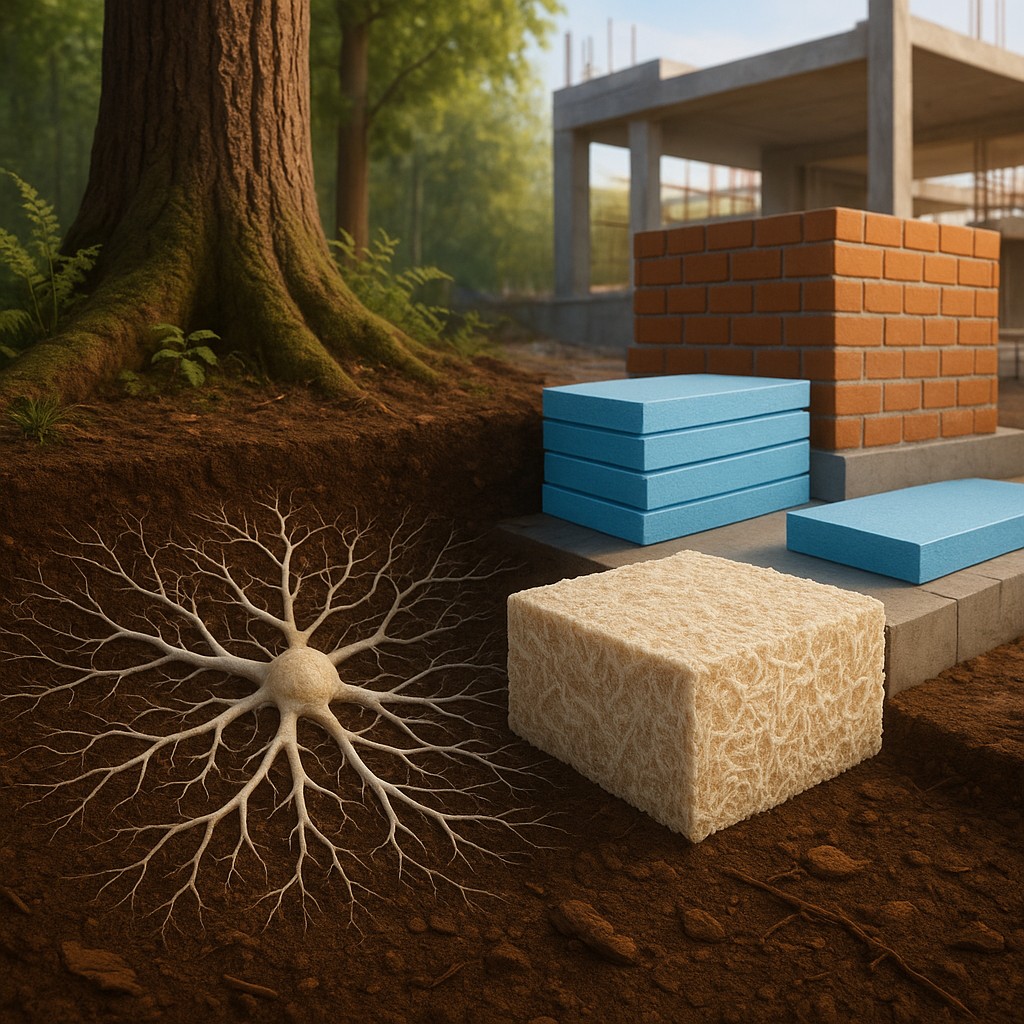
Picture yourself in the middle of a busy construction site. You are surrounded by the smell of wet concrete, the scream of power saws, and stacks of bright blue or white foam boards. These synthetic insulators are the hidden lungs of our buildings, keeping us warm in winter and cool in summer. However, these materials have a dark side we rarely discuss. They are essentially solidified oil, made through energy-heavy chemical processes that pump carbon into the air. To make matters worse, if a fire breaks out, these foams can become high-speed lanes for flames, melting and releasing toxic fumes before anyone can even reach for an extinguisher.
Now, shift your focus from the factory to the quiet, damp floor of an ancient forest. Beneath the soil, a silent and incredibly skilled architect is at work. This architect is mycelium, the root-like network of fungi that stretches for miles under the earth. While we usually only notice a mushroom popping up after a rainstorm, the real magic happens underground. There, tiny white threads weave together to create a material that is as strong as it is sustainable. Scientists and engineers are now realizing that by partnering with this humble fungus, we can literally grow our houses out of thin air and farm waste. It is a future where buildings act more like trees than like polluters.
The Secret Architecture of the Underground Web
To understand why mushroom roots are better at insulating a home than a million-dollar chemical compound, we have to look at them under a microscope. Mycelium is made of a vast web of tiny filaments called hyphae. These threads are not just random fluff; they are nature’s 3D printers. In the wild, mycelium acts as a master recycler, breaking down fallen logs and dead leaves to turn them into soil. When we use this power for construction, we give the fungus "feedstock," which is usually just leftover agricultural waste like hemp stalks, corn husks, or sawdust. The fungus treats this trash like a gourmet meal, knitting the loose fibers into a solid, incredibly dense mat.
The secret ingredient that makes this mat so special is chitin. This is the same tough, fibrous substance that forms the shells of crabs, lobsters, and beetles. As the mycelium grows through its food source, it fills in air gaps with a network of chitin-rich fibers. The result is a composite material that is lightweight, porous, and surprisingly durable. Because it is filled with tiny air pockets trapped within the chitin web, it creates a powerful barrier against heat. This is exactly what insulation is supposed to do: stop heat from moving from one side of a wall to the other. By using a living organism to knit these structures, we get a high-performance material that didn't require a single drop of oil to create.
Turning Agricultural Waste into Fireproof Armor
One of the most terrifying things about modern building materials is how they react to fire. Most plastic-based insulation is treated with chemical flame retardants, which are often criticized for health risks and environmental damage. Even with these chemicals, plastic tends to melt and drip when it gets hot, which can spread a fire through a building in minutes. Mycelium offers a completely different solution. Because of its unique chemical makeup and high nitrogen content, mycelium does not "catch" fire in the traditional sense. Instead of melting or bursting into flames, the surface simply chars.
This charring is a brilliant natural defense. When a flame hits a mycelium brick, the outermost layer turns into a blackened crust. This crust acts as a heat shield, protecting the inner layers and preventing the heat from passing through. In lab tests, researchers have held blowtorches to mycelium panels for several minutes while the back of the panel stayed cool enough to touch. This natural fire resistance could revolutionize city safety, providing precious extra minutes for people to get out without the need for toxic chemicals. It turns out the same biological structure that helps a fungus survive in a competitive forest is perfect for protecting a suburban living room.
Comparing the Old Guard with the New Growth
When we judge any building material, we usually look at three factors: how well it stops heat, how it handles fire, and what it does to the planet. For decades, Expanded Polystyrene (EPS) and fiberglass have ruled the industry because they are cheap and effective. However, when we place them side-by-side with mycelium, the "low cost" of traditional materials starts to look like a massive debt we are leaving for future generations. Mycelium isn't just a "green" substitute; it represents a fundamental shift in how we think about making and throwing things away.
| Feature |
Conventional Plastic Foam (EPS) |
Mycelium-Bound Composites |
| Primary Source |
Oil and fossil fuels |
Farm waste and fungus spores |
| Carbon Footprint |
High (releases CO2) |
Negative (traps CO2) |
| Fire Reaction |
Melts, drips, and releases toxic smoke |
Chars and creates a heat shield |
| Production Time |
Instant (chemical expansion) |
5 to 10 days (biological growth) |
| End of Life |
Sits in a landfill for centuries |
100% biodegradable and compostable |
| Chemical Content |
Contains harsh fumes and retardants |
Naturally non-toxic and organic |
As the table shows, the main trade-off right now is production time. A chemical factory can pump out miles of plastic foam in an afternoon, whereas a fungus needs about a week to "eat" its way into a solid shape. However, this week of growth is when the magic happens for our climate. While the plastic factory is burning energy and emitting gas, the mycelium is storing carbon. It takes the carbon that plants sucked out of the air while they were growing and locks it into a solid form inside the building's walls. This turns construction from a source of pollution into a massive carbon sponge.
The Challenge of Living in a Material World
If mycelium is so incredible, you might wonder why every house on your block isn't already made of mushrooms. The main hurdle is one that all organic matter faces: water. In the forest, fungi love moisture; it helps them thrive. In a house, however, moisture is the enemy. If a mycelium insulation panel gets soaked and stays wet, it might start doing exactly what it does in the woods, it could begin to rot. It might attract other types of mold or simply break down, leaving the wall hollow and the house cold.
To solve this, researchers are developing specialized "skins" and coatings to protect the mycelium core. Some use bio-based waxes or oils to create a water-resistant barrier, while others "bake" the mycelium longer to kill the organism and change the proteins that attract water. This ensures the material stays solid and effective for decades. There is also the challenge of consistency. While a chemical plant can make every piece of plastic identical, biological growth depends on temperature, humidity, and what the fungus eats. Engineers are currently working on precision-controlled "growth chambers" that act like giant vertical farms to ensure every brick is just as strong and fireproof as the last.
Beyond the Wall and into the Future
The potential for mycelium doesn't stop at flat insulation panels. Because fungi grow into whatever shape they are given, we can use molds to create complex, flowing shapes that would be impossible or incredibly expensive to make with traditional materials. Imagine acoustic tiles that look like rolling waves, grown to fit the echoes of a concert hall, or structural columns grown as a single, seamless piece of chitin. We are moving toward a "bio-fabricated" world where we don't just take materials from nature, but work with nature to grow exactly what we need.
This shift also addresses the massive waste problem in the building industry. Currently, when a building is torn down, most of the insulation ends up in a landfill for hundreds of years. Mycelium changes the story. At the end of a building's life, the insulation can simply be broken up and mixed into the soil as nutrient-rich compost. It is the ultimate "cradle-to-cradle" system, where the waste of one generation becomes the fertilizer for the next. By embracing the fungal network, we are not just building better houses; we are joining a circular economy that mimics the efficiency of the natural world.
Embracing the Fungal Revolution
The journey from a forest floor to a skyscraper is a long one, but the steps we are taking today are nothing short of revolutionary. We are learning that the answers to our biggest environmental problems don't always require more complex machinery or more volatile chemicals. Sometimes, the solution is right beneath our feet, waiting for us to notice it. By viewing fungi as partners rather than pests, we unlock a toolkit of biological wonders that can protect our homes from fire, clean our air of carbon, and end our reliance on fossil fuels.
As you look around your own home today, think about the materials hidden behind your wallpaper and under your floorboards. The move to mycelium insulation is more than just a change in building codes; it is a shift in how we choose to live. It invites us to imagine a world where our cities are grown with intention, where our success is measured in carbon captured rather than carbon spent, and where our shelters are born from the earth and can return to it without a trace. The future of construction is breathing, growing, and incredibly resilient, and it all starts with a single spore.