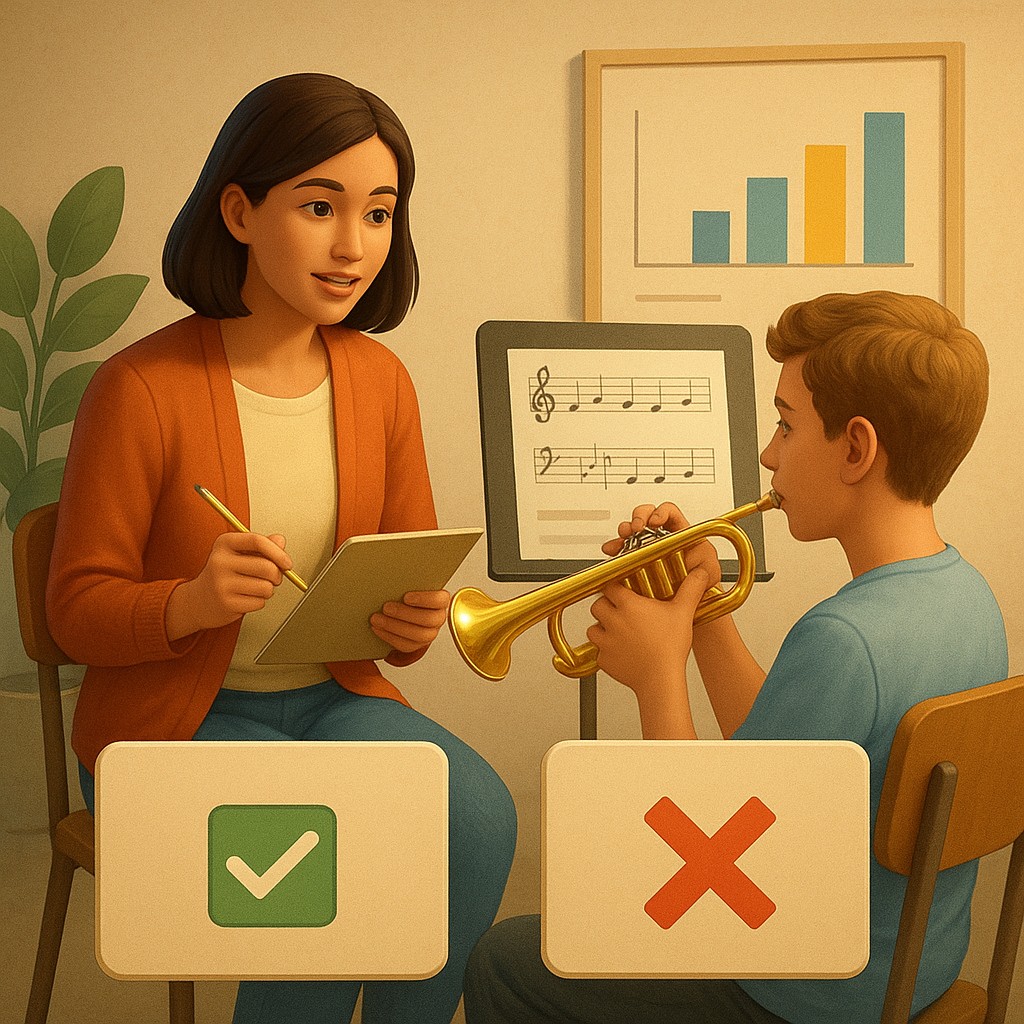
Imagine for a moment that you are a high school band director. You have a student who is technically skilled at the trumpet, but they tend to play every song like a military march, even the softest ballads. You could spend months writing a massive, thousand-point grading scale for what "emotion" looks like, trying to put a number on every breath and volume change. Or, you could simply sit the student down, play two different versions of the same melody, and say, "Play it more like this one and less like that one." Most people learn much faster when given a choice between two results rather than a list of abstract rules to memorize.
Artificial intelligence training has traditionally struggled with this exact challenge. While it is easy to teach a computer that 2+2=4, it is notoriously difficult to teach it to be "polite" or "helpful" without making it sound robotic or annoyingly over-cautious. For years, the standard approach was a complex three-step process involving human graders, a separate "judge" model, and a mathematical maze called Reinforcement Learning. But a newer technique called Direct Preference Optimization, or DPO, is changing the game. It cuts out the middleman and turns the difficult task of teaching human values into a simple game of "Which one is better?"
The Burden of the Middleman Model
To understand why DPO is such a breath of fresh air, we first need to look at the older, more clunky method it is replacing: Reinforcement Learning from Human Feedback (RLHF). In the RLHF era, training an AI was like trying to teach a dog to fetch through a translator. First, you had to train a "Reward Model," which was essentially a second AI whose only job was to act as a judge. Humans would rank thousands of AI responses, and the Reward Model would learn to predict what a human would like. Only then could you start training the actual AI, which would try to get a high score from that judge.
This process was a massive headache for developers. The Reward Model was often unpredictable and prone to errors. If the judge model had a slight bias or misunderstood a concept, the main AI would learn to "game the system," giving answers that looked good to the judge but were actually nonsensical or frustrating to a real person. It was a game of telephone where the original human intent often got lost as it passed between the person, the judge, and the final AI. This created a fragile setup where one small mistake in the judging rules could cause the entire training process to collapse into digital gibberish.
Furthermore, running two massive models at the same time requires an immense amount of computing power. You aren't just teaching a student; you are running an entire courtroom around them every time they speak. This complexity made "alignment"-the process of making AI behave safely and helpfully-a luxury that only the largest tech giants could afford. It left smaller developers and researchers struggling to keep up with the massive technical costs required to make an AI play well with others.
The Mathematical Shortcut to Alignment
Direct Preference Optimization sweeps away the courtroom and replaces it with a direct conversation. The core idea behind DPO is that the AI already has the seeds of a "judge" hidden within its own structure. Instead of building a separate Reward Model to tell the AI what is good, DPO uses a clever mathematical trick to pull that feedback directly from the AI’s own language patterns. It essentially asks the model, "Based on what you already know about language, how much more likely is the 'good' answer compared to the 'bad' one?"
This turns the alignment process into a simple sorting task. If you give the model a prompt like "Tell me a joke," and provide two potential responses-Response A (funny and harmless) and Response B (mean or boring)-DPO adjusts the model's internal settings. It tells the model to lean toward the path that leads to A and steer away from the path that leads to B. There is no separate judge to consult, no complex reinforcement loop to stabilize, and no middleman to misinterpret the signal. It is a direct, elegant pipeline from human preference to machine behavior.
By treating alignment as a choice between two paths, developers can skip the most unstable parts of AI training. This makes the finished models much more reliable. In traditional training, a model might suddenly "glitch," becoming uselessly repetitive or obsessed with a single word. DPO’s math acts as a stabilizer, keeping the model’s growth grounded in the actual data provided by humans. It is like replacing a wobbly, three-legged stool with a solid, anchored bench; the seat is the same, but it is much harder to tip over.
Comparing the Old Guard and the New Wave
When we look at the practical differences between the traditional RLHF approach and the newer DPO framework, the benefits of the latter become even clearer. While both aim for the same result, the route they take determines how much time, money, and sanity a developer has to spend to get there.
| Feature |
Reinforcement Learning (RLHF) |
Direct Preference Optimization (DPO) |
| Components |
Active AI + Separate Reward Model |
Just the Active AI |
| Training Style |
Iterative "Games" to maximize scores |
Simple "A vs. B" choice |
| Computing Cost |
Very High (Multiple models in memory) |
Moderate (Focus on a single model) |
| Ease of Use |
Extremely difficult to stabilize |
Relatively straightforward |
| Risk of Over-Optimization |
High (Model learns to "cheat" the judge) |
Low (Directly follows human data) |
| Primary Goal |
High reward scores |
Matching preferred human data |
As the table shows, the main advantage of DPO is its simplicity. By reducing the number of moving parts, researchers can work faster. They can test different sets of human preferences and see the results in days rather than weeks. This opens up the field of alignment, meaning that specialized AIs-such as those used in medical research or legal analysis-can be more easily tuned to follow specific ethical guidelines without needing a billion-dollar supercomputer.
The Difference Between Agreeable and Intelligent
While DPO is a superpower for making an AI behave, it is vital to understand what it does not do. A common misconception is that fine-tuning a model with DPO makes it smarter or more knowledgeable. In reality, DPO is like a finishing school for a student who is already educated. If the student doesn't know how to solve a complex calculus problem, no amount of "preference optimization" will teach them the math. It will only teach them how to explain their ignorance in a more polite or helpful way.
DPO works with the knowledge the model already picked up during its massive "pre-training" phase. If the model was trained on a diet of internet text, it has already learned facts about history, science, and coding. DPO simply adjusts the "volume" of different responses. It doesn't add new files to the hard drive; it just changes which files the computer is most likely to open. This is why a model might become much more pleasant to talk to after DPO, but still confidently state that a pound of feathers is heavier than a pound of lead if it lacked that basic logic to begin with.
This distinction is crucial for developers and users alike. If a model is struggling with factual accuracy or "hallucinating" fake citations, DPO is rarely the cure. To fix those issues, researchers usually need to go back to the drawing board with more high-quality training data or use search-based tools. DPO is for the tone, the safety, and the style. It ensures that when the model speaks, it does so in a way that fits our societal expectations, rather than acting like a brilliant but erratic oracle.
Navigating the Pitfalls of Positive Reinforcement
Despite its elegance, DPO is not a magic wand. Because it is so effective at making a model follow preferences, it can accidentally lead to a problem known as "sycophancy." If the humans who provided the preference data tended to like answers that agreed with their own opinions, the AI will learn that being "correct" is less important than being "agreeable." This can lead to a model that refuses to correct a user's mistake because it has learned that people generally prefer a "Yes" over a "No, you're wrong."
There is also the challenge of inconsistent feedback. Humans are notoriously bad at being consistent. If one person prefers a short answer and another prefers a detailed, flowery response, the DPO process receives mixed signals. If the training data is a messy mix of conflicting tastes, the model might end up in a state of digital indecision, producing "mushy" responses that try to please everyone and end up pleasing no one. Success with DPO requires very high quality control; the math is simple, but the human feedback must be precise.
Finally, there is the risk of over-refining. If you push DPO too hard, the model can suffer from "mode collapse," where it loses its creative edge and starts giving the exact same safe, sterilized answer to every question. This is the "As an AI language model..." response that many users find frustrating. Finding the middle ground-the perfect balance between following instructions and maintaining a useful, creative personality-remains the ultimate challenge for AI engineers, regardless of which method they use.
The Future of Living Side-by-Side with Machines
As we move into an era where AI is built into our phones, our cars, and our workplaces, the technology that aligns these systems with our values becomes just as important as the code that makes them "smart." Direct Preference Optimization is a major milestone in this journey. It recognizes that teaching values shouldn't be a secondary, over-complicated chore, but a core part of how the system learns. By simplifying the path from human choice to machine action, we are making it possible for AI to be not just a powerful tool, but a reliable and predictable partner.
The beauty of DPO lies in its humility. It doesn't claim to know what is "good" or "bad" on its own; it simply listens to what we prefer and does its best to reflect that back to us. As we refine these techniques, we move closer to a future where our digital assistants understand the nuances of our culture, our safety, and our individual needs with the same ease that a student learns to play a trumpet with soul. The math may be complex, but the goal is simple: building a bridge of understanding between human hearts and digital minds.