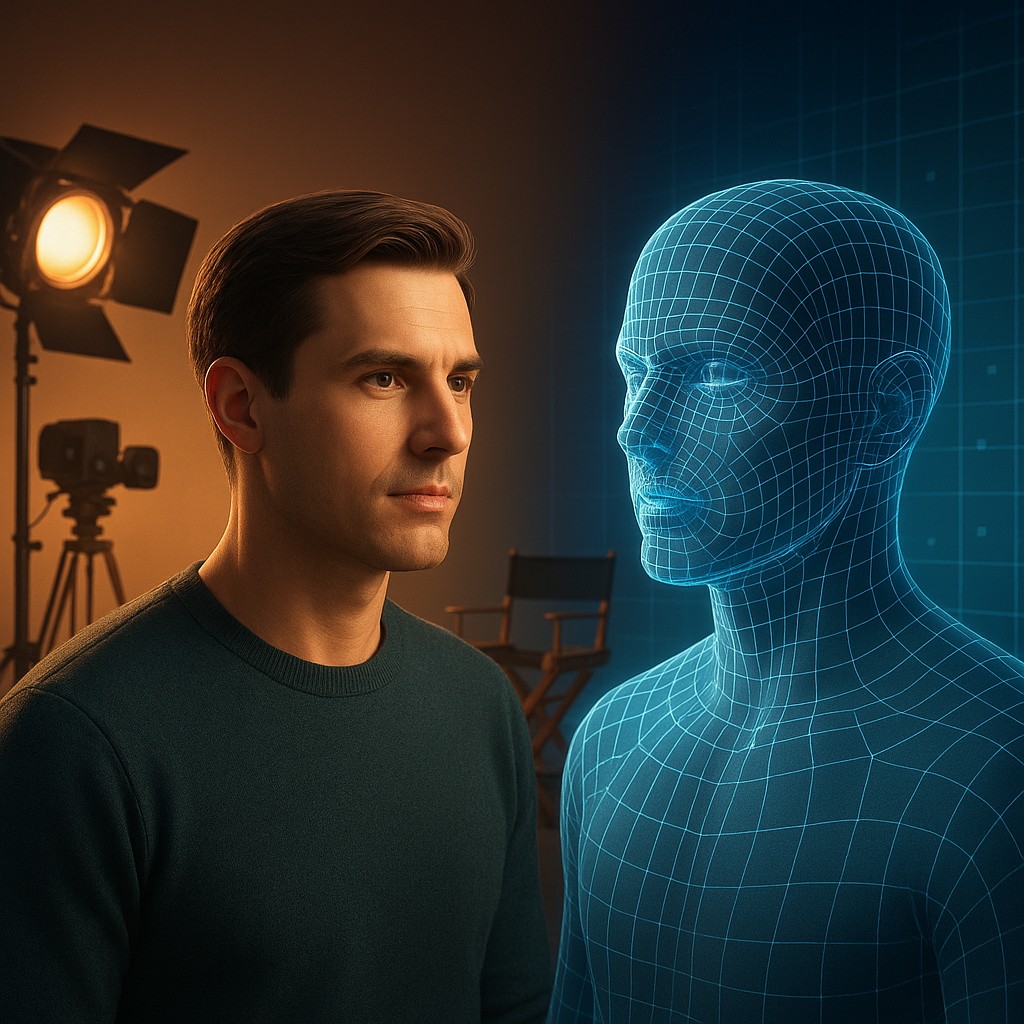
Imagine walking onto a Hollywood film set where the sun never sets, the wind always blows at the perfect speed, and the lead actor is somehow in London, Los Angeles, and on a sixteenth-century pirate ship all at once. This isn't a director’s fever dream; it is the modern reality of high-end filmmaking. For decades, the biggest challenge in cinema hasn't been the acting or the script, but the light. Light is stubborn. It bounces off surfaces, soaks into skin, and changes color every minute as the sun moves across the sky. When a director tries to blend a scene filmed in a studio with a background generated by a computer, the tiniest mismatch in how light hits a chin or a forehead gives the trick away instantly, breaking the audience's immersion.
To bridge this gap, the industry has adopted a concept from aerospace and manufacturing: the digital twin. A digital twin is more than just a 3-D model; it is a mathematically precise replica of an actor’s physical traits. It maps everything from how skin pores trap light to the specific way muscles move under the surface. By creating these virtual clones, studios can solve lighting problems before a single camera starts rolling. This shift moves the craft of cinematography away from the physical set and into the world of data science and predictive physics.
The Physics of Skin and the Problem of Consistent Light
To understand why digital twins are necessary, we have to look at the sheer complexity of human skin. Skin isn't just a flat surface like a piece of paper; it is translucent. When light hits your face, it doesn't just bounce off the top layer. It sinks in slightly, scatters through layers of tissue and blood vessels, and then exits at a different spot. This effect, called subsurface scattering, is what gives humans their healthy "glow." If a digital scene has a bright orange explosion on the left, but the actor was filmed under static white studio lights, the human eye notices that the orange glow isn't "sinking" into the skin correctly. The brain signals that something is fake, even if you can’t quite explain why.
By creating a digital twin, cinematographers can run simulations. They take a high-quality scan of the actor and place it into a virtual engine, such as Unreal Engine or Unity, which mimics the laws of physics. They then place virtual lights from the digital world around the virtual actor. This allows the crew to see exactly where the shadows should fall and what color the reflections should be on the actor's cheeks. When it is time to film the real person, lighting technicians adjust physical LED panels on set to match the virtual simulation with millimeter precision. This ensures that the digital world and the physical actor are bathed in the exact same mathematical "truth" of light.
From Photo Mapping to Light Fields
The journey of creating a digital twin begins in a specialized rig that looks like something out of a science fiction movie. Most of these systems use LightStage technology. The actor sits in the center of a giant dome lined with thousands of precisely controlled LED lights and dozens of high-speed cameras. Instead of just taking a "picture," the system captures the actor’s face under every possible lighting direction in seconds. This process doesn't just record the shape of the face; it captures the "reflectance field," which is essentially a map showing how the face reacts to light from every possible angle.
Once this data is captured, it is processed into a high-density mesh. While a standard video game character might be made of a few thousand polygons (the flat shapes that make up a 3-D model), a film-grade digital twin has millions. This level of detail is necessary to capture "micro-geometry," such as the tiny wrinkles that appear during a smile or the specific texture of individual pores. This data is then "rigged," meaning a digital skeleton and muscle system are attached to the scan. This allows the digital twin to mimic the actor's performance perfectly, providing a guide for how light should shift as the actor speaks or moves.
Navigating the Virtual Production Workflow
The use of digital twins has created a new era called virtual production. In the past, "fix it in post" was the mantra of frustrated directors. They would film the actor first and then spend months trying to make the digital backgrounds match. Today, the digital twin allows for a "pre-visualization" phase that is so accurate it serves as a roadmap for the entire shoot. Because the studio already has the actor’s digital double, they can build the entire scene virtually months before the actor arrives. This saves millions of dollars because the trial and error happens in a computer rather than on a set with hundreds of paid crew members waiting.
| Feature |
Traditional Live Action |
Virtual Production with Digital Twins |
| Lighting Strategy |
Manual adjustments on set; hoping it matches the CGI later. |
Pre-simulated in a physics engine; matched physically on set. |
| Actor’s Presence |
Must be physically present for all lighting tests. |
Digital twin used for testing; actor only arrives for final takes. |
| Backgrounds |
Green screens that leak unwanted color onto actors. |
LED "Volumes" (screens) that project the environment onto the actor. |
| Post-Production |
Months of "rotoscoping" (tracing frames) to fix mismatches. |
Near-instant blending because the light was correct from the start. |
| Flexibility |
Limited by the physical location and the time of day. |
Infinite; the digital twin can be relit for any time of day instantly. |
The Ethical and Legal Frontier of the Digital Persona
The rise of the digital twin is more than a technical win; it is an ethical and legal powder keg. When a studio creates a high-quality 3-D scan of an actor, who owns those gigabytes of data? In the past, an actor was paid for their time on set. If they weren't there, they weren't being used. But a digital twin can be repurposed. It can perform stunts that are too dangerous for a human or "de-age" a performer for a flashback. It could even be used to keep an actor "working" long after they have retired or passed away. This has led to intense negotiations between labor unions like SAG-AFTRA and major studios.
The heart of the debate is "informed consent" and "pay." Actors are now asking for "digital rights" in their contracts. These clauses lay out exactly how a digital twin can be used, for how long, and whether the actor (or their estate) gets a performance fee even if the real person never stepped onto a soundstage. There is also the fear of digital identity theft. If a studio owns a perfect digital replica of a famous face, what happens if that data is leaked or used in a way the actor dislikes? These are not hypothetical questions; they are the active battlegrounds of the 2025 entertainment industry.
Correcting Myths about the "Death of the Actor"
One common mistake is thinking digital twins are meant to replace actors entirely. While the technology can create a computer-generated performance, the real goal is the opposite: to improve the human element. Directors find that the more realistic the lighting and environment are, the better the actor performs. If an actor stands in a green room with a piece of tape on a pole as a co-star, the performance often feels flat. However, if they stand in a "Volume" (a room made of LED screens) where the lighting perfectly matches their digital twin's data, they can actually see the world they are supposed to be in.
Another myth is that digital twins make filmmaking "easy." In reality, it just swaps one type of work for another. While it cuts down time on a physical set, it requires a massive army of technical artists, light physicists, and data engineers. The "digital cinematographer" is a new role in the industry, requiring someone who understands both the artistic soul of a lens and the cold logic of a computer algorithm. The "soul" of the movie still comes from the human director and the human actor; the digital twin is simply a sophisticated paintbrush that ensures the light of the story shines clearly.
The Future of Living Archives and Interactive Media
Looking beyond the movie theater, digital twin technology will likely change our everyday lives and how we interact with history. Imagine a museum where you can sit across from a digital twin of a historical figure, lit by the same afternoon sun that hit them in 1945. Consider the future of gaming, where characters aren't just inspired by celebrities but are mathematically identical replicas that react to the lighting in your own living room through augmented reality. The technology developed to make a superhero's cape glow is the same technology that will eventually allow us to preserve the human likeness with startling permanence.
As we move forward, the line between the real world and the computer-generated world will continue to blur until it essentially disappears. We are entering an era where reality is no longer fixed, but programmable. By mastering the physics of light through digital twins, we haven't just made movies look better; we have gained the ability to capture the essence of human presence and recreate it anywhere, at any time. This change invites us to appreciate the incredible complexity of our own bodies and the magical way a simple particle of light interacts with a human face to tell a story. In this new digital age, the light will always be perfect, and the performance will never have to end.