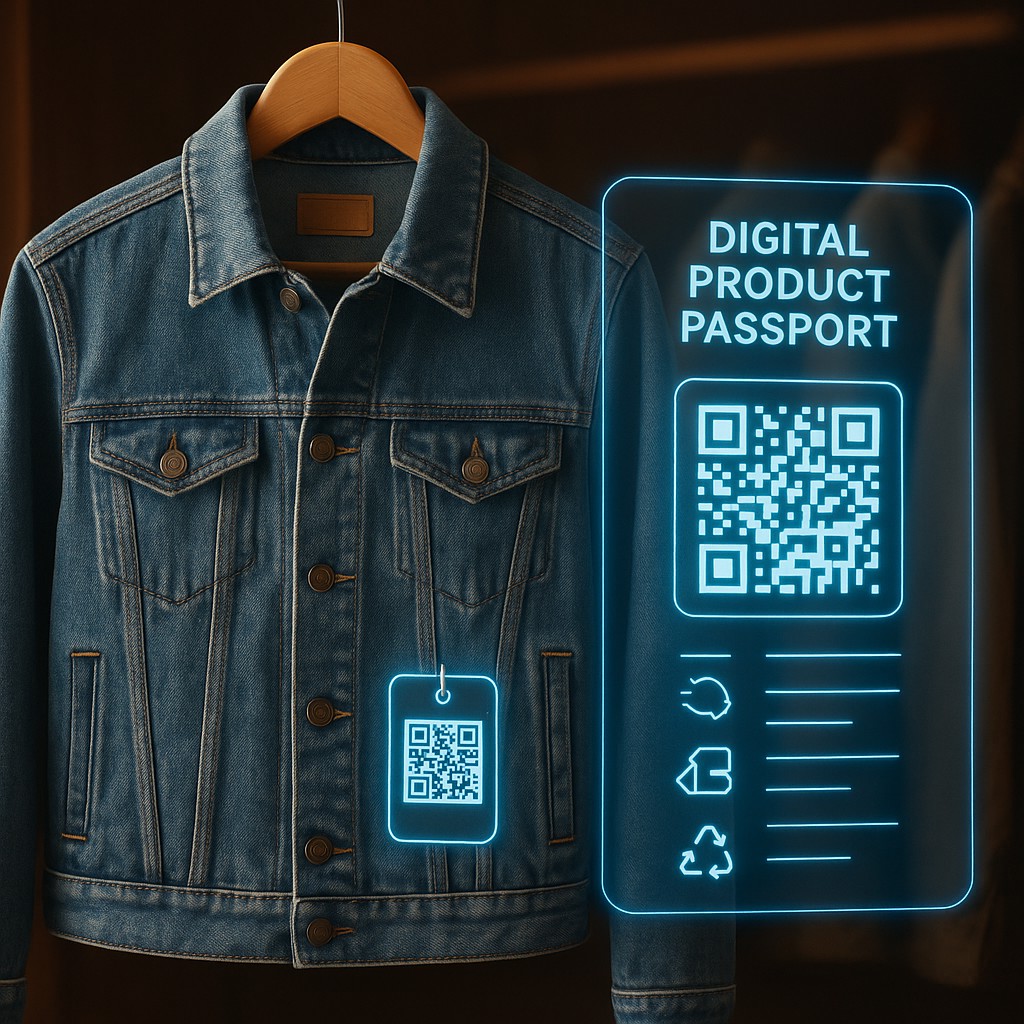
Imagine standing in front of your closet and realizing that every single item hanging there has a secret life story it is itching to tell you. That vintage-style denim jacket might look like a simple piece of rugged cotton, but it carries a hidden history involving high-pressure dye vats in Turkey, organic cotton fields in India, and perhaps a brief three-month stint with a previous owner in Berlin who decided the sleeves were just an inch too short. For decades, the fashion industry has operated in a "don't ask, don't tell" fog. A simple polyester blend label was often the only clue we had about a garment’s journey from the earth to our shoulders. We bought things, wore them until they frayed, and then tossed them into a metaphorical black hole, hoping they might end up somewhere useful despite having no data to guide their rebirth.
That fog is finally lifting as a new era of radical transparency arrives in the form of the Digital Product Passport (DPP). This isn't just another shiny QR code leading to a generic marketing video about "eco-friendly vibes." Instead, it is a sophisticated, encrypted ledger that acts as a physical item's digital twin, recording every repair, every chemical treatment, and every change of hands. By merging the physical world of textiles with the unchangeable security of digital tracking, we are moving away from a disposable culture. We are headed toward a circular economy, where products are treated more like valuable assets than temporary snacks. This shift forces us to rethink what it means to "own" something, turning a one-time transaction into a long-term relationship with the objects in our lives.
The Architecture of a Truth Machine
At its most basic level, a Digital Product Passport functions as a verifiable paper trail that lives in the cloud but is anchored to a physical tag. Manufacturers embed these tags in various ways. They can range from standard QR codes to sophisticated NFC (Near-Field Communication) chips - small wireless transmitters - sewn into the hem, or encrypted RFID tags woven directly into the fabric. When you scan this tag with a smartphone, you aren't just seeing a website; you are accessing a secure database that pulls together information from every stage of the supply chain. This includes where the raw materials came from, the specific factories involved in weaving and assembly, and even the exact chemical makeup of the dyes used to get that specific shade of midnight blue.
This system is designed specifically to dismantle "greenwashing," a deceptive practice where companies make misleading environmental claims to win over conscious consumers. In the past, a brand could claim a sweater was "made with recycled materials" while providing almost zero evidence. With a DPP, those claims must be backed by data entries that are often time-stamped and verified by outside auditors. If a brand claims a garment was refurbished, the passport would ideally show the date of the repair and the specific facility that did the work. This creates a high-stakes environment for manufacturers where honesty is no longer an optional marketing strategy, but a technical requirement.
The beauty of this system lies in its ability to solve the problem of "information imbalance." In traditional markets, the seller knows everything about the product while the buyer knows very little. By opening up access to this data, the DPP empowers consumers to make decisions based on reality rather than perception. If you see two identical shirts, but one has a passport showing it was produced in a facility that recycles its water and the other shows a history of chemical runoff, the choice becomes much easier. This isn't just about feeling good; it's about holding the entire global supply chain accountable to a set of visible, trackable standards.
From Linear Consumption to Circular Mastery
To understand why this matters, we have to look at the "Take-Make-Waste" model that has dominated fashion since the Industrial Revolution. In this linear system, resources are extracted, products are used briefly, and then they are buried in landfills where they take centuries to rot. The Digital Product Passport acts as the vital infrastructure for the "Circular Economy," which seeks to keep materials in use for as long as possible. Without a passport, a recycler at the end of a piece of clothing's life has no idea if a shirt is 100% cotton or a blend of five different plastics. This uncertainty makes recycling expensive and inefficient, often leading to "downcycling," where high-quality textiles are turned into low-value items like insulation or rags.
With a DPP, the recycler becomes a precision operator. They scan the tag and instantly see the "material health" of the garment. They know exactly which fibers can be recovered and which chemicals need to be neutralized. Furthermore, this data helps the resale market thrive. Imagine buying a pre-owned luxury handbag. Instead of relying on a sketchy "certificate of authenticity" that could easily be forged, you scan the chip and see the entire ownership history and repair record. This increases the resale value of high-quality goods because the digital twin proves the item's origin and care.
| Feature |
The Old Status Quo (Linear) |
The DPP Future (Circular) |
| Material Origin |
Vague "Made in.." labels |
Verified fiber source and farm location |
| Repair History |
Unknown and unrecorded |
Logged events at authorized repair shops |
| Chemical Safety |
Blind trust in brand claims |
Transparent list of dye and finish ingredients |
| Recyclability |
Guesswork based on physical feel |
Precise material breakdown for fiber recovery |
| Ownership |
Transactional and anonymous |
Documented lifecycle with authenticated resale |
The Tension Between Transparency and Privacy
While the benefits for the planet are immense, Digital Product Passports introduce a complex ethical tug-of-war regarding the data of the people who make our clothes. To achieve true transparency, a passport should ideally show the working conditions of garment workers. However, in an age of digital surveillance, how do we track the "who" and "where" without infringing on the privacy of individuals in the supply chain? If a passport records every step in a factory, there is a risk that this data could be used to monitor worker productivity in ways that are intrusive or even harmful, especially in regions with weak labor protections.
This creates a "transparency paradox." We want to know that the person who sewed our shirt was treated fairly, but we don't want to turn their workplace into a digital fishbowl. Balancing these concerns requires careful data management. The industry is currently exploring "aggregated data" solutions, where the passport confirms that labor standards were met at a specific facility without revealing the identities or specific movements of individual workers. It is a reminder that while technology can solve environmental problems, it must be used with a human-centric focus to ensure we aren't trading ecological health for social exploitation.
Furthermore, there is the question of consumer privacy. If your jacket has an encrypted tag that tracks its history, does that tag also track you? Most DPP designs are "passive," meaning they only send data when someone intentionally scans them from a few inches away. However, the theoretical possibility of location tracking or consumer profiling lingers in the back of many minds. Ensuring that these passports focus on the product's journey rather than the owner's behavior is essential for widespread use. The goal is to create a biography for the object, not a surveillance log for the person wearing it.
The Mechanics of Trust in a Global Market
The shift toward Digital Product Passports is largely being fueled by new regulations, such as the European Union's Ecodesign for Sustainable Products Regulation (ESPR). These laws are moving toward a reality where a product cannot enter the market unless it comes with a compliant digital passport. This is a massive logistical challenge, but it also creates a standardized language for trust. When every brand has to play by the same rules, the "race to the bottom" in quality and ethics becomes much harder to win. Brands that have invested in durable, repairable goods suddenly find themselves at a competitive advantage because their passports prove their quality.
Think of it like the "Nutrition Facts" label on food. Before those were mandatory, companies could make all sorts of wild health claims with no consequences. Once the label became standard, it changed the way companies made their products and the way consumers shopped. The DPP is the "Nutrition Facts" label for every physical object we own. It changes the psychology of the purchase. Instead of seeing a $50 shirt as a fleeting impulse buy, you see it as a blend of materials that will one day need to be returned to the soil or spun into a new garment. It encourages us to think in decades rather than seasons.
This level of detail also opens up new business models. Instead of just selling you a jacket and saying goodbye, a brand can use the DPP to offer "Product-as-a-Service." They might offer free repairs for the life of the garment, with every repair logged in the passport to maintain the item's value. Or they might offer a buy-back program where they take the item back once you're done with it, using the passport data to make the refurbishing process easier. The passport turns the brand from a mere seller into a long-term guardian of the resources they have put into the world.
A New Story for the Things We Carry
We are entering a period where the "soul" of an object is no longer a poetic metaphor, but a set of verifiable facts. This transformation invites us to become more than just consumers; it invites us to become caretakers of a more responsible world. When you can see the effort, the chemistry, and the craftsmanship that went into a single piece of cloth, you naturally treat that cloth with more respect. You might choose to patch an elbow rather than buy a replacement, knowing that your repair will be part of that garment's permanent digital legacy.
As these encrypted tags become as common as laundry care labels, the mystery of the supply chain will slowly evaporate. We will find ourselves living in a world where we can finally trust the things we touch, knowing they weren't produced in the shadows at the expense of the environment. This is the ultimate promise of the Digital Product Passport: it restores the connection between the maker and the user, ensuring that every garment tells a story of integrity. So, the next time you pick up a piece of clothing, look for that hidden tag. It’s not just a piece of tech; it’s a commitment to a future where we value the journey just as much as the destination.