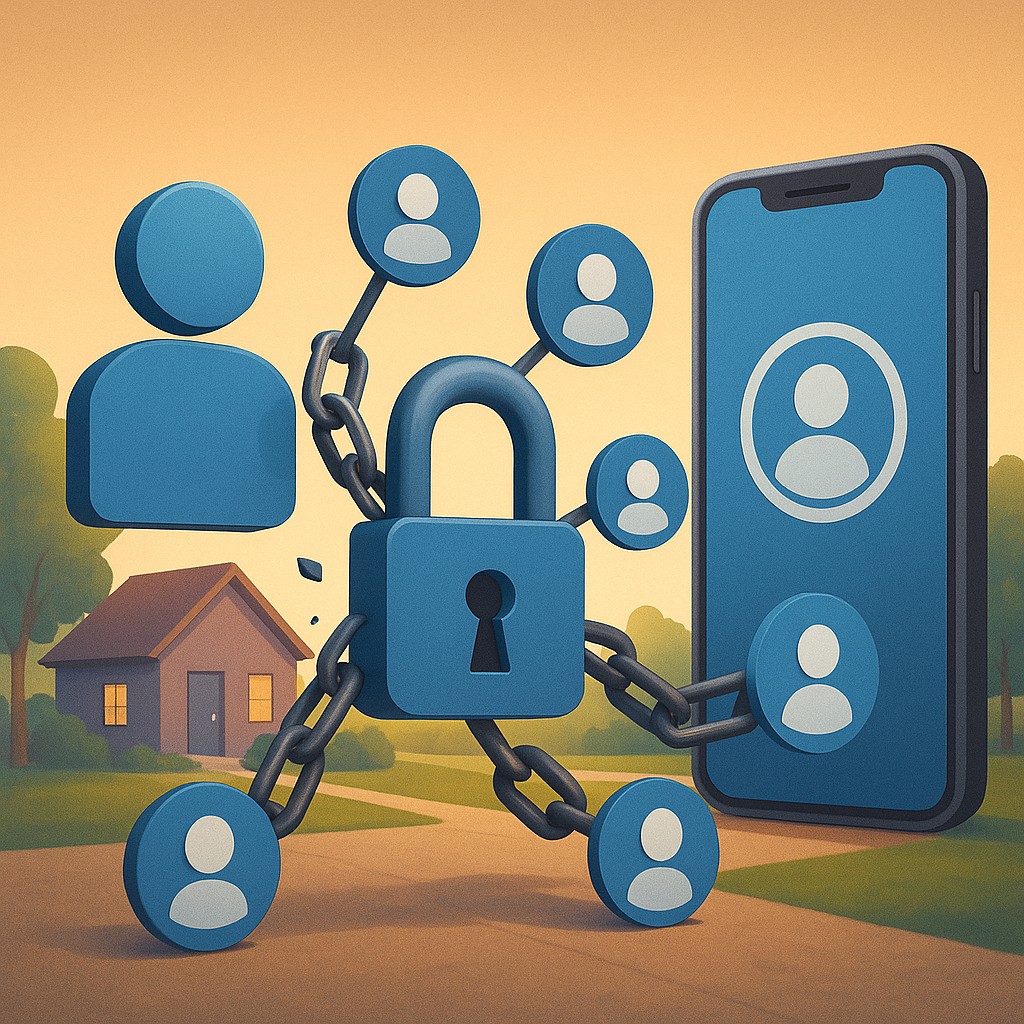
Imagine you decide to move from an urban apartment to a quiet house in the suburbs. In the physical world, your friends do not vanish just because you changed your mailing address. You simply send a text or share your new location, and the relationship continues regardless of your neighborhood. However, in the digital world of social media, we have lived under a strangely restrictive lease. If you no longer like the rules, the interface, or the owners of a specific platform, you cannot simply pack up your "neighborhood" and leave. To move to a new app, you have to abandon your followers, your history, and your connections, essentially starting your social life from scratch.
This digital barrier is known as "social graph lock-in." For decades, the "social graph" - the map of who you are and everyone you interact with - has been the private property of tech giants. They guard this data because it acts as their "moat," the primary reason you stay on their platform even when you are unhappy with the service. But a quiet revolution is underway through decentralized social protocols. These systems are testing a future where your social network is a portable asset that belongs to you, much like your phone number or email address, rather than the company providing the screen.
Breaking the Chains of Digital Feudalism
To understand why this shift is so radical, we have to look at the current "feudal" model of the internet. In this setup, platforms act like lords who own the land (the servers) and the people (the data). You are a digital tenant. If the lord decides to raise the rent, hide your posts behind an algorithm, or ban you for an arbitrary reason, you lose your digital community. This "walled garden" approach means that if you have 10,000 followers on one app, they are effectively trapped there with you. You cannot move that list to a competitor because the two apps do not speak the same "language."
Decentralized Social Graphs (DSGs) change the basic blueprint of these relationships. Instead of a platform's database being the only record of your life, the information lives on a shared, public, or linked ledger. Think of it like a giant, global phone book that no single company owns. When you "follow" someone on a decentralized protocol, that connection is recorded as a piece of data tied to your unique Decentralized Identifier (DID). It does not matter if you use App A, App B, or App C to view your feed; the underlying graph remains the same. You carry your audience with you like a backpack, plugging it into whatever interface suits your mood.
This transition turns social media companies from landlords into service providers. In this new world, they are no longer competing to see who can trap the most users. Instead, they must compete on the quality of their features, the speed of their app, and how well their algorithms help you find new content. If a platform starts cluttering your feed with annoying ads or toxic posts, you can simply log into a different app. Your friends, your posts, and your followers will be waiting there for you, exactly as you left them.
The Architecture of Portable Identity
At the heart of this movement are protocols like ActivityPub, the Decentralized Social Networking Protocol (DSNP), and AT Protocol. These act as "translation layers" that allow different apps to talk to each other. Imagine if someone on a photo-sharing app could follow an author on a blogging site, and when the author updates their status, it appears as a photo-card in the first person’s feed. This cross-platform communication is called federation. It relies on a system of "Inboxes" and "Outboxes" where servers talk to each other using a standard language, much like how a Gmail user can send a message to a Yahoo user without a second thought.
| Feature |
Traditional Social Media |
Decentralized Social Graphs |
| Data Ownership |
Owned by the corporation |
Owned by the individual user |
| Switching Costs |
Extremely high (lose all followers) |
Zero (move followers to new apps) |
| Censorship |
Platform-wide bans at company discretion |
Individual server rules; content stays online |
| Innovation |
Closed; only the company adds features |
Open; anyone can build a new interface |
| Privacy |
Data sold to advertisers for targeting |
Users control what data they broadcast |
The magic happens through public-key cryptography. When you create an account on a decentralized social graph, you are not just making a username and password; you are generating a "key pair." Your public key serves as your address, and your private key is your digital signature. This means only you can authorize a post or a follow request. Because this happens at the protocol level, no central authority can impersonate you or take away your handle. It moves trust from a human CEO to a set of mathematical rules.
The Moderation Paradox
If everyone owns their own data and no one is in charge, how do we keep the internet from becoming a wasteland of spam and toxicity? This is the biggest hurdle for decentralized systems. In a centralized world, if a user posts something harmful, the platform deletes it from the database and the problem is mostly solved for that specific app. In a decentralized graph, once a post is broadcast and recorded, it might be visible across dozens of different applications. There is no single "delete" button that reaches every corner of the network.
However, supporters of decentralization argue that this allows for a more flexible approach to moderation. Instead of a "one-size-fits-all" policy decided in a corporate boardroom, moderation moves to the "client" level - the app you actually use. Developers can build special filters, or users can subscribe to "moderation lists" curated by communities they trust. For example, a parent might use a filter that only shows family-safe content, while a scholar might choose a filter that prioritizes verified sources. The content is not necessarily deleted from existence, but it is invisible to those who do not want to see it.
This shifts responsibility from top-down control to user choice. It acknowledges that the internet is too large for any single entity to be the global judge of truth. By separating the content from how it is sorted, we allow different versions of "the truth" to exist at the same time without forcing them on everyone. While critics worry this might create echo chambers, supporters point out that current algorithms already trap us in bubbles to keep us clicking. In a decentralized model, you at least get to choose who designs your bubble.
From Attention Merchants to Experience Curators
For the last fifteen years, social media has run on the "attention economy." Because platforms own your data, they are incentivized to keep you on the screen as long as possible using psychological tricks and outrage. They do this to sell your attention to advertisers. When the graph is decentralized, this model falls apart. If an app becomes too manipulative, the user leaves and takes their valuable connections to a competitor that treats them better.
This forces a massive shift in how software is made. Companies move from "data hoarding" to "user experience" as their main way to compete. Developers might charge a small subscription fee for a better interface or offer specialized tools for photographers and researchers that big apps usually ignore. We could see an explosion of niche social apps that all plug into the same global network. Imagine an app just for book lovers or one built for scientists to review each other's work, all while staying connected to their main follower base.
Furthermore, this allows for "composable" social features. Today, if you want a "dislike" button on a major platform, you have to wait for the company to decide if it is profitable. In an open world, a developer could build a plugin that adds a "dislike" layer for everyone using their specific app. This type of open innovation means the best ideas for how we interact can come from the community rather than a corporate product team.
Navigating the Challenges of Adoption
Despite the technical promise, moving the world to decentralized social graphs is not as simple as flipping a switch. The "network effect" is a powerful force; people go where their friends already are. Most users currently trade their privacy for the convenience of a polished app that is easy to use. For decentralized protocols to succeed, they must make it easier to sign up. Technology like blockchain wallets or choosing a specific "server" can feel intimidating compared to a simple email-and-password login.
There is also the question of cost. Storing billions of posts and photos is expensive. Centralized companies pay for this by selling your data. In a decentralized model, who pays the bills? Some protocols use blockchain technology where users pay tiny fees to post. Others rely on servers run by volunteers or nonprofits. For this to go mainstream, we need economic models that do not rely on exploitation but also do not break the bank for the average user.
Finally, we must consider the law. Governments are increasingly holding platforms responsible for what users post. If there is no central platform to blame, how does regulation work? We will likely see a shift toward regulating the "access points" (the apps) rather than the underlying network. Much like how the government regulates websites rather than the basic plumbing of the internet, the future of social media law will have to adapt to a world where data is fluid.
Owning Your Digital Destiny
The journey toward a portable social graph is more than a technical upgrade; it is a fundamental shift in what it means to live online. For too long, we have treated our digital relationships as something we rent from a company. We have accepted that our history and community ties can be taken away or manipulated for profit. The rise of decentralized identifiers and open protocols is the first real step toward digital ownership.
As these experiments continue, the power balance of the internet begins to tilt. It invites us to imagine a world where you are the true owner of your digital identity. You are free to explore different landscapes and join various communities without ever fearing you will lose the people who matter most to you. The walls of the garden are coming down, and for the first time, the gate is wide open for you to take your friends and go wherever you please.