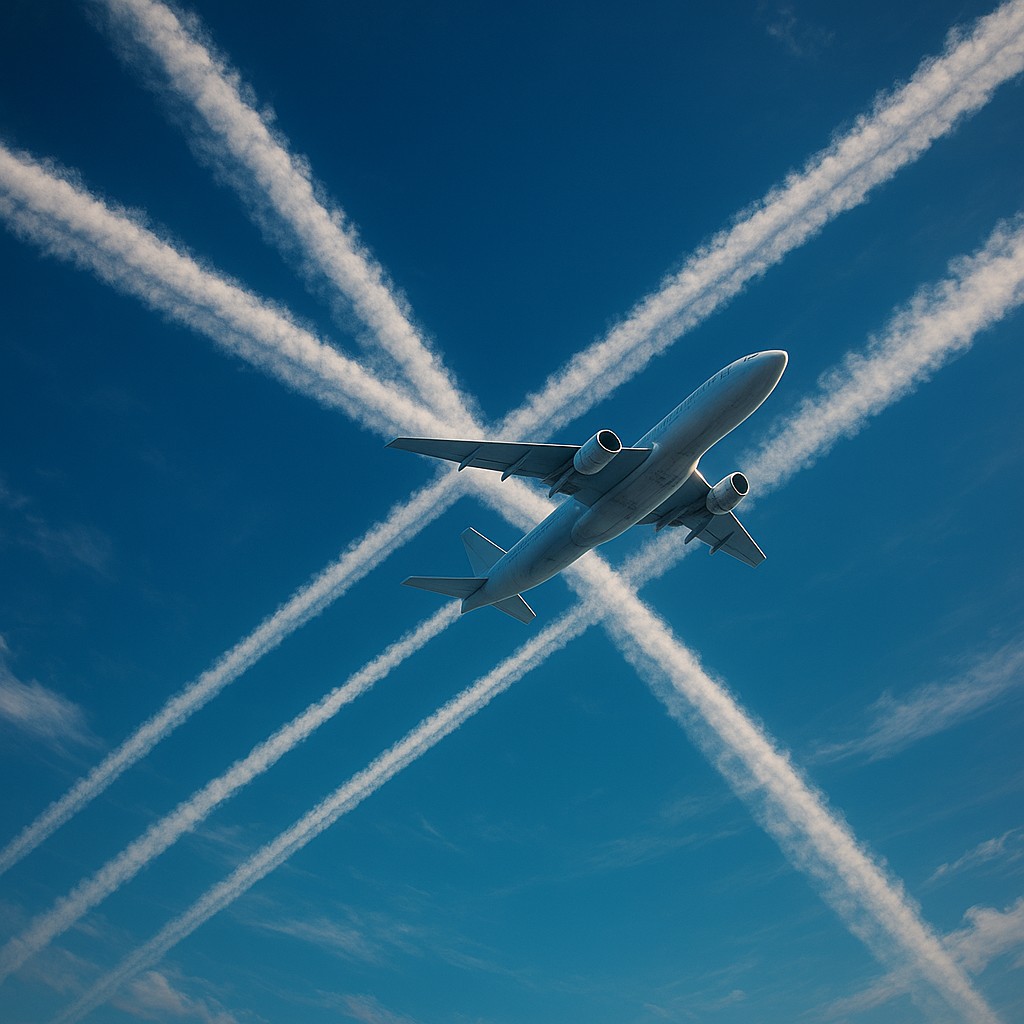
If you have ever looked up at a clear blue sky only to see a crisscross of thin white lines, you have seen one of the most obvious signs of human activity on our planet. These streaks, known as contrails, are often mistaken for harmless water vapor or a simple byproduct of high speeds. However, they are much more influential than they look. While they might appear to be nothing more than thin, wispy clouds, contrails are essentially a form of accidental weather modification on a global scale. On a busy day over the North Atlantic or the United States, these artificial clouds can spread out to cover thousands of square miles, acting like a thin thermal blanket wrapped around the Earth.
The physics behind these streaks is relatively simple, but the consequences are surprisingly complex. When a jet engine burns fuel, it releases hot water vapor and tiny soot particles into the freezing, thin air of the upper atmosphere. Under the right conditions, that water vapor instantly freezes onto the soot, forming billions of tiny ice crystals. Most of these vanish within minutes, but if the air is moist enough, they stay and grow. This creates a difficult dilemma for modern science. While we have spent decades focusing on the carbon dioxide coming out of the exhaust pipe, it turns out that these white lines in the sky might be causing just as much, if not more, immediate warming.
The Secret Greenhouse in the Sky
To understand why a few clouds matter so much, we have to look at the Earth’s energy balance. During the day, clouds can be helpful because they reflect sunlight back into space, which has a cooling effect. However, at night, and even during much of the day, clouds also act as insulators. They trap the heat rising from the Earth’s surface, preventing it from escaping into the cold vacuum of space. Contrails are particularly "good" at trapping this heat because they often form at high altitudes where the temperature difference between the ground and the air is extreme.
Recent climate studies have revealed a startling statistic: the warming effect from contrails, technically known as "effective radiative forcing," may be greater than the warming caused by all the carbon dioxide aviation has ever produced. While CO2 stays in the atmosphere for centuries, contrails only last for a few hours or days. This creates a unique opportunity. If we can stop contrails from forming today, we remove their warming influence almost immediately. Unlike the slow, difficult process of removing CO2 from the atmosphere, "turning off" contrails is like flipping a light switch in a dark room. The challenge, of course, is knowing exactly where and when to flip that switch.
Identifying the Supersaturated Danger Zones
Contrails do not form everywhere. If a plane flies through very dry air, the water vapor in the exhaust evaporates almost instantly, leaving no trace behind. The "danger zones" are regions of the atmosphere that are ice-supersaturated. In these areas, the air holds more moisture than it normally could, but it lacks the "seeds" necessary for that moisture to turn into ice. When a plane flies through, its exhaust provides the perfect surface for that moisture to latch onto, triggering the formation of long-lasting, heat-trapping clouds.
The breakthrough in recent international aviation trials involves mapping these invisible zones in real time. Using a combination of advanced satellite sensors, such as those on the GOES-16 weather satellite, and high-tech weather models, scientists can now predict where these moist regions exist. These maps are not static; they shift and flow like invisible rivers in the sky. By adding this data to flight planning software, we can treat these humid patches like tiny thunderstorms or pockets of turbulence. Instead of flying straight through them, pilots can navigate around or over them, preventing the contrail from ever forming.
The Mathematical Tradeoff of Modern Navigation
Nothing in physics comes for free, and avoiding contrails is no exception. To avoid a moist layer of air, a pilot usually has to change altitude, perhaps by dropping or climbing two thousand feet. This takes the aircraft away from its most fuel-efficient cruising height. Since engines are designed to work best at specific pressures and temperatures, any change usually results in burning a bit more fuel. This creates a direct conflict between two types of environmental impact: the immediate warming of the cloud versus the long-term warming of the extra carbon dioxide.
Researchers and pilots are currently testing the "break-even" point of this tradeoff. If shifting a flight path burns 2 percent more fuel but reduces the total climate impact of that flight by 20 percent, it is an obvious win for the planet. However, if the extra fuel burn is too high or the resulting contrail would have been short-lived anyway, the move might actually do more harm than good. Finding the "sweet spot" requires massive amounts of data and processing power to ensure that every extra pound of fuel burned results in a significant reduction in atmospheric heat.
| Metric |
Traditional Flight Path |
Contrail-Avoidance Flight Path |
| Fuel Consumption |
Baseline Efficiency |
1% to 2% Increase |
| CO2 Emissions |
Standard output |
Slightly higher |
| Cloud Formation |
Likely in humid zones |
Greatly reduced or eliminated |
| Atmospheric Lifespan |
Long-term (Centuries) |
Short-term (Hours/Days) |
| Total Climate Impact |
High due to dual threats |
Potentially 30% lower overall |
Testing the Theory in High-Stakes Trials
The transition from a lab theory to an international aviation standard is already underway. Recent trials involving major airlines and tech giants have put these theories to the test in the real world. In one notable series of tests, pilots were given instructions to avoid contrails during certain parts of their flights over several months. These were not just guesses; they were calculated maneuvers based on AI predictions and satellite checks. After the flights landed, researchers used independent satellite images to see if the clouds actually disappeared.
The results were incredibly promising. In many cases, a simple altitude adjustment of just 2,000 feet was enough to prevent a massive cloud plume from forming. Satellite evidence showed that these adjusted flights produced significantly fewer long-lasting contrails than the control group of flights that ignored the humidity data. This was the first large-scale proof that we can manage the "cloudy" side of aviation’s footprint without redesigning the entire airplane. It turns out that the solution was not a new engine or a magic fuel, but better maps and smarter choices by the people in the cockpit.
Overcoming the Logistics of a Crowded Sky
While the science is sound, the logistics are a bit more complicated. The sky is a crowded place, organized into invisible highways managed by air traffic controllers. When a pilot wants to change altitude to avoid a moist patch of air, they cannot just move the plane on a whim. They must request permission from controllers who are busy managing hundreds of other planes to ensure everyone stays a safe distance apart. If dozens of pilots all want to change altitude at once to save the climate, the current air traffic control system could become overwhelmed.
To make contrail avoidance a daily reality, we need to automate the communication between weather satellites, flight planning computers, and air traffic control centers. We are looking at a future where the "path of least resistance" is no longer just the shortest line between two cities, but the path that creates the smallest environmental footprint. This means developing global standards for humidity data and creating software that can calculate these tradeoffs in seconds. It is a massive data-sharing challenge that requires cooperation between different countries, airlines, and tech providers, but the potential payoff makes it one of the most exciting frontiers in green technology.
Redefining the Future of Sustainable Flight
The most impressive part of this technology is that it does not require us to wait twenty years for a new fleet of hydrogen-powered planes. It is a software solution for a hardware problem. By simply changing how we fly the planes we already have, we can make a measurable dent in global warming today. This represents a shift in how we think about "clean" travel. Being a green traveler in the future might not just mean flying less or using bio-fuels, but supporting airlines that use the best weather data to keep the skies clear.
As we continue to improve our understanding of the upper atmosphere, we are realizing that our impact on the planet is often a matter of precise timing and location. Aviation has long been seen as one of the hardest industries to clean up, but contrail avoidance gives us a head start. It teaches us that nature is a sensitive system, and sometimes, avoiding a major impact is as simple as shifting our perspective by a few thousand feet. By respecting the invisible boundaries of humidity and temperature, we can continue to connect the world without leaving a lasting, warming shadow behind us.
The journey toward sustainable skies is not just about the fuel in the wing; it is about the wisdom in the cockpit and the data in the cloud. As these trials move from experimental phases to standard procedures, we are witnessing the birth of a more mindful era of travel. Every time you look up and see a clear blue sky where there used to be white streaks, you might be looking at the results of a pilot making a quiet, calculated choice to protect the world below. It is a reminder that with enough data and a bit of creativity, we can find ways to live in harmony with the atmosphere that sustains us.