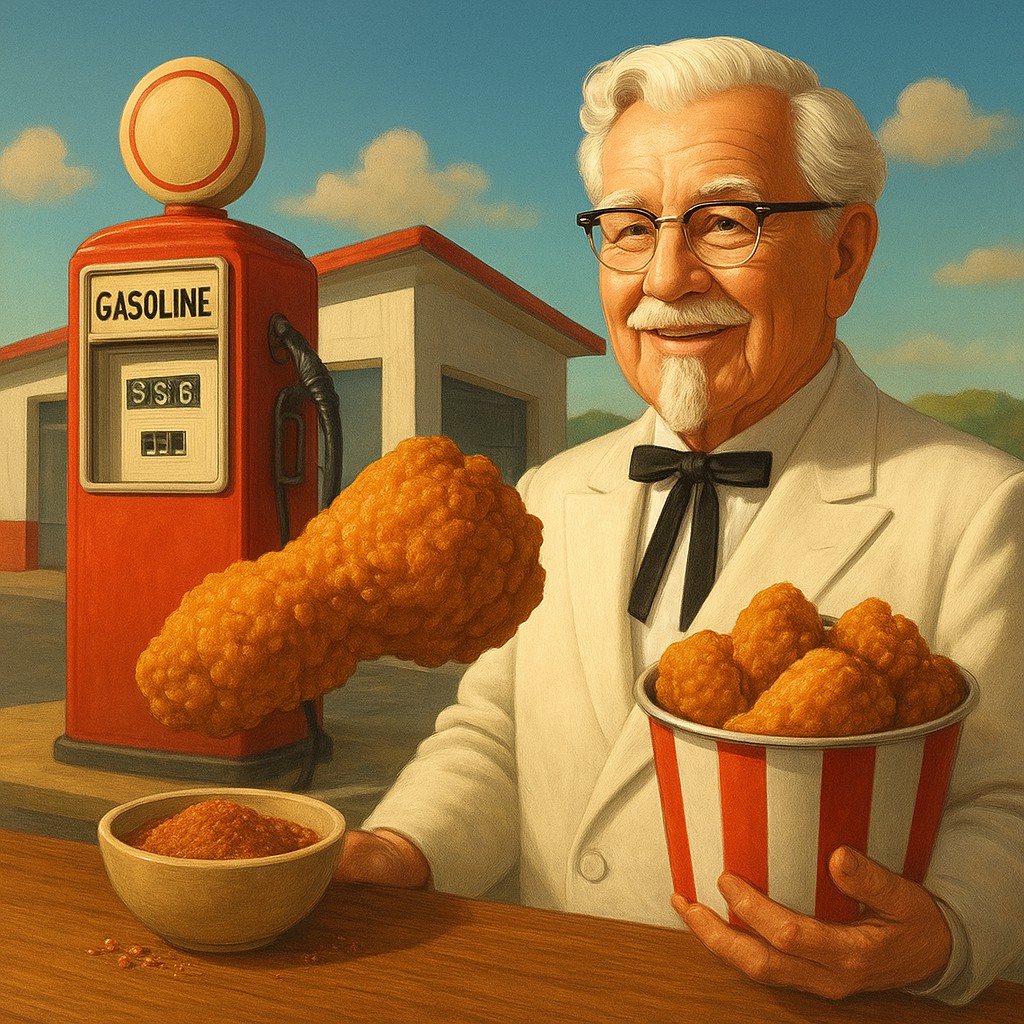
Most fast-food brands look like they were made in a lab: a clever logo, a catchy jingle, and a marketing budget big enough to be seen from space. Kentucky Fried Chicken is different. Its origin story has a human face, a white suit, a black string tie, and a stubborn streak that could fry a boot and still ask for seconds.
Colonel Harland Sanders did not build KFC like a young tech founder in a hoodie with venture capital. He built it as a working man who tried many jobs, failed more than once, got into his share of scraps, and kept going. His story matters because it teaches a practical lesson: what looks like a "big break" from afar is often just persistence seen up close.
A restless kid who kept changing jobs (and learning anyway)
Harland David Sanders was born in 1890 in rural Indiana. When his father died, he had to grow up fast. He cooked for his siblings while his mother worked, and that early responsibility gave him something valuable: real comfort in a kitchen. Not fancy culinary school comfort, but the "feed people or they will not eat" kind that sticks.
As a young man, Sanders moved through a long list of jobs: farmhand, streetcar conductor, soldier briefly, railroad worker, insurance salesman, and more. People often turn this into a joke, as if he could not hold a job. A better view is that Sanders was sampling the early 1900s American economy the way some people sample hot sauces. He learned what he liked, what he hated, and what he could do well enough to bet his future on.
His personality mattered too. He could be charming and generous, but he could also be fiery, proud, and quick to argue. That mix does not always work in office politics, but it can be useful when you are building something from scratch. If you want a neat hero story, Sanders will disappoint. If you want a real one, he is perfect.
The gas station that turned into a restaurant (by accident and hunger)
The turning point came in Kentucky during the Great Depression. Sanders ran a service station in Corbin, Kentucky. Cars were becoming common, roads were improving, and travelers needed stops. Sanders noticed something simple: people did not just want gas, they wanted a meal and a friendly face.
So he started serving food to customers. At first it was not a plan to open a big restaurant. It was more like, "If folks are going to sit while their car gets fixed, I might as well feed them." He served country-style meals, and his fried chicken became the star. Eventually he opened a dining room, and the place became known as Sanders Cafe.
Here is what made Sanders smart, even if he did not sound like a modern entrepreneur:
- He listened to demand. Customers wanted his chicken, so he focused on it.
- He made the experience personal. He greeted people, chatted, and built loyalty.
- He focused on consistency. Travelers came back because they knew what they would get.
This was not a viral brand yet. It was a local success built on food that felt comforting and reliable, the kind of meal that makes you loosen your belt and forgive your enemies.
The secret recipe and the pressure cooker breakthrough
One of KFC’s biggest myths is that the "11 herbs and spices" recipe appeared like magic, fully formed and instantly famous. In reality, the idea evolved. Sanders tested seasonings and methods over time, trying to make chicken that was both flavorful and recognizable. The "secret recipe" became part product, part marketing, and part real competitive edge.
Another key innovation was speed. Traditional fried chicken takes time, and travelers rarely want to wait. Sanders adopted pressure frying, which uses a pressure cooker adapted for frying chicken. That cooked chicken faster while keeping it juicy, so he could serve more customers without turning the meat into dry regret.
This combination mattered:
- Flavor identity: a seasoning that tasted distinct enough to be memorable.
- Operational advantage: faster cooking that still delivered quality.
- Repeatability: a process that could be taught and copied, which is crucial for scaling.
Sanders was not just cooking. He was building a system, even if he would have rolled his eyes at someone who called it that.
Becoming “Colonel” Sanders: a title, a costume, and a brand persona
Many people assume Sanders was a military colonel. He was not. The "Colonel" title came from the state of Kentucky. In 1935, the governor awarded him the honorary title of Kentucky Colonel, given to people recognized for contributions to the state.
Sanders embraced the title and, later, the look. The white suit, string tie, and goatee became a visual shorthand for his brand. This was not just vanity. It was early personal branding with theatrical flair. Long before influencers, Sanders understood that people remember characters.
Here is a useful business lesson hidden in the costume: if your product is easy to confuse with others, a memorable story and image help customers recall you. Plenty of places sold fried chicken. Only one had a "Colonel" whose face could be stamped onto a bucket and spotted from a moving car.
The setback that forced a new idea: franchising
The most dramatic part of the KFC story is that Sanders did not scale by opening more cafes himself. He scaled because he lost the conditions that made his original location work.
In the early 1950s, a new interstate highway rerouted traffic away from Corbin, Kentucky. Fewer travelers meant fewer customers. Sanders eventually sold his restaurant and, by many accounts, did not have much left. The popular legend says he had only $105 to his name. The exact number is debated, but the larger truth is clear: he needed a new plan.
That plan was franchising.
Instead of owning every restaurant, Sanders licensed his recipe and cooking method to other restaurant owners. In return he got a small fee for each chicken sold. This was a brilliant adaptation, because it let his chicken travel without him having to buy land, hire large staffs, or manage every location himself.
He hit the road, pitching his chicken to restaurant owners. Picture an older man driving around with a pressure fryer, cooking samples, and asking skeptical owners to take a chance. Some said no. Many said no. But some said yes, and those yeses multiplied.
How KFC scaled: simple economics and strict standards
Franchising can look like a shortcut, but it is actually a trade. You get faster growth, but you risk losing quality control. Sanders cared deeply about consistency, and he was blunt when a franchise did it wrong. Stories of him inspecting kitchens and criticizing gravy are KFC folklore, and they ring true because they fit his personality.
Early KFC growth worked because it balanced two forces:
- Local ownership energy: franchisees had a personal stake and worked hard.
- Central rules: the recipe and method created uniformity across locations.
This helps explain why fast food became a powerful American export. It was not only the food. It was the repeatable model: a predictable customer experience delivered at scale.
A quick timeline of key moments
| Year/Period |
What happened |
Why it mattered |
| 1890 |
Sanders is born in Indiana |
Humble beginnings, early responsibility |
| 1930s |
Sanders Cafe grows in Corbin, Kentucky |
Fried chicken becomes the signature |
| 1935 |
Named a Kentucky Colonel |
Title becomes part of the brand persona |
| Late 1930s to 1940s |
Recipe and methods refined |
Builds a repeatable product identity |
| Early 1950s |
Highway changes reduce traffic |
Forces Sanders to rethink the business |
| 1952 onward |
Begins franchising |
Unlocks rapid growth without owning every location |
| 1964 |
Sanders sells KFC to investors |
Company becomes a global expansion machine |
Selling the company: when the founder becomes the mascot
In 1964, Sanders sold KFC to investors led by John Y. Brown Jr. and Jack C. Massey. People sometimes say he "got rich and retired." In reality, he stayed involved as a brand ambassador and did not always like what corporate growth did to the food and operations.
Once a company scales, decisions shift. Investors focus on efficiency, supply chains, and margins. Founders often care about craft, pride, and the small details customers do not see. Sanders became the face of KFC, traveling and promoting the brand, while also criticizing changes he disliked. It is a classic founder story: your creation grows up, moves out, and starts making choices that annoy you.
KFC expanded aggressively, including overseas. The Colonel’s image became iconic worldwide. In many places the brand is more than fast food. It is a symbol of American-style dining, even when locals add their own twist.
Common misconceptions and what’s actually true
The Colonel Sanders story is so popular that it picks up exaggerations. Here are a few misconceptions worth clearing up.
Misconception 1: “Colonel” means he was in the military
He served briefly in the military as a young man, but the famous Colonel title is honorary from Kentucky, more like a civic honor than a battlefield rank.
Misconception 2: He succeeded only because he started late
People like the "he was old when he made it" angle to inspire persistence, and that part is fair. But it can hide the real engine of his success: decades of work, testing, and customer service. His later breakthrough was built on earlier learning, not sudden luck.
Misconception 3: The secret recipe is the only reason KFC worked
Flavor mattered, but the business model mattered just as much. Pressure frying, franchising, and consistency systems turned good chicken into a global product. Plenty of great recipes stay local because they are hard to scale.
Misconception 4: He was always a polished businessman
Sanders was rough around the edges. He argued, he made mistakes, and he could be stubborn to a fault. His success was not about being perfect. It was about being persistent and adaptable when the world changed around him.
The bigger lesson: KFC as a story about resilience and systems
Remove the white suit and the myths, and the heart of the story is simple. Sanders found something people wanted, learned how to deliver it reliably, and changed his business model when circumstances forced him to. That last part is key. Many people work hard when things go well. Fewer people can reinvent themselves when the road literally reroutes away from their front door.
KFC shows the difference between a great product and a scalable one. Sanders’s genius was not just cooking tasty chicken. It was turning that tastiness into steps other people could follow, in kitchens he did not own, for customers he would never meet. That is the quiet magic of franchising: a local experience copied faithfully enough across thousands of miles.
And yes, there is something charming about the founder becoming a character. It is marketing, but it is also storytelling with a human anchor. We remember faces better than spreadsheets, and Sanders gave KFC a face people could trust.
Closing: what you can take from the Colonel (besides extra napkins)
Colonel Sanders’s story is not a fairy tale about instant success. It is a long, messy, human tale about learning by doing, adapting when life changes the rules, and staying stubborn in the useful direction. If you are building a skill, a career, a business, or even a new habit, the Colonel’s lesson is encouraging: progress can be slow, and your path can be weird.
You do not need to be flawless, young, or perfectly planned. You need to keep experimenting, keep listening to what works, and be willing to change your method without losing your goal. Sanders turned a roadside meal into a global icon not because everything went right, but because when things went wrong, he kept cooking, kept selling, and kept moving forward.