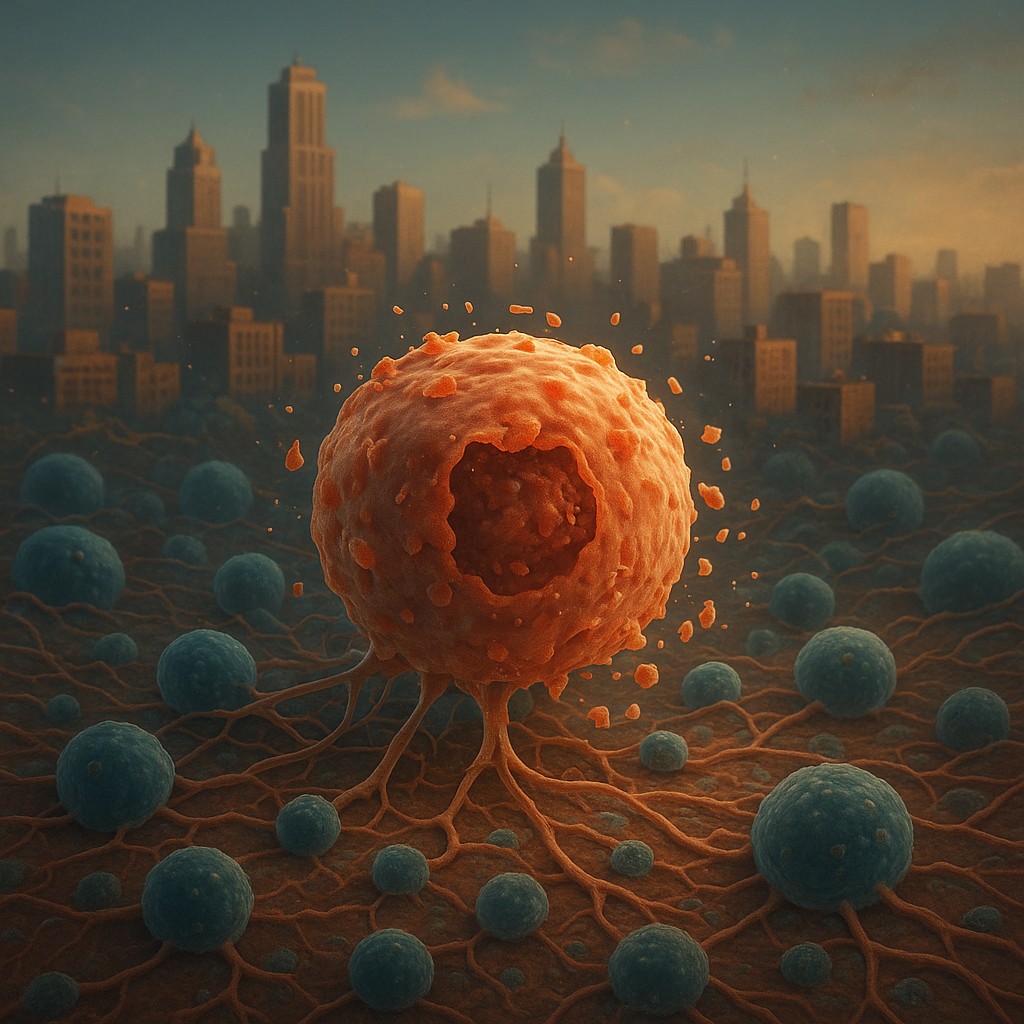
Imagine for a moment that you are the lead architect of a sprawling, bustling city. This metropolis is alive, constantly growing, and remarkably efficient. However, it faces a unique challenge: space is limited and the building codes are incredibly strict. To keep the city thriving, you cannot simply add new skyscrapers and parks forever. Eventually, older buildings become structurally unsound, neighborhoods get too crowded, and construction errors lead to faulty foundations that could topple an entire block. In this city, your most vital tool is not a hammer or a crane, but a precisely controlled demolition crew. This team knows exactly when to take a building down to make room for something better.
Inside your body, a trillion tiny demolition crews are working right now to keep you alive and healthy. This process is called apoptosis, a term taken from the ancient Greek word for "falling off," like leaves dropping from a tree in autumn. It is a sophisticated, highly regulated form of programmed cell death that ensures your biological city remains in peak condition. Without it, our bodies would quickly become cluttered with broken, infected, or dangerous cells. It is one of nature’s most elegant solutions to the problem of maintaining a complex living thing. It acts as a biological "self-destruct" button, pressed only when it is absolutely necessary for the good of the whole body.
The Difference Between a Quiet Exit and a Messy Accident
To truly appreciate the grace of apoptosis, we must contrast it with its chaotic cousin, necrosis. If apoptosis is a controlled demolition where the building is carefully dismantled and the debris is hauled away in neat trucks, necrosis is like a gas leak that leads to an unexpected explosion. Necrosis happens when a cell falls victim to a sudden, traumatic injury, such as a physical wound, a toxic chemical, or a lack of oxygen. In these cases, the cell membrane simply gives up and bursts, spilling its internal contents into the surrounding tissue. This cellular "vomiting" causes a massive amount of inflammation and stress for neighboring cells, often leading to the pain and swelling we feel as the body rushes in to clean up the mess.
Apoptosis is a much more polite affair. When a cell receives the signal that its time is up, it does not explode. Instead, it begins to shrink inward, tidying up its internal parts into neat little packages called "apoptotic bodies." The cell’s DNA is chopped into uniform pieces, and the exterior of the cell changes its chemical signature to essentially wave a flag that says, "Please eat me." Specialized scavenger cells, known as macrophages, recognize this signal and quickly swallow the cell fragments before they can leak any harmful enzymes. This prevents inflammation and allows the surrounding tissue to continue its work without distraction.
| Feature |
Apoptosis |
Necrosis |
| Nature of Death |
Programmed and intentional |
Accidental and traumatic |
| Cell Appearance |
Shrinks and fragments |
Swells and bursts |
| Impact on Neighbors |
None; the process is self-contained |
Causes inflammation and damage |
| Biological Purpose |
Development and health maintenance |
Response to injury or infection |
| Cleanup Method |
Neatly packaged and eaten by scavengers |
Messy spill requiring immune response |
Sculpting Life From a Blank Canvas
One of the most awe-inspiring roles of apoptosis occurs long before you are even born. During development in the womb, the body creates many temporary structures that act as scaffolding for the final "product." Think of a sculptor working with a block of marble. They do not just add clay to build a statue; they also chip away at the stone to reveal the form hidden inside. Apoptosis is the body’s internal chisel. In the womb, a human fetus actually develops hands and feet that look more like paddles or oars, with solid webbing between the fingers and toes.
If that webbing stayed put, we would all be born with duck-like flippers. However, at a specific point in development, the cells in that webbing receive a genetic command to undergo apoptosis. Those cells systematically dismantle themselves, allowing the fingers and toes to separate into distinct digits. This same sculpting happens in the brain, where the body overproduces neurons and then "prunes" away the ones that do not make strong connections. This process effectively streamlines our neural pathways. It even happens in the immune system, where the body creates a vast array of white blood cells and then eliminates the ones that might mistakenly attack your own healthy tissues.
The Intricate Chemistry of the Self-Destruct Sequence
How does a cell actually decide it is time to punch its own clock? The decision-making process is a complex web of chemical checkpoints that would make a high-security vault look simple. There are two primary ways the process starts: the "intrinsic" pathway (the internal alarm) and the "extrinsic" pathway (the external order). The intrinsic pathway is triggered when the cell detects internal problems, such as severe DNA damage or high levels of stress. The mitochondria, which we usually call the "powerhouse of the cell," act as the ultimate judge here. If the damage is too great to repair, the mitochondria release a protein called cytochrome c, which acts like a master key to unlock the destruction enzymes.
The extrinsic pathway is triggered by signals from outside the cell. Sometimes, a neighboring cell or an immune cell detects that something is wrong, perhaps that the cell has been hijacked by a virus or is starting to look cancerous. These external cells bind to "death receptors" on the target cell’s surface, sending a signal straight to the interior to start the shutdown sequence. Both pathways lead to the activation of caspases, which are the biological executioners. Caspases are enzymes that systematically shred the cell’s proteins and structural supports, ensuring the death process is irreversible and efficient.
When the Guard Fails at the Gate
While apoptosis is a masterpiece of biological engineering, things can go horribly wrong if the system breaks down. It is a delicate balancing act; you need just the right amount of cell death to keep the body in harmony. If the self-destruct button gets stuck in the "on" position, the body begins losing cells it actually needs. This is often what happens in brain-wasting diseases like Alzheimer’s or Parkinson’s. In these conditions, for reasons researchers are still trying to fully understand, healthy neurons begin undergoing apoptosis prematurely, leading to a loss of memory and motor control.
On the flip side, if the self-destruct button is broken or ignored, we face the opposite problem: cells that should have died continue to live and multiply. This is the hallmark of cancer. Many cancer cells find ways to silence their internal alarms or block the caspases from doing their job. Even when their DNA is mutated and dangerous, these "immortal" cells keep dividing, eventually forming tumors that can overwhelm the body. This is why many modern cancer treatments focus on trying to "re-teach" these rogue cells how to undergo apoptosis, essentially fixing the broken safety switch so the body can naturally clear the threat.
The Beauty of a Necessary Ending
It may seem a bit grim to spend so much time thinking about death, even at a microscopic level, but apoptosis is truly a celebration of life’s complexity. It reminds us that for an organism to thrive, it must prioritize the health of the whole over the survival of any single part. Every day, billions of your cells quietly step aside, making room for new growth and protecting you from potential threats. This invisible choreography is what allows you to heal from injury, grow from an embryo into an adult, and maintain a defense against the countless tiny errors that occur in our biology every single hour.
As you go about your day, take a moment to appreciate the quiet, diligent work of your cellular demolition crews. They are the reason your fingers are separate, your brain is wired correctly, and your immune system isn't constantly in a state of inflamed panic. Apoptosis is proof that sometimes, letting go is the most vital part of holding everything together. By understanding this process, we gain a deeper respect for the incredible intelligence built into our very DNA, a system that knows exactly when to say goodbye so the rest of you can keep saying hello to the world.