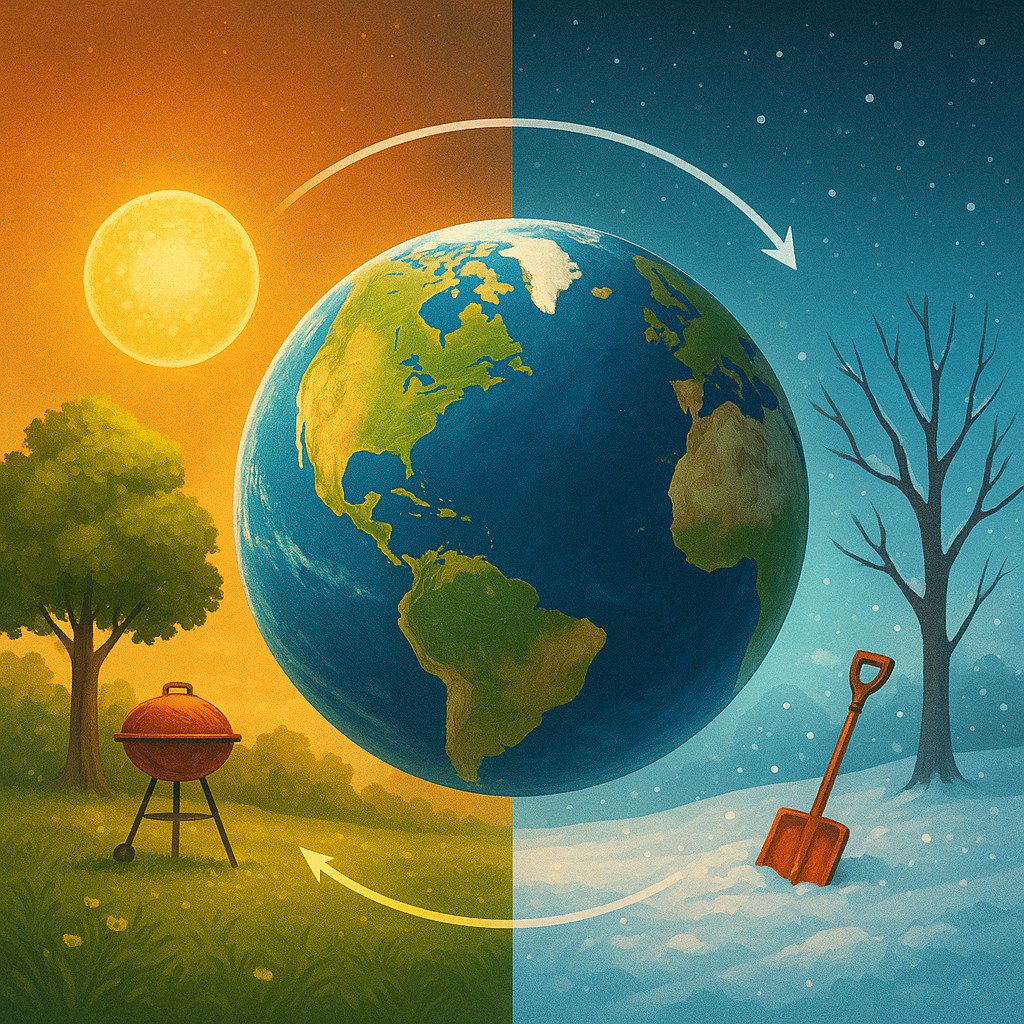
Have you ever noticed how the air in Canada seems to undergo a total personality shift in just a few short months? We go from July afternoons where the heat makes the asphalt shimmer and the cicadas scream, to January mornings where the air is so cold it feels like it might shatter inside your lungs. For many of us, this yearly transformation is just a mystery we accept as part of the deal for living in the Great White North. We pull out the shovels, put away the barbecues, and wait for the cycle to restart, rarely asking why nature flips the switch so violently.
Yet, the answer isn't just a list of dry scientific facts; it is a true cosmic dance. Despite what many people believe, it has nothing to do with the distance between the Earth and the Sun. If that were the case, we would all be freezing at the exact same time as people in Australia. The truth is much more elegant. It all comes down to a simple tilt - a small angle that changes everything about how energy travels through space to hit the ground in Toronto, Montreal, or Vancouver. Understanding this process is like getting a look behind the scenes of a grand theater: once you see the ropes and pulleys, the show becomes even more fascinating.
The Great Illusion of Orbital Distance
One of the most stubborn myths is that the Earth moves away from the Sun in the winter and closer in the summer. On its face, this seems logical: if you move away from a campfire, you get colder. However, if this theory were true, the entire globe would experience winter at the same time. Instead, while we are shivering in Canada during January, our friends in Argentina are tanning on the beach. In reality, Earth’s orbit isn't a perfect circle, but a slightly stretched oval called an ellipse. The point where we are closest to the Sun, known as the perihelion, actually happens in early January. You read 그hat right: the Earth is at its closest to the Sun at the exact moment Canadians are facing their worst blizzards.
The real culprit behind our frostbite and sunburns is the "obliquity of the ecliptic," which is just a fancy way of saying the Earth is tilted. Imagine our planet as a spinning top that doesn't stand straight up, but leans to the side at an angle of about 23.5 degrees. This tilt is fixed. As the Earth journeys around the Sun throughout the year, its axis always points toward the North Star. This permanent lean means that for part of the year, the Northern Hemisphere is angled toward the Sun, while for the other half, it is angled away.
This tilt wasn't a minor accident. Scientists believe it was caused by a massive collision billions of years ago with another Mars-sized planet named Theia. That impact didn't just create the Moon; it gave the Earth the "slant" that makes life as we know it possible. Without this tilt, there would be no seasons. The weather in Ottawa would be the same in January as it is in July - one long, gray stretch of the same routine. Canada wouldn't be a land of four seasons, but a place frozen in a single, permanent climate.
The Magic of the Solar Angle
Why is that 23.5-degree angle so powerful? It all comes down to how concentrated the energy is. In the summer, when the Northern Hemisphere tilts toward the Sun, the solar rays hit us almost vertically, or "directly." Imagine holding a flashlight and pointing it straight down at the floor. The light forms a small, bright, intense circle. All the energy from the light is packed into one small spot. This is exactly what happens in July in Canada. The Sun climbs high in the sky, and its rays have less atmosphere to travel through before hitting the ground, allowing them to heat the earth with incredible efficiency.
In the winter, the script is flipped. Because we are tilted away from the Sun, it seems to hug the horizon. If you take that same flashlight and tilt it at a sharp angle, the spot of light stretches out into a large, pale oval. The same amount of light is now spread over a much larger area. The energy is "diluted." In Canada during December, the Sun never manages to climb very high. Its rays arrive at a very shallow angle and must pass through a much thicker layer of atmosphere. This air absorbs and scatters much of the heat before it can ever touch your face.
| Season in Canada |
Northern Hemisphere Orientation |
Solar Ray Angle |
Daylight Hours |
| Summer (June-Aug) |
Tilted toward the Sun |
Direct and vertical (Concentrated) |
Long (up to 15-16h) |
| Autumn (Sept-Nov) |
Shifting away |
Angled and decreasing |
Average and falling |
| Winter (Dec-Feb) |
Tilted away from the Sun |
Very shallow and spread out (Diluted) |
Short (about 8-9h) |
| Spring (March-May) |
Shifting toward |
Angled and increasing |
Average and rising |
This difference in angle explains why it can be -20 degrees Celsius even on a perfectly sunny January day without a cloud in sight. The Sun is there, you can see it, but its power is weakened by the long, slanted journey it has to take through our frozen atmosphere. On the other hand, even though the Sun is technically "farther away" in terms of actual kilometers during the summer, the vertical path of its rays is so strong that it can easily push temperatures to 30 degrees or higher across the Prairies and Southern Ontario.
Day Length and the Energy Budget
The angle of the rays is only half the story. The other crucial factor is exposure time. Because Canada is located far from the equator, our variations in daylight are extreme. In the summer, thanks to that famous tilt, we spend much more time in the light than in the dark. In cities like Edmonton or Saskatoon, June days can last nearly 17 hours. That is 17 hours of non-stop energy hitting the ground, buildings, and lakes. During the short 7-hour night, the Earth simply doesn't have enough time to release all that built-up heat. The result is a steady climb in temperature day after day.
In winter, the cycle turns cruel. Days shorten drastically. In Montreal, the Sun can set before 4:30 p.m. in December. This means we only get 8 or 9 hours of very weak sunlight to try to warm our surroundings, followed by 15 hours of pitch-black night where heat escapes into deep space. Imagine trying to heat a house by turning on a small space heater for 8 hours, then opening every window for the next 16 hours. The indoor temperature is going to drop. This constant "energy deficit" is what turns Canada into a giant freezer during the winter months.
There is also a major feedback effect caused by snow. When the cold sets in and snow blankets the Canadian landscape, it acts like a giant mirror. Snow has a very high "albedo" - a term for how much light a surface reflects - meaning it bounces up to 90% of solar rays back into space. Instead of soaking up what little heat the low Sun sends our way, the snow-covered ground rejects it instantly. It’s a vicious cycle: it’s cold, so it snows; and because it snows, the ground can’t warm up, which keeps it cold. In the summer, the dark soil, green forests, and lake water absorb energy instead of reflecting it, helping to maintain our pleasant summer weather.
Air Masses and Canada's Unique Geography
While the Earth’s tilt is the main engine, Canada’s specific geography acts as an amplifier. Unlike Europe, which is protected by warm Atlantic currents and has mountain ranges like the Alps running east-to-west, North America is an open corridor. Between the Rockies in the west and the Appalachians in the east, there are no major barriers to stop air from flowing North to South. This is often called the "air tunnel."
In the winter, Central Canada becomes a high-pressure zone where extremely dense, cold, and dry Arctic air piles up. Since there are no mountains to block it, this air can slide freely from the North Pole down to the Great Lakes and beyond. This is the famous "polar vortex." This air has had plenty of time to chill over the frozen lands of Nunavut and the Northwest Territories, where the Sun sometimes doesn't even rise for weeks. When this air mass hits us, it brings that Siberian cold that forces us to wear three layers of wool.
In the summer, the situation flips. That same geographic corridor allows hot, humid air from the Gulf of Mexico to surge northward. This tropical air isn't just hot; it's heavy with moisture. This is why summers in Ontario, Quebec, or Manitoba often feel so thick and sticky. Our lack of mountain barriers is a double-edged sword: it lets us enjoy tropical-style heat for a few months but leaves us defenseless against the Arctic for the rest of the year. The Canadian climate is a permanent battlefield between the North Pole and the Tropics, with each season marking a temporary victory for one side.
Thermal Inertia: The Seasonal Lag
You might have noticed something strange: the summer solstice - the day the Sun is highest and the day is longest - happens around June 21. Yet, the hottest months in Canada are usually July and August. Similarly, the winter solstice is December 21, but February is often much colder than December. Why the delay? This is called thermal inertia. The Earth is made of rock, soil, and massive bodies of water that do not change temperature instantly.
Think of a large pot of water on a stove. Even if you turn the heat to high, the water doesn't boil immediately. It takes time for the energy to spread. The Earth works the same way. In June, the Sun hits the ground and oceans with maximum heat, but it takes several weeks for those masses to soak up enough energy to reach their peak temperature. Conversely, in December, the Earth is only just starting to lose the heat it stored during the summer. It isn't until February that the "stockpile" of heat is totally gone and the cooling reaches its lowest point.
This lag gives us some climate stability, but it also drags out our winters. In March, it often feels like spring should be here because the Sun is stronger and the days are longer. But the ground is still frozen deep down, and the lakes are locked in ice. It takes a massive amount of energy to melt all that ice and warm the earth before the air can finally turn mild. This invisible struggle against the "leftover" cold is what makes the Canadian spring so unpredictable and often much later than we'd like.
An Invitation to Watch the Cosmic Waltz
It is fascinating to realize that every part of our daily life in Canada - from the crunch of snow under our boots to the buzz of mosquitoes in the humid heat - is the direct result of events happening millions of kilometers above us. We live on a planet that dances asymmetrically, giving us a climate that is always in motion. The cold we sometimes dread is actually a sign that our part of the world is taking a break, tilting respectfully away from the Sun to let the earth rest under a white blanket.
The next time you head out to shovel your driveway or grab an ice cream under a blazing sun, take a moment to look up. Remember that you are on a tilted spaceship, hurtling through the void, and it is specifically that one quirky little angle that makes your home so vibrant and ever-changing. The Canadian climate isn't just a weather report; it is a life-sized astronomy lesson that we get to experience every day. To appreciate the seasons is, at its heart, to appreciate the incredible precision of the universe - an adventure where every snowflake and every sunbeam has its perfect place in the cycle of life.