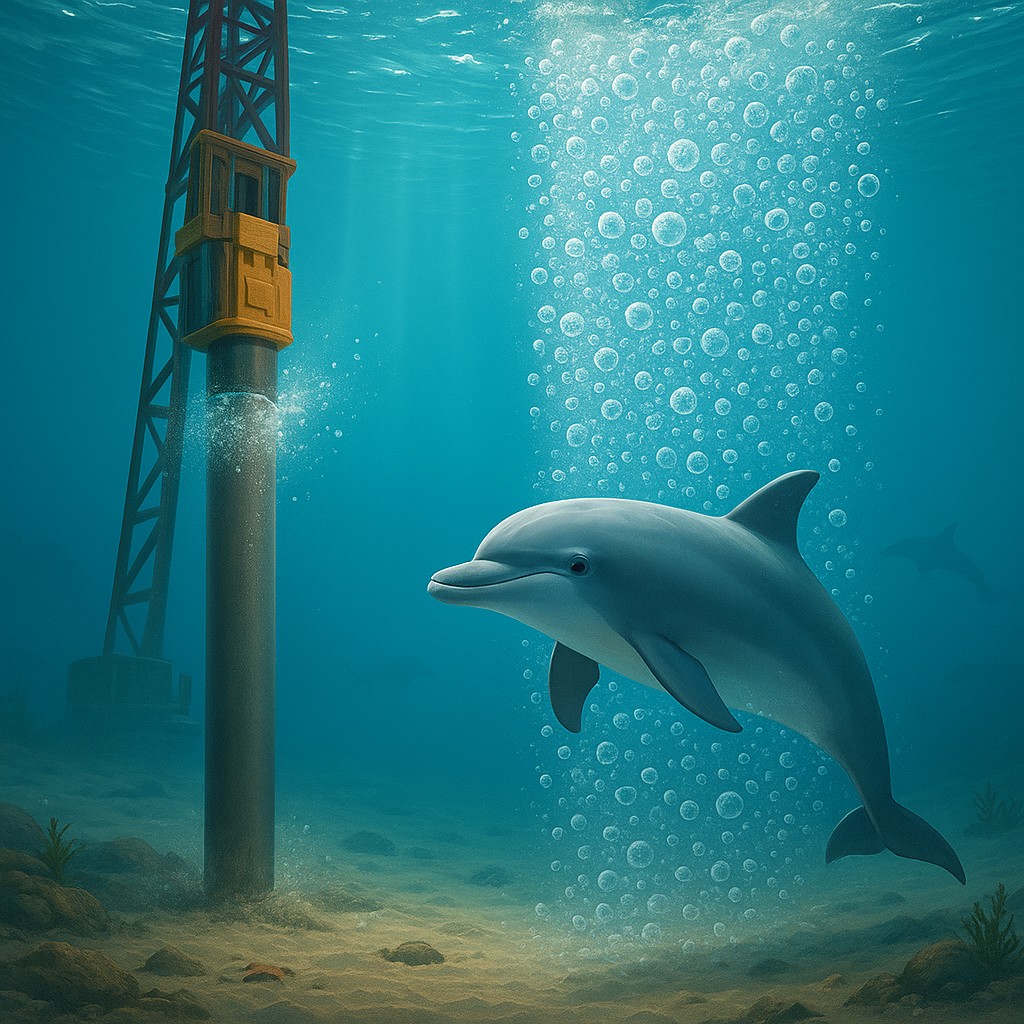
Imagine standing in the front row of a heavy metal concert where the speakers are the size of skyscrapers. The volume is turned up so high you can feel your teeth rattle. Now, imagine you cannot cover your ears or walk away because you are a dolphin and the concert is happening in your living room. When engineers build offshore wind farms or bridges, they often use a process called pile driving. This involves hammering massive steel pillars into the seabed with the force of a falling building. Under the water, where sound travels faster and further than it does in the air, these bangs aren't just loud; they are physically violent. They create pressure waves that can shatter a whale’s sensitive hearing or leave a porpoise completely lost in a world where sound is their only map.
To solve this, scientists haven't asked the hammers to be quiet, because physics simply does not allow a multi-ton hammer to be shy. Instead, they have turned to one of the most delicate things in nature: the humble bubble. By encircling construction sites with a massive, rising wall of air, engineers have discovered they can create a soundproof room in the water. This "bubble curtain" acts as a sophisticated filter that traps and breaks up the energy of the noise before it can tear through the ecosystem. It is a striking example of how a simple change in density can solve a massive industrial problem, ensuring that as we build a greener future for ourselves, we don't accidentally deafen our neighbors beneath the waves.
The Physics of an Underwater Megaphone
To understand why a bubble curtain is necessary, we first have to appreciate how efficiently water carries a tune. In the air, sound waves lose energy quickly because air is relatively "squishy" and thin. If you shout at a friend across a field, your voice vanishes after a few hundred feet. However, water is much denser than air and does not compress easily. This means that when a pile driver hits a post, the water molecules don't just "squish"; they pass that energy along like a series of steel marbles hitting one another. Sound travels about four and a half times faster in water than in air, and it can travel for dozens of miles without losing its punch.
For a marine mammal like a sperm whale or a harbor porpoise, this is a nightmare. These animals rely on biosonar, or echolocation, to find food and navigate. Their hearing is so sensitive that the percussive waves from offshore construction can cause permanent tissue damage or even death if they are too close. Even at a distance, the background noise of the ocean rises so high that these animals can no longer "see" with their ears. It is like trying to find your way home in a room filled with thick, blinding smoke and a siren that never stops. The bubble curtain is designed to clear that smoke by changing the material through which the sound travels.
Breaking the Wave with Walls of Air
The magic of the bubble curtain lies in a concept called acoustic impedance. Imagine you are driving a car and you suddenly move from a smooth paved road into a thick patch of deep mud. Your momentum is immediately disrupted because the "medium" you are traveling through has changed. Sound waves experience something very similar when they hit a boundary between two different materials. When a sound wave traveling through water hits a wall of air bubbles, it doesn't just pass through. Because air is so much less dense and more "springy" than water, the sound wave hits a snag.
As the energy hits the bubble wall, several things happen at once. First, some of the sound reflects off the bubbles, bouncing back toward the source like a ball hitting a gym mat. Second, the bubbles themselves act as tiny shock absorbers. They take the massive, organized pressure wave and break it up into thousands of tiny, disorganized vibrations. As the bubbles wobble and squeeze under the pressure of the noise, they convert that sound energy into a tiny amount of heat. By the time the sound manages to scramble through the thick "curtain" of rising air, it has lost its lethal edge. This isn't just a minor muffled noise; a well-designed bubble curtain can reduce sound intensity by 90 percent or more.
Tailoring the Curtain to the Current
Setting up a bubble curtain is more complex than just dropping a garden hose into the ocean. It requires immense engineering and a deep understanding of local water movement. Engineers lay large, perforated pipes on the seafloor in a massive ring around the construction site. Powerful compressors on a nearby ship pump air into these pipes, which then escapes through specifically sized holes to create a steady, dense wall of bubbles. If the bubbles are too big, they rise too fast and leave gaps. If they are too small, they might not provide enough of a "cushion" to stop the deep thuds of the hammer.
The biggest challenge, however, is the ocean itself. Water is rarely still, and strong tides or currents can grab a bubble curtain and pull it sideways until it looks less like a wall and more like a messy trail of smoke in the wind. If the curtain drifts too far, it creates a "leak" where the sound can escape at full volume. Engineers use computer models to predict tides and current speeds, sometimes using double or even triple rings of bubble curtains to ensure that even if one layer is pushed by the current, the others stay in place to catch the sound. It is a constant game of cat and mouse with the elements to keep that soundproof room intact.
How Bubble Curtains Compare to Traditional Methods
While bubble curtains are the gold standard for protecting marine life today, they are part of a broader "acoustic toolkit" that engineers use. Before bubbles were common, the options were much more limited and often less effective. To show why bubbles are the preferred choice, we can compare them to other common methods used to dampen underwater noise.
| Method |
How it Works |
Pros |
Cons |
| Acoustic Deterrents |
Using "pingers" to scare animals away before work begins. |
Low cost and easy to set up. |
Doesn't reduce noise; can cause stress to animals. |
| Isolation Cassettes |
Hard sleeves placed around the pillar being driven. |
Very effective at the source. |
Extremely expensive and hard to install in deep water. |
| Soft Starts |
Starting the hammer slowly to warn animals to leave. |
Costs nothing; gives animals a "heads up." |
Does not protect animals that cannot move fast enough. |
| Bubble Curtains |
A wall of air that absorbs and reflects sound energy. |
Highly effective; protects a wide area around the site. |
Vulnerable to strong currents; requires massive energy. |
The Complexity of Living in a Liquid World
It is worth noting that while bubble curtains are incredibly effective, they aren't a perfect "mute" button. Sound is a sneaky traveler. While the bubble curtain stops the noise that travels through the water, it cannot stop the vibrations that travel through the earth itself. When a pillar is hammered into the seabed, the shockwaves travel down into the rock and sand, then "leak" back up into the water several hundred yards away, bypassing the bubble curtain entirely. This is known as "ground-borne noise," and it is the next challenge for marine scientists and engineers to tackle.
To fight this, some projects are experimenting with "hydro-sound dampers," which are essentially large nets filled with foam balls or elastic balloons that hang in the water. These act as a secondary physical barrier to catch those deep vibrations that the bubbles might miss. The goal is to create a "layered defense" system. By combining bubble curtains with these physical dampers and timing construction for seasons when migrating whales aren't in the area, we are moving toward a world where industrial progress doesn't have to mean ecological destruction. We are learning to speak our industrial language in a way the ocean can safely ignore.
The Invisible Shield of the Future
The mechanics of bubble curtains remind us that the most elegant solutions to massive problems are often rooted in the basic rules of physics. We are using the difference between a liquid and a gas to create a life-saving shield for some of the most intelligent creatures on our planet. It is a testament to human ingenuity that we can build massive structures in the middle of the ocean while still caring enough to provide "earplugs" for the dolphins swimming nearby. This technology represents a shift in how we view our relationship with the environment: no longer as a silent backdrop to be used, but as a living system that deserves our respect.
As you think about the vast, blue expanses of our oceans, imagine those rising walls of bubbles scattered across the globe. They are more than just air in water; they are a sign of a maturing civilization that has learned to build without breaking everything in its path. The next time you see a wind turbine spinning on the horizon, remember that beneath the surface, there was likely a quiet, shimmering wall of bubbles standing guard. It ensures that the song of the whales can continue, uninterrupted by the heartbeat of human progress. It is a beautiful irony that the loudest noises of our modern world are being defeated by something as soft and fleeting as a breath of air.