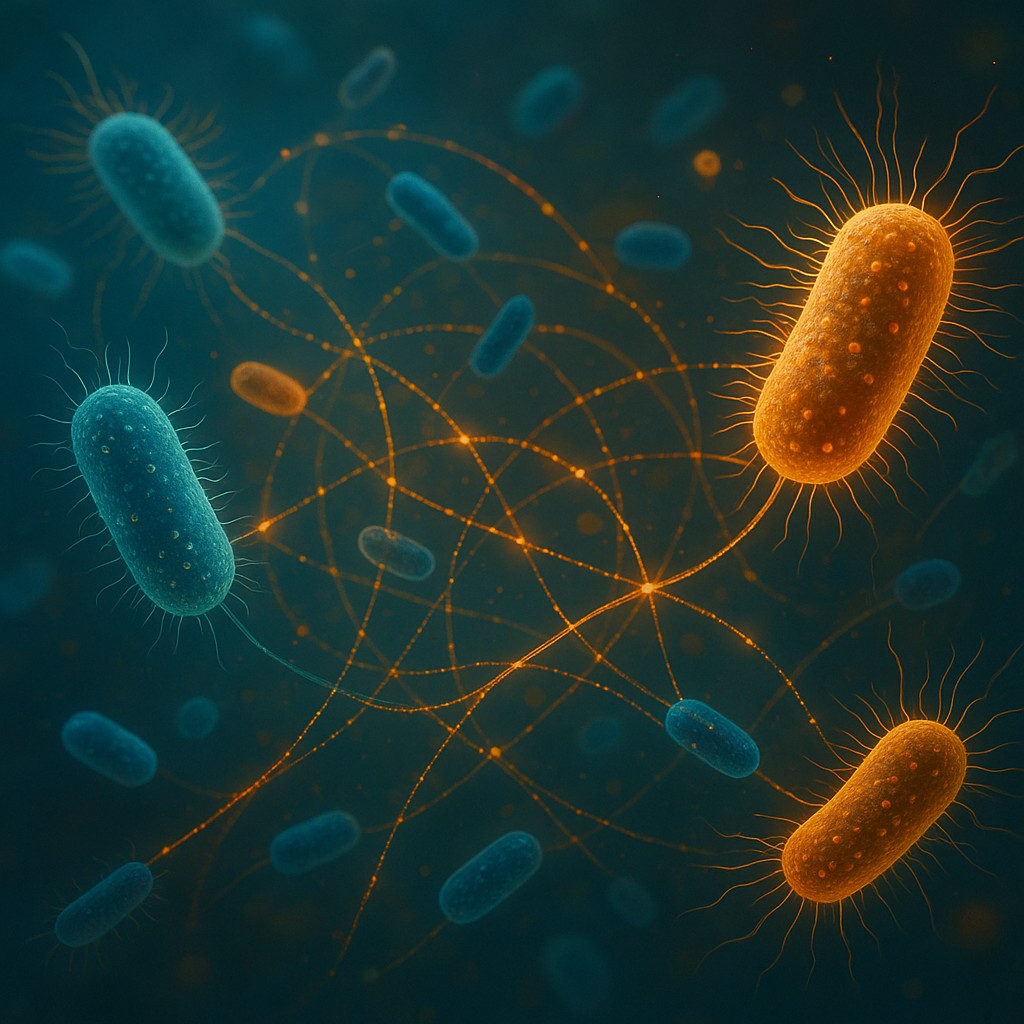
In the quiet, microscopic corners of a hospital ward or a city's wastewater system, a high-stakes trade of information happens every second. We usually think of evolution as a slow, generational crawl where parents pass traits to their children. However, bacteria have mastered a much faster shortcut. Imagine if you could walk up to a stranger on the street, shake their hand, and instantly gain the ability to speak fluent French or play the cello. For bacteria, this isn't science fiction; it is their primary way to survive. They don't just wait for a lucky mutation to help them survive an antibiotic. Instead, they actively download the "blueprints" for resistance from their neighbors.
This biological file-sharing system changes everything we thought we knew about infection control. Public health agencies no longer look at individual "bad bugs" in isolation. Instead, they use high-speed genomic sequencing (a process that maps an organism's entire DNA) to treat bacterial communities like a massive, interconnected social network. By mapping how resistance genes move rather than just tracking the bacteria themselves, researchers can see how a harmless microbe living in the soil might hand off a "survival kit" to a deadly germ in an operating room. Understanding this invisible web of transmission is the key to staying one step ahead of the next superbug.
The Horizontal Revolution of Bacterial Software
Most people are familiar with "vertical gene transfer," which is the traditional "family tree" model of biology. A mother cell divides into two daughter cells, passing down its DNA like an inheritance. If the mother cell had a mutation that made it resistant to penicillin, both daughters will have it too. This process is slow and depends entirely on how fast the bacteria can reproduce. However, bacteria also use "horizontal gene transfer" (HGT). This looks less like a family tree and more like a crowded internet cafe where everyone is sharing USB drives. This allows even unrelated species of bacteria to trade genetic material in real time.
The primary vehicle for this trade is the plasmid. Think of a plasmid as a small, circular "accessory" piece of DNA that exists outside the main bacterial chromosome. If the chromosome is the essential operating system the bacteria needs to function, the plasmid is a specialized app. One plasmid might contain the instructions for "How to Deactivate Tetracycline," while another might offer "Iron Acquisition in Hostile Environments." Bacteria can copy these plasmids and physically "toss" them to neighboring cells through various methods. These include conjugation (bacterial "sex" where they form a physical bridge), transformation (picking up DNA from their surroundings), or transduction (delivery via viruses).
This means that drug resistance is a group effort. A population of bacteria can "crowdsource" its defenses. Even if a specific germ has never encountered a certain drug before, it can survive an attack if it happens to be standing next to a harmless environmental microbe that already has the right "app" installed. This fluid exchange makes the microbial world incredibly resilient and unpredictable. A single resistance gene can hop across species boundaries faster than we can develop new medicines.
Decoding the Genomic Paper Trail
To track this invisible trade, scientists use Whole-Genome Sequencing (WGS). In the past, if a hospital had an outbreak of E. coli, labs would simply try to grow the bacteria in a petri dish to see which drugs killed it. This was like trying to identify a criminal by only looking at their height and weight. Today, genomic surveillance allows us to read the bacteria's entire "manifesto." We can see the exact sequence of every gene, allowing us to identify not just the species, but the specific strain and any suspicious plasmids it might be carrying.
By comparing these genetic sequences across different patients and environments, public health agencies can build a map of how the infection spreads. If three patients on different floors of a hospital have different species of bacteria, but all those bacteria carry an identical, highly specific resistance plasmid, investigators know they are dealing with a single "plasmid outbreak." The bacteria are different, but the weapon they are using is the same. This allows hospitals to find a common source, such as a contaminated piece of medical equipment or a specific sink drain, where these plasmids are being handed out like leaflets at a convention.
| Feature |
Vertical Gene Transfer |
Horizontal Gene Transfer |
| Direction |
Parent to child |
Between unrelated peers |
| Speed |
Slow (based on reproduction) |
Rapid (nearly instant) |
| Genetic Diversity |
Limited to small mutations |
Access to a massive "shared library" |
| Analogy |
Inheriting your father's nose |
Downloading a software update |
| Impact on Resistance |
Stays within one family line |
Spreads across entire ecosystems |
The Environmental Reservoir and the Pathogen Bridge
One of the most startling discoveries of modern genomic surveillance is how much the "outside world" influences human health. We used to think that drug resistance was something created in hospitals because that is where we use the most antibiotics. However, resistance genes are actually ancient. Soil bacteria have been producing natural "antibiotics" to fight each other for millions of years. Consequently, they have also been evolving "resistance" to those chemicals for just as long. These environmental microbes are the original authors of the resistance apps.
The danger arises when these environmental genes find a bridge into the human population. This often happens in places where humans, animals, and waste meet. For example, runoff from a farm might carry animal bacteria into a river, where they meet urban sewage. In this "genetic melting pot," a harmless water bacterium might trade a resistance plasmid to a human pathogen like Klebsiella. Because our genomic surveillance is now sensitive enough to track these specific "genetic signatures," we can see these hand-offs happening in real time across the globe.
This "One Health" perspective recognizes that human health is tied to the health of animals and the environment. If we only look at the bacteria inside a patient's body, we are seeing the end of the story, not the beginning. By monitoring wastewater and livestock, public health agencies can spot a new resistance plasmid months or even years before it causes a major outbreak in a city hospital. This early warning system allows doctors to change antibiotic guidelines and "patch" the medical system before the bug even arrives.
Predicting the Next Move in the Microbe Chess Match
The ultimate goal of tracking these networks is to move from reacting to medicine to preventing outbreaks before they start. By using machine learning and genomic data, researchers are beginning to identify "high-risk" plasmids. Some plasmids are like general-purpose tools that can work in almost any species of bacteria, while others are more specialized. If a high-risk plasmid that provides resistance to "last-resort" antibiotics (like carbapenems) is detected in a local sewage plant, hospitals in that area can be put on high alert.
This data allows for very specific interventions. Instead of ordering expensive, hospital-wide changes, managers can find the specific wards where the "genetic traffic" is highest. They might discover that a certain type of cleaning solution works against most bacteria but actually triggers a "stress response" that makes some species trade plasmids more frequently. This level of detail was impossible before we could see the world through the lens of genomic data.
Furthermore, this research is debunking the myth that antibiotic resistance is only an "individual" problem caused by patients not finishing their prescriptions. While using drugs responsibly is vital, genomics shows us that resistance is a communal, environmental trait. A person could follow their doctor's orders perfectly but still pick up a highly resistant germ that "downloaded" its defenses from a source miles away. This shifts the focus from the individual to the system, highlighting the need for better sanitation, cleaner water, and global surveillance networks.
The microscopic world is far more social and cooperative than we ever imagined. By learning to "listen" to the genetic conversations happening between bacteria, we are finally beginning to understand the rules of their game. This knowledge doesn't just help us fight back; it shows the incredible complexity of life. As we continue to map these vast transmission networks, we move closer to a future where we can predict and prevent outbreaks before they ever reach the doctor's office.