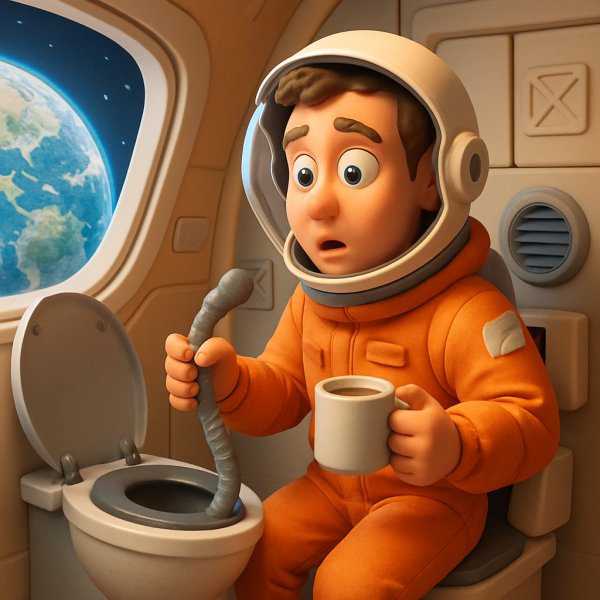
<h2>Imagine being 250 miles above Earth and absolutely needing to go - what then?</h2>
Floating in the gentle hush of a spacecraft, you sip rehydrated coffee, watch the sunrise crawl across continents, and suddenly nature calls. On Earth you would walk into a bathroom, sit, and be done in a few minutes. In space, that simple event becomes a small engineering challenge, a hygiene choreography, and a lesson in physics all at once. Far from comedic, the question of how astronauts go to the bathroom reveals how human needs shape technology when gravity is removed from the equation.
The good news is that astronauts do not float around leaving skid marks or toss waste into the cabin. The more important news is that humans have solved the problem with a mix of suction, clever seals, recycling, and good training. The story touches on fluid dynamics, life-support engineering, water recovery, and even psychology - so buckle up for a surprisingly rich ride through one of the most intimate parts of spaceflight.
<h2>Why peeing and pooping in microgravity is trickier than you expect</h2>
On Earth gravity pulls liquids and solids down into a toilet bowl. In microgravity, there is no "down" to do that work. Liquids form spheres, cling to surfaces, and drift. Without a method to control and collect fluids, urine, sweat, and splashes could contaminate equipment, create slip hazards, or carry microbes into ventilation systems. Solids pose a different problem: without containment they can float away, splatter, or break up, creating tiny particles that are hard to capture and potentially harmful if inhaled.
Engineers therefore design space toilets to manage motion rather than rely on gravity. That means using air flow and mechanical seals to pull urine and feces away from the body into containment devices, preventing floating mishaps and keeping the cabin healthy. It also means integrating waste handling with life-support systems - for example, by turning urine back into drinking water - which changes the toilet from a disposal device into a vital recycler.
<h3>The surprising evolution of space toilets: from makeshift bags to sophisticated recyclers</h3>
Early space missions took a pragmatic approach. During the Mercury and Gemini days astronauts used rubber bags, collection bottles, and absorbent garments for short flights. These solutions were functional but uncomfortable, and they highlighted the need for better systems as missions lengthened. By the Apollo era and especially on space stations, dedicated waste systems were developed, evolving into the modern units used on the International Space Station.
On the ISS and similar platforms, toilets are specialized machines combining fans, pumps, and separators. The American module uses the Waste and Hygiene Compartment, which handles solids with a series of sealed canisters and uses airflow to collect liquids. Other modules, such as those on the Russian segment, use different hardware but the same fundamental principles. Over time the focus shifted from mere containment to resource recovery and crew comfort, with new designs aiming for lower maintenance, higher reliability, and better user experience.
<h3>How modern space toilets actually work - airflow, vacuum, and separation put to clever use</h3>
Modern space toilets use suction to pull waste away from the body and into tightly sealed containers. Airflow does the job that gravity does on Earth: a fan-created airstream draws urine and fecal matter toward a waste inlet where it is captured. For urine, funnels sized for male and female anatomies connect to hoses that carry fluid into a processing stream. For feces, there is a seat with a lid and a bagging system that isolates solids, then compacts or stores them depending on mission needs.
The separation of liquids and solids is key, because liquids are usually processed and recycled while solids require storage or treatment. Sensors and valves monitor the flow, and seals prevent odors and particles from escaping. The design balances ergonomics - the astronaut must align with the inlet - with engineering constraints like mass, power, reliability, and ease of maintenance.
Here is a simple comparison table of urine and feces handling on the ISS:
| Aspect |
Urine system |
Solid-waste system |
| Collection method |
Funnel and hose, using airflow suction |
Toilet seat with air stream and a sealed bag/canister |
| Immediate handling |
Sent to Urine Processor Assembly for reclamation |
Contained, dehydrated or stored in canisters |
| End use |
Recycled into potable water after treatment |
Stored for disposal, sometimes returned to Earth |
| Main challenges |
Preventing leaks, processing brines |
Odor control, compact storage, periodic replacements |
<h4>Step-by-step: what an astronaut does when using the ISS toilet</h4>
Using the ISS toilet is a procedure, practiced on the ground and reinforced in training. First, the astronaut secures themselves to the toilet using foot restraints and thigh straps to maintain alignment - think of tiny seatbelts that stop you from drifting away. For urine, the astronaut positions the funnel, turns on the fan, and lets suction guide the flow into a hose. For feces, the astronaut sits on the seat, uses the air flow to pull waste into a bag beneath the seat, and then closes the lid and seals the bag for storage.
After use, cleaning is done with no-rinse wipes; waste bags are sealed and moved to storage; and surfaces are wiped down. For urine, the hose is flushed with water and then returned to its cradle. Throughout the process, sensors and labels confirm that canisters are properly installed and not overfilled. The procedure might sound involved, but with training it becomes quick and routine.
<h4>Hygiene, smells, and the human side of using a bathroom in orbit</h4>
Privacy matters more than you might expect. Crews typically use curtains or dedicated stalls and schedule time for personal hygiene, and maintaining dignity is a design goal for toilets. Odor control relies on a combination of sealed containers, activated charcoal filters, and continuous air circulation. Still, cabin smells can be a concern, so crews are trained to manage the system and report any persistent odors.
Hygiene involves more than odor - microbial control is crucial. Surfaces are regularly cleaned, and materials are chosen to resist bacterial growth. Menstruation, incontinence, and diapers are accommodated with disposable garments, pads, and specially designed devices when needed. The overall aim is to make the experience as normal and comfortable as possible for a crew living in close quarters for months.
"Spaceflight changes everything, even the way you do the smallest daily tasks. A functioning, comfortable toilet does more than dispose of waste - it supports morale, health, and mission success."
<h3>How pee becomes drinking water - the science of urine recycling</h3>
One of the most impressive achievements of space habitation is turning urine back into water. The ISS uses a Water Recovery System that includes the Urine Processor Assembly. Urine is treated, distilled in low-pressure conditions, and filtered through multiple stages including particulate filters, ion exchange, catalytic oxidation, and activated carbon. The result is reclaimed water that meets strict purity standards and is used for drinking, food rehydration, and other needs.
NASA reports that the ISS can recover about 70 to 90 percent of water from urine and humidity, depending on the specific system and maintenance status. This recycling reduces the amount of water that must be launched from Earth, which is hugely important because every kilogram taken to orbit is expensive. The technology also influences terrestrial water treatment research, particularly in arid regions and disaster response, showing clear practical value beyond space.
<h3>Designing for the Moon, Mars, and long voyages - the next toilet frontiers</h3>
Long missions to the Moon and Mars create new challenges. With longer durations, toilets must be more reliable, easier to maintain by non-experts, and lighter and more compact. Lunar habitats add another wrinkle - the Moon has some gravity, but it also has abrasive dust that can jam mechanisms. Mars has partial gravity and big communication delays, so systems must be autonomous or fixable without immediate expert help.
NASA is developing the Universal Waste Management System for Artemis missions, and commercial providers are working on alternatives for crewed landers and habitats. The goals include reducing consumables, simplifying maintenance, improving comfort, and ensuring compatibility with waste-processing or storage plans. For Mars missions, engineers must decide whether to store waste for return, process it in-situ for resource recovery, or use it in habitat life-support loops.
<h4>Design problems solved and design problems still keeping engineers awake</h4>
Many acute problems have solutions: airflow-based collection, sealed canisters, and recycling loops are proven. But some issues remain active areas of research and careful testing. Biofilm formation in pipes can clog systems and harbor microbes; handling menstrual and hygiene products requires robust, adaptable receptacles; and the psychological impact of privacy and smells on long-duration crews needs ongoing attention. Engineers also worry about redundancy - a single-point failure in a toilet system on a months-long mission could reduce crew wellbeing and mission efficiency.
Testing, redundancy, and crew training are core risk mitigations. Ground analogs, underwater simulations, and parabolic flights help refine designs, and feedback from astronauts directly informs iterations. The aim is to design toilets that are modular - easily swappable components - and diagnosable with simple tools, reducing the need for spare parts and complex repairs in remote missions.
<h3>Common myths checked and set straight</h3>
Myth: Astronauts simply pee in a bag and toss it out the window. Reality: While urine collection bags were used on very early missions or in emergencies, modern systems collect and often recycle urine. Nothing is simply thrown into space from the ISS, and deliberate venting is carefully controlled.
Myth: Space toilets are small and primitive. Reality: They are compact but sophisticated machines that incorporate pumps, fans, sensors, and water-recovery tech. They are engineered for durability and cleanliness, not cramped indignity.
Myth: Floating poop is a real risk. Reality: Solid waste is contained and managed. Floating particles are a concern, which is why filters, sealed canisters, and cleaning protocols are essential.
<h3>Thought experiments and small design challenges for curious readers</h3>
What if you had to design a toilet for a one-person habitat on Mars that would be serviced only once every two years? How would you balance mass, reliability, and human comfort? Consider using simple questions to frame your design: how will you prevent leaks, how will you store or process solids, and how will you recycle or treat urine? Sketch a flow: collection - initial separation - treatment - storage or reuse.
Try this mini-challenge: list three redundant systems you would include to prevent toilet failure from disrupting a long mission, and explain why. Possible answers could include duplicate fans to maintain suction, a manual mechanical pump for emergencies, and a replaceable cartridge for filters to reduce maintenance time. This kind of systems thinking translates directly to many areas of engineering and problem-solving.
<h3>Practical takeaways you can use on Earth and in thought experiments</h3>
Learning about space toilets sharpens several useful skills: systems thinking - where individual parts interact; risk management - identifying single points of failure; resource recycling - turning waste into usable materials; and human-centered design - making technical systems serve dignity and comfort. These lessons apply to designing resilient infrastructure, emergency kits, or even improving sanitation in low-resource settings.
If you want to explore further, look up NASA's Waste and Hygiene Compartment, the Urine Processor Assembly, and the Universal Waste Management System. Watching astronaut interviews about life aboard the ISS also gives human perspective; they often talk candidly about training, routines, and the small rituals that make life in space possible.
<h4>A short, human case study - when toilets need a hands-on fix in orbit</h4>
During long missions, components sometimes fail and crews become technicians. Astronauts on space stations have performed repairs ranging from simple part swaps to complicated replacements that required careful coordination with engineers on Earth. These repairs demonstrate the value of modular design and thorough ground training; crewmembers practice hands-on maintenance before flight, and mission control guides them step-by-step during the real operation.
The lesson is that even elegant systems can break, and the human element - flexible thinking, calm troubleshooting, and good communication with ground teams - is as important as hardware. Crews report that solving these problems together builds confidence and cohesion, turning an awkward bathroom failure into a story of teamwork.
Final reflection: next time you use your bathroom, think about the clever physics and engineering that usually go unnoticed. In space, a bathroom is not a private luxury - it is a vital link in the life-support chain. That small, rather ordinary act of going to the toilet becomes an opportunity to marvel at how humans adapt and innovate when we leave the comforting pull of Earth and learn to live among the stars.