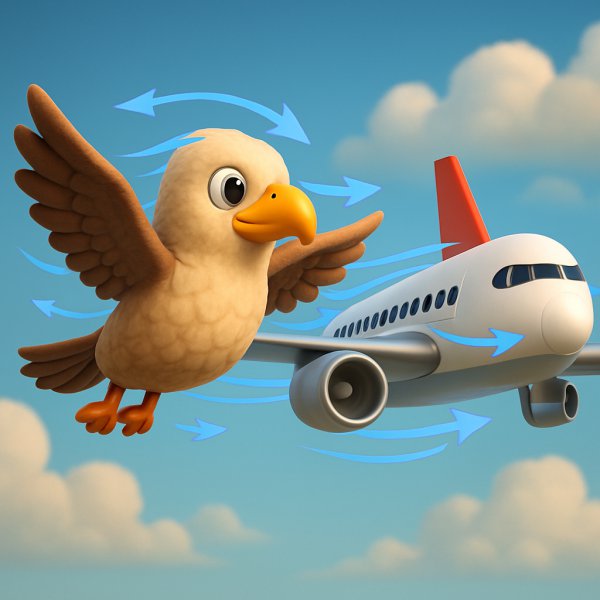
Imagine a giant bird with a clever secret: how planes lift off and stay in the air
Have you ever watched an airplane climb away from a runway and wondered how that huge metal thing manages to float above the ground? It is one of those everyday miracles that feels obvious when you see it, but when you try to explain it you discover a surprising blend of simple forces, clever shapes, and careful control. Planes fly because air pushes them up while engines push them forward, and engineers have learned how to shape and balance those pushes so an airplane becomes a predictable, obedient machine rather than a sky-bound boulder.
Let us walk from the obvious to the subtle. We will use vivid analogies, a touch of physics, stories about real inventors, and some small experiments you can try at home or in your head. By the end you will not only be able to answer the question How do planes fly? but also explain why stalls happen, why wings are shaped the way they are, and how pilots steer a huge vehicle like a pen balanced on a finger.
Feeling lift with a thought experiment and a piece of paper
Hold a stiff sheet of paper by one short edge and let the rest hang down. Now blow across the top of the paper. If you did it right, the paper lifts upward. That simple trick is a concentration of the same physics that helps airplanes fly. Two things happened: your breath sped up over the top surface, and the paper rotated a bit so the hanging part got pushed up. The result is lift.
This experiment introduces two ways to think about lift. One explanation describes pressure differences when air speeds up, and another describes how the wing redirects air down, producing an upward reaction force. Both are true and both are needed to build intuition.
The two core ways to explain lift - and how they agree
A wing makes lift by changing the speed and direction of air around it. The explanations most people hear fall into two families, which are often presented as competing but are actually complementary. Here is a short table to keep them straight.
| Way of explaining lift |
Key image |
What it emphasizes |
Classic source |
| Pressure difference (Bernoulli-style) |
Air moves faster over curved top, pressure falls |
Faster air means lower pressure, pressure difference pushes wing up |
Bernoulli principle, used by aerodynamicists |
| Momentum change (Newton-style) |
Wing pushes air down, air pushes wing up |
Force arises from redirecting air downward |
Newton's third law, intuitive for engineers |
Both explanations are consistent: speeding up air over the wing often means air is being turned downward. The quantitative formula that engineers use blends these ideas: Lift L = 0.5 * rho * V^2 * S * CL, where rho is air density, V is speed, S is wing area, and CL is the lift coefficient that depends on wing shape and angle. That formula shows why bigger wings, faster speeds, or a higher CL produce more lift.
Anatomy of a wing and the cleverness of its shape
A wing is not a flat plank. Wings are subtly curved and twisted. The top surface usually bulges outward a bit while the bottom is flatter; this curvature is called camber. The wing's angle relative to the incoming air is the angle of attack. Together these two features control how the air flows and how much lift the wing creates.
Wings also have devices: flaps that increase surface area and camber for takeoff and landing, slats that smooth the airflow at high angles, and spoilers that deliberately disturb the flow to reduce lift or increase drag. Winglets at the tips reduce energy-wasting vortices that form from high-pressure air under the wing spilling to the low-pressure top. Every shape choice is a compromise between lift, drag, weight, structural strength, and fuel efficiency.
A helpful analogy is to picture the wing like a spoon moving through water at a slight angle. The spoon pushes water down and creates lift that supports the spoon. Change the spoon’s angle too much and the flow becomes messy; the spoon stalls and loses lift. That stall is exactly what happens when an airplane wing exceeds its safe angle of attack.
Angle of attack, stalls, and the sweet spot of flying
Angle of attack is the secret knob pilots and designers care about. It is the angle between the wing’s chord line and the incoming air. As angle of attack increases from zero, lift rises steeply because the wing deflects more air downward and the pressure distribution improves. But after a certain point the air can no longer follow the wing’s top surface and separates, causing a sudden loss of lift known as a stall.
Stalls are not mechanical engine failures; they stem from the fluid dynamics of air. Modern aircraft are designed with warning systems and stall recovery procedures because pilots need to know when the wing is approaching that limit. Glider pilots and aerobatic flyers are particularly tuned to feel the onset of stall because they fly close to aerodynamic limits to get the best performance.
Reflective question: next time you look at the wings on approach, imagine the pilot managing angle of attack, speed, and flaps like tuning three sliders on a radio to keep the plane comfortably in the lift zone.
Thrust, drag, and the dance of forces in steady flight
Lift fights gravity and thrust fights drag. Engines — propellers or jets — provide forward force called thrust. As the aircraft speeds up, air flowing around the wing creates lift. Drag is the aerodynamic resistance that opposes motion through the air, coming from friction, pressure differences, and the wing’s shape.
In level, steady flight, three conditions hold: lift equals weight, thrust equals drag, and moments are balanced so the plane does not pitch uncontrollably. Pilots and autopilots constantly manage throttle, trim, and control surfaces to keep these balances. When climbing, the pilot increases thrust or angle of attack so lift exceeds weight temporarily. When descending, thrust is reduced or pitch lowered.
A practical tip for a non-pilot: when you fly commercially, the pilot is continuously managing small changes in these forces; what feels like turbulence is often the aircraft adjusting to tiny gusts and temperature variations. The plane is not "fighting" the air; it is negotiating with it.
Control surfaces, stability, and how pilots steer an airplane
An airplane uses three primary control axes: roll, pitch, and yaw. Each is controlled by a specific surface: ailerons for roll, the elevator for pitch, and the rudder for yaw. Smaller devices, like trim tabs and spoilers, fine-tune behavior and reduce pilot workload.
Designers also ensure stability. A stable airplane, like a tossed ball that rights itself, returns toward straight flight when disturbed. Engineers achieve stability by placing the center of gravity and tail surfaces so that the plane resists rapid pitching or yawing. Fighter jets trade some stability for maneuverability, making them harder to fly without computer assistance, while airliners favor stability for passenger comfort and safety.
Quote:
"An airplane is just not a great place to be without a little stability." - paraphrase of classic aerodynamic wisdom.
Case study: From the Wright brothers’ wind tunnel to modern jets
The Wright brothers were the first to understand that controlled, powered flight needed careful testing of wing shapes and control systems. They built a wind tunnel in 1901 and measured lift and drag for different wing sections. Their experiments showed how small changes in shape and angle matter, and they invented the idea of wing-warping to control roll, which later evolved into ailerons.
Fast-forward to the 21st century and modern aircraft like the Boeing 787 or Airbus A350 use carbon-fiber materials, winglets, and highly optimized wing shapes to reduce drag and save fuel. NASA and other research agencies run computational fluid dynamics models and wind tunnel tests to squeeze ever more efficiency from wings. The flight principles remain the same, but our tools and materials have made flight far cleaner and more reliable.
Common misconceptions and simple corrections
-
Misconception: Wings are shaped so that air has to travel farther over the top, and thus faster, and that is the sole reason for lift. Correction: The "equal transit time" story is a simplification that leads people astray. In reality, air over the top typically moves much faster than the bottom and does not arrive at the trailing edge at the same time as bottom air. Lift comes from both pressure differences and momentum change, not from a forced equal travel time.
-
Misconception: Heavier planes need different physics to fly. Correction: Physics is the same for any weight; heavier aircraft simply need more lift, which requires larger wings, higher speed, or higher lift coefficients.
-
Misconception: If engines fail, planes must fall immediately. Correction: Airplanes are gliders with heavy inertia and efficient wings. Pilots train to glide and find safe landing options; many emergency landings have succeeded because the aircraft can glide for dozens of miles.
Small challenges and mental experiments to deepen understanding
-
Paper airplane lab: Make two paper gliders, one with a flat wing and one with a curved top. Throw them gently and observe differences in glide distance and stability. Try adding small upward-deflecting tabs at the rear (like trim) to see how pitch changes.
-
Visualize lift: Stand near a busy highway and watch leaves swirl when big trucks pass. The truck pushes air and creates pressure differences that lift and toss leaves. That is a mini demonstration of momentum transfer and pressure effects.
-
Calculate basic lift: Use the lift formula L = 0.5 * rho * V^2 * S * CL to estimate the lift for a small model glider. Assume rho = 1.225 kg/m^3, pick reasonable values for V, S, and CL, and see what combinations give enough lift to match the model’s weight.
Reflective question: If you could change one thing about airplane wings to make them more efficient, what would you try - more span, less drag, lightweight materials, or adjustable geometry? Think about tradeoffs.
Practical tips for passengers and aspiring pilots
-
For nervous flyers: understand the plane’s wings are designed to be forgiving. Many safety systems and redundant controls exist so pilots can handle problems comfortably.
-
For DIY experimenters: use cheap model gliders or toy drones to explore how changing wing area, weight, or angle affects performance. Controlled, small tests teach more than watching videos.
-
For prospective pilots: practice recognizing the signs of approaching stall - mushy controls, higher nose attitude for same speed, and gentle buffet. Stall recovery is primarily lower angle of attack and adding power.
Final thought: Flight is simple physics dressed in engineering elegance
Planes fly because wings are shaped and controlled to manage air flow, creating lift that balances gravity while engines provide the forward push needed to keep air moving. The story of flight is an excellent example of how careful measurements, repeated experiments, and creative problem solving turn simple physical laws into practical technology. From a paper airplane in your hand to a jet crossing an ocean, the principles are the same, and our growing mastery of them has changed the world.
If you leave with one clear image, picture a wing as a clever scoop that redirects a river of air downward, and remember that every steady, graceful flight is the result of countless tiny nudges by a pilot or autopilot keeping lift, thrust, and balance in harmony. Now go fold a paper airplane, adjust its wings, and see physics in action.