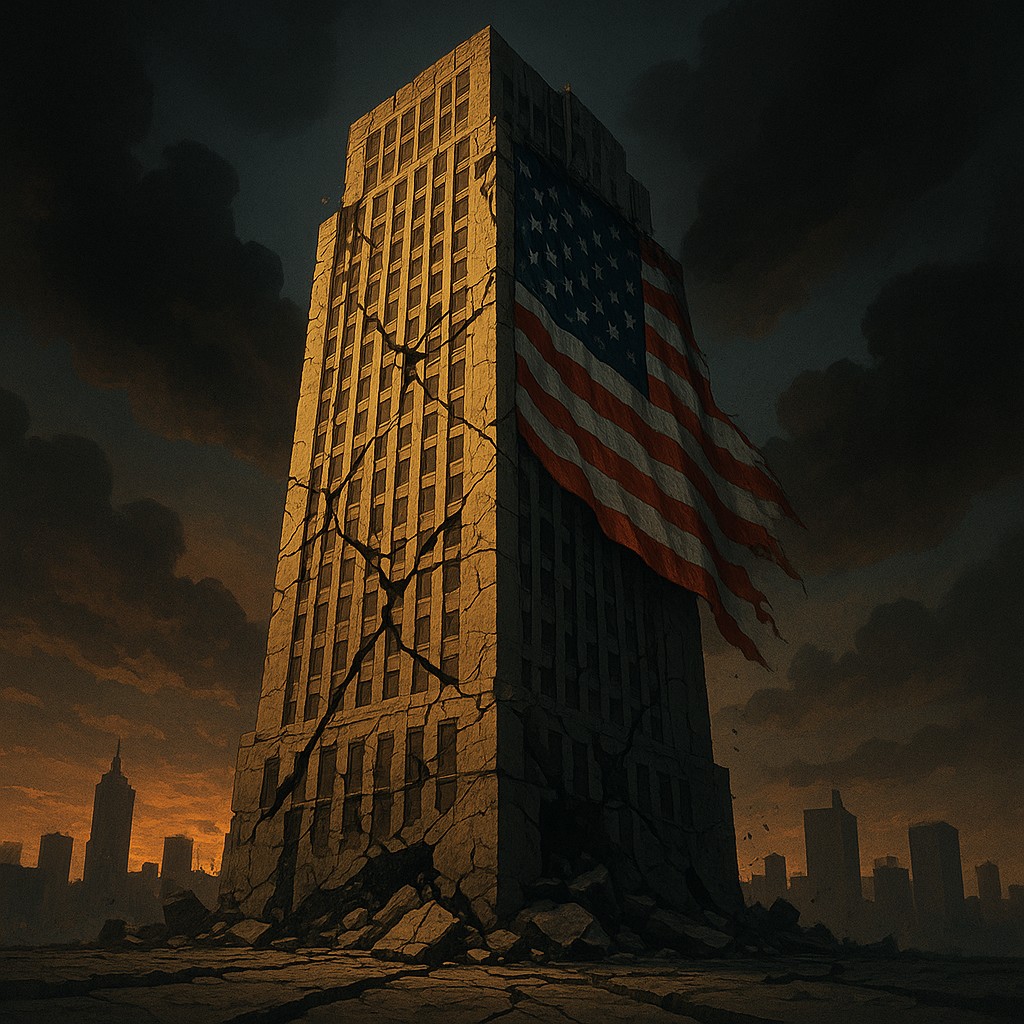
History is a graveyard of "unbeatable" empires, filled with the ghosts of civilizations that believed their sun would never set. From the marble columns of Rome to the tea-soaked harbors of Victorian Britain, the pattern of rise and fall is as rhythmic as the tides. When we look at the United States today, we see a global superpower that has shaped the world's money, culture, and military since the end of World War II. However, no superpower is immune to the laws of decay. Understanding how such a massive entity might unravel is more than just a gloomy thought experiment; it is a fascinating study of politics, economics, and human nature.
Think of an empire like a giant skyscraper. On the outside, it looks shimmering and solid, but its true health depends on the strength of the steel beams inside and the stability of the ground beneath it. A collapse rarely happens because of one single explosion. Instead, it is usually a slow buildup of cracks in the foundation, a bit of rust on the bolts, and a sudden storm that the building is too weak to handle. In this exploration, we will dive into what a modern American "fall" might actually look like, focusing on the internal and external pressures that have historically brought down the giants of the past.
Domestic Economic Troubles
Economics is the lifeblood of any empire, and for the United States, that blood is the U.S. Dollar. Since the mid-1900s, the dollar has been the world's primary reserve currency. This means almost everyone on Earth uses it to trade essential goods like oil, gold, and electronics. This gives the U.S. an "exorbitant privilege," allowing it to borrow money at lower costs and run massive deficits that would sink any other nation. If the world were to suddenly lose faith in the dollar, perhaps due to permanent high inflation or the rise of a digital or gold-backed competitor, the U.S. would find itself unable to fund its massive global presence.
Beyond the currency itself, there is the staggering reality of the national debt. While debt is common for nations, the "debt-to-GDP ratio" (the size of the debt compared to the size of the economy) is the number that keeps economists awake at night. When the cost of merely paying interest on what you owe begins to dwarf the amount of money spent on education, roads, or defense, you have entered a "debt spiral." In this scenario, the government might be forced to print more money to cover its bills. This devalues the currency even more and wipes out people's savings. This economic hollowing out doesn't just make people poorer; it destroys the social bond that keeps a country together.
The Friction of Internal Division
A house divided against itself cannot stand. Historically, internal fighting kills empires more often than foreign invasions do. In a hypothetical fall, the primary driver would likely be "affective polarization." This is a technical term for when people stop just disagreeing on policy and start viewing their neighbors as enemies. When a society loses its shared reality, the basic functions of government begin to jam. Laws aren't passed, budgets aren't settled, and the peaceful transfer of power, the hallmark of a stable republic, becomes increasingly shaky.
This internal friction often shows up as a decline in trust. When citizens no longer believe that the courts, the media, or the voting system are fair, they stop playing by the rules. We might see a scenario where different states or regions begin to ignore federal laws, leading to a "soft dissolution" of the country. In this version of the fall, the U.S. doesn't disappear from the map, but it becomes a dysfunctional collection of bickering territories rather than a unified superpower. The machinery of the state becomes so heavy with red tape and resentment that it simply stops moving.
The Burden of Global Overstretch
The concept of "imperial overstretch" describes a situation where a nation's global commitments cost more than it can afford. The United States currently maintains hundreds of military bases around the world and promises to protect dozens of other nations. This is a massive logistical and financial task. If the economy at home weakens, the U.S. would face a "guns vs. butter" dilemma: does it keep aircraft carriers in the South China Sea, or does it fix crumbling bridges in the Midwest?
As the U.S. pulls back from its global roles due to budget cuts or a lack of public support, it creates a power vacuum. Politics, like nature, hates a vacuum. Other regional powers will start to push their own agendas, and the international system the U.S. built will begin to break apart. This leads to a loss of "soft power," which is the ability to get what you want through attraction and influence rather than force. When the world no longer looks to American culture, technology, or diplomacy as the gold standard, the empire loses its invisible grip on world affairs. At that point, a final decline feels inevitable.
Comparing Drivers of Historical and Modern Decline
To understand how the U.S. compares to the giants of the past, it helps to see the recurring themes that lead to a shift in world power. The following table summarizes how these factors might appear in a modern American scenario compared to the Roman Empire.
| Factor of Decline |
Roman Empire Example |
Hypothetical U.S. Scenario |
| Monetary Issues |
Mixing cheap metals into silver coins until they were worthless. |
Loss of the U.S. Dollar's status as the world's main currency. |
| Military Strain |
Relying on foreign mercenaries and defending borders that were too long. |
"Imperial overstretch" and the rising cost of high-tech war. |
| Social Unity |
Constant civil wars between competing generals and emperors. |
Extreme political division and loss of trust in the system. |
| Infrastructure |
Decay of the Roman road system and failing water aqueducts. |
Aging power grids, bridges, and digital networks. |
| External Pressure |
Migrations and invasions by Germanic tribes like the Goths. |
Rise of several competing world powers and economic groups. |
The Fragility of Complex Systems
Modern societies are incredibly complex. This makes them efficient, but it also makes them fragile. We rely on "just-in-time" shipping, satellite networks for GPS and banking, and a massive power grid that is vulnerable to both physical attacks and hacking. In a hypothetical collapse, the spark might not be a political revolution, but a "cascading failure" of these systems. Imagine a massive solar flare or a sophisticated cyber-attack that knocks out power and the internet across the continent for weeks.
In a world where no one carries cash and food is delivered by trucks guided by satellites, such a disruption would lead to immediate chaos. If the government cannot restore order or provide basic services quickly, local communities might take matters into their own hands. This shift to local power is a classic sign of imperial collapse. People stop looking to the distant capital for help and start looking to whoever can provide safety and food nearby. The vast, interconnected empire effectively breaks into smaller, self-sufficient pieces that are no longer interested in the national cause.
Myths of the Sudden Crash
It is a common mistake to think that empires "fall" like a tree in the woods, with a loud crash on a specific day. In reality, it is usually a "transition" or a "decline" that takes decades. People living through the fall of Rome didn't wake up one Monday and say, "Well, that's it for the Empire." For most people, life simply got a little more expensive, a little more dangerous, and the government felt a little further away each year. The myth of the sudden crash often prevents us from seeing the quiet erosion of the things that make a nation great.
Another myth is that a fall must be caused by one "bad" leader. While leadership matters, the fall of a superpower is usually built into the system. Even the most brilliant leader cannot easily reverse fifty years of debt or a shift where the population is aging faster than it can be replaced. Decline is often the result of success itself; a nation becomes so wealthy and comfortable that it stops inventing new things and starts bickering over how to divide what it already has.
The Resilience of the American Idea
While the study of decline is serious, it also highlights the unique strengths that have allowed the United States to reinvent itself several times before. Unlike many previous empires, the U.S. is not built on a single ethnic group or a royal family, but on a set of ideas. If those ideas, such as individual liberty, the rule of law, and the spirit of innovation, remain healthy, they act as a powerful "immune system" against total collapse. History shows that nations that can adapt to new realities often find a way to thrive in a "post-superpower" world, even if they aren't the only leader anymore.
The hypothetical fall of the U.S. wouldn't necessarily mean the end of the American people or their culture, but it would mean the end of an era where America ran the show. To prevent the "rust" from winning, a society must remain curious, self-critical, and willing to invest in the future rather than just spending what it earned in the past. As we look at the challenges ahead, from AI to climate change, the goal isn't just to survive as an empire, but to grow into a more durable version of a republic. By understanding the traps that caught Rome and the British Empire, we gain the perspective needed to build a foundation that is not just tall, but truly lasting.