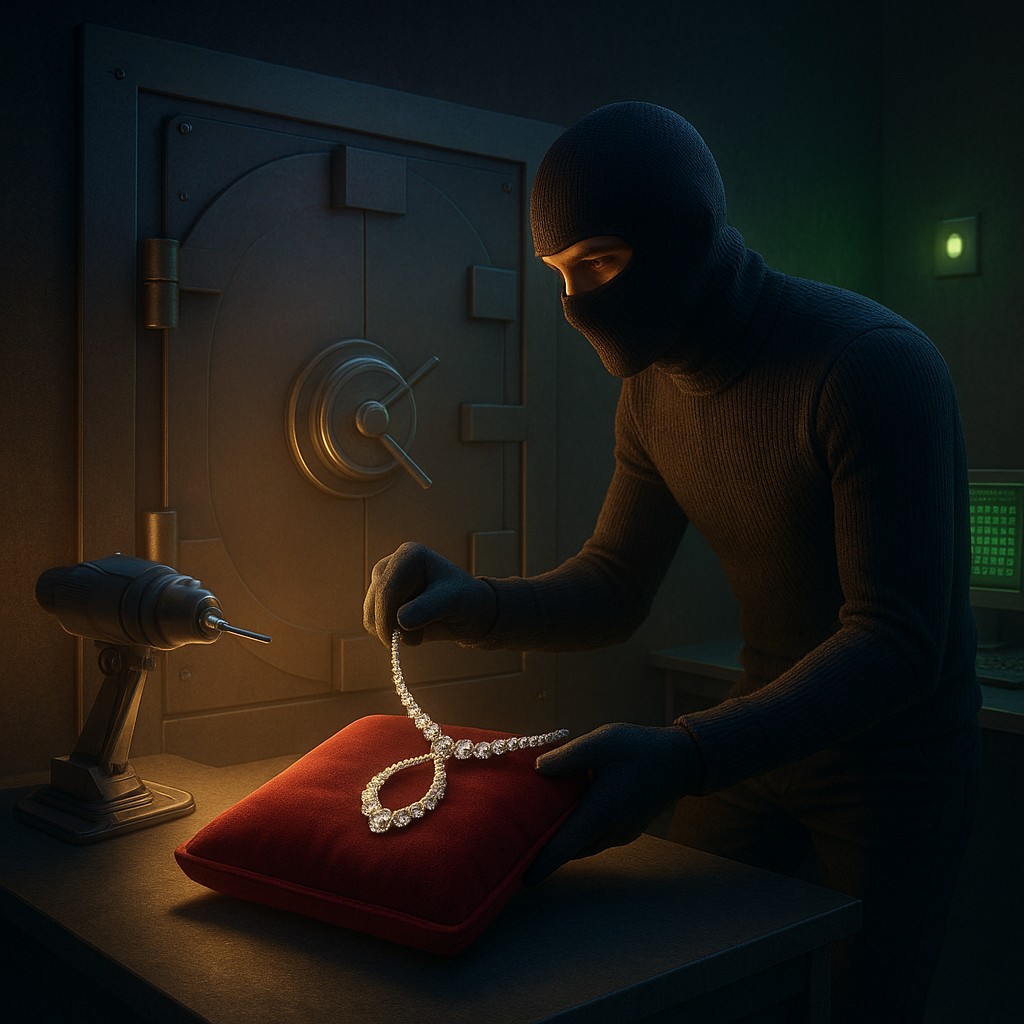
Imagine you are a master thief standing before a high-security vault in the basement of a silent museum. You have spent months preparing for this moment, bringing a high-speed robotic glass cutter and a computer capable of testing millions of digital combinations every second. In the world of traditional cybersecurity, this vault is honest. If you punch in the wrong code, the red light flashes, the buzzer sounds, and the heavy steel door stays shut. While the door is locked, it still gives you a vital piece of information: it tells you that you are wrong. This feedback is a compass for hackers. It tells them to toss that specific key aside and try the next one, letting them systematically narrow down the options until the door finally swings open to reveal the gold.
But now, imagine a different kind of vault. You punch in a random code, and to your surprise, the light turns green. The door clicks open, and inside, you find a velvet cushion holding a glimmering diamond necklace. You grab the prize and vanish into the night, only to discover later at a pawn shop that the stones are worthless glass. Meanwhile, the real diamond is still sitting in that same vault, protected by a different combination you never even tried. This is the psychological and mathematical shift brought about by "honey encryption." It transforms a digital lock from a brick wall into a hall of mirrors, where every wrong turn feels like a victory and the truth is buried under a mountain of convincing lies.
The Flaw in the Traditional Digital Fortress
To understand why we need a new way to hide data, we have to look at how traditional encryption works. Most modern security relies on "all or nothing" logic. When you encrypt a file, you are essentially scrambling the data into a chaotic mess of bits known as ciphertext. To turn that mess back into something readable, you need the correct mathematical key. If an attacker tries to guess your password using a "brute force" attack - simply guessing every possible combination - they are essentially throwing millions of keys at the lock. Every time they use the wrong key, the system produces "garbage" data, which looks like random electronic noise. An attacker’s computer can instantly recognize this noise as a failure, discard the key, and move on to the next attempt in a fraction of a millisecond.
The problem here is not that the lock is weak, but that the lock is too helpful. By signaling whether a guess is right or wrong, the system assists the attacker in their search. Even the strongest encryption methods are theoretically vulnerable if an attacker has enough time and computing power to try every possible combination. As computers get faster and the threat of quantum computing grows, the time required to exhaust these possibilities keeps shrinking. We have spent decades making the walls thicker and the locks more complex, but we have ignored the fact that we are still giving the burglar a map that tells them exactly where they are in their search.
Turning the Tables with Plausible Deniability
Honey encryption flips the script by removing the "error message" entirely. In this system, there is no such thing as a wrong key in the eyes of the attacker. Whether they type in "password123" or the actual complex key, the system will always spit out something that looks like valid information. If the vault contains a list of credit card numbers, every single incorrect guess will generate a fake list of credit card numbers that follow the correct format and logic. If the vault contains medical records, every wrong key produces a fake record with realistic names, blood types, and diagnoses.
This creates a massive bottleneck for the hacker. Suddenly, their high-speed computer cannot tell the difference between a successful hack and a decoy. The verification process, which used to be handled automatically by a simple line of code, now requires a human being to step in and investigate the data. Imagine a hacker who generates ten thousand "decrypted" files in an hour. Instead of having one real file and 9,999 files of gibberish, they now have 10,000 files that all look authentic. To find the real prize, they would have to manually verify the social security numbers, call the "customers" on the list, or try to use the credit card numbers. The sheer amount of work involved makes the attack too expensive and slow to be worth it.
How Context-Aware Decoys Work
The magic of honey encryption lies in a component called a Distribution Transforming Encoder (DTE). Standard encryption treats data as just a string of ones and zeros, but honey encryption understands the shape of the data it is protecting. For a decoy to work, it must look exactly like the real thing to an automated script. If you are protecting a list of US zip codes, the DTE ensures that every decoy generated also consists of five-digit numbers that correspond to actual locations. If the system produced a zip code like "99999" or "ABCDE," the hacker’s computer would immediately flag it as a fake.
This requires the programmer to build a map of the data types before the encryption happens. If the data is a collection of text messages, the honey encryption system uses language models to ensure the fake outputs follow the rules of grammar and normal conversation. This way, if a government agent or a digital thief tries to crack a private message, they might end up reading a perfectly ordinary, AI-generated conversation about what to have for dinner, never realizing that the actual message about a secret meeting is hidden under a different key.
| Feature |
Traditional Encryption |
Honey Encryption |
| Result of Wrong Key |
Returns "junk" or an error message. |
Returns a realistic but fake decoy. |
| Feedback Loop |
Tells the attacker immediately that they failed. |
Leads the attacker to believe they succeeded. |
| Primary Goal |
Making decryption mathematically impossible. |
Using deception to waste the attacker's time. |
| Verification |
Can be automated by a computer. |
Requires human judgment or external checks. |
| Burden on Attacker |
Minimal once a key is found. |
Massive labor costs to verify the data. |
Moving Beyond the Password Vault
While the most obvious use for this technology is in password managers, its potential reaches deep into national security and corporate espionage. Consider the world of "Canary Data." Companies often plant fake accounts in their databases to detect if a breach has occurred. Honey encryption takes this a step further by turning the entire database into a field of decoys. If a competitor steals a company’s research database, they might spend years trying to develop a chemical formula or a software algorithm they found in the "decrypted" files, only to find out that the math was subtly flawed in a way that makes the final product fail.
This also has major benefits for whistleblowers and activists working in dangerous environments. In countries with repressive governments, a person might be forced to hand over their encryption keys under threat of violence. With honey encryption, the individual can provide a "duress key" that reveals documents that look sensitive but are actually harmless or fabricated. This provides a layer of safety that traditional encryption simply cannot offer, as it allows the user to satisfy the demand for information without actually giving up their secrets. It plants a seed of doubt in the mind of the interrogator: is this the real data, or just the honey?
The Psychology of Cybersecurity
At its heart, honey encryption is as much about psychology as it is about math. It exploits the "Sunk Cost Fallacy" - the tendency to keep following a failing path because of the effort already put in - and the overconfidence of attackers. When a hacker sees something that looks like a successful decryption, their brain releases dopamine. They believe the hard work is over. By the time they realize they have been chasing a ghost, they may have already exposed their own location, drained their budget, or alerted the authorities by trying to use the fake data. It turns the attacker’s own tools and speed against them, making their efficiency their greatest weakness.
We are moving into an era where "hiding" information is no longer enough. In a world of infinite computing power, the only way to truly protect a secret is to hide it in plain sight, surrounded by a thousand convincing replicas. Honey encryption represents a shift from a defensive mindset to a deceptive one. It acknowledges that no wall is unbreakable, so it focuses on making sure that when the wall does break, the thief finds nothing but a handful of dust and a lot of wasted time.
The beauty of this approach is that it puts the power back into the hands of the defenders. You are no longer just a passive observer hoping your firewall holds; you are an architect of illusions. As you continue to explore the world of technology and security, remember that the most effective shield is often the one the enemy doesn’t even know they are hitting. By embracing the craft of honey encryption, we can build a digital world that is not just harder to break, but much more frustrating to rob. Stay curious, stay skeptical, and always consider what lies beneath the surface of the data you see.