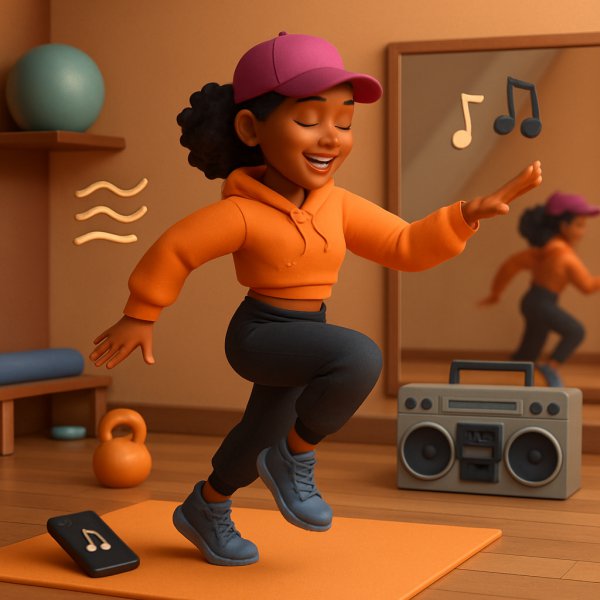
Why hip-hop dance is one of the smartest fitness choices you can make
Imagine a workout that makes you grin, improves your coordination, and leaves you breathless in the best way possible. That is hip-hop dance for fitness in a nutshell. Unlike repetitive gym routines, hip-hop blends rhythm, style, and movement variety so your brain and body both get a workout. It is a cardio session that also trains balance, agility, posture, and expressiveness, which means you come away stronger and more confident, not just tired.
Think about the difference between pushing through a monotonous treadmill interval and learning a new groove that syncs to a favorite track. The latter is more likely to stick because it is fun and meaningful, and the brain rewards novelty with dopamine. That is why people who dance consistently often report better mood, improved memory for movement, and a stronger sense of accomplishment than those who only do traditional cardio. You are not just burning calories; you are building a movement vocabulary.
This Learning Nib will guide you from the very first beat to a full-bodied 30-minute routine you can try today. We will unpack fundamentals, practice drills, progressions, safety, and the science that explains why hip-hop dance is efficient and sustainable for fitness. Expect practical cues, a simple practice plan, and reflection prompts to make the work feel personal and memorable.
Before we lace up, one quick promise: you do not need to be "rhythmic" or have dance experience. Hip-hop dance for fitness is about rhythm training, repetition, and playful experimentation. If you can walk, you can dance. The goal here is progress, not perfection.
The movement building blocks: basic grooves and why they matter
The foundation of hip-hop fitness is groove. A groove is a rhythmic way your body moves with the beat, and it is the doorway to more complex moves. Start with a relaxed bounce - think of your knees as soft springs and your chest as a metronome that follows the snare. Bouncing keeps your center of mass dynamic, improves aerobic capacity, and makes transitions smoother. The bounce also reduces joint impact compared to stiff, vertical movements and helps your body use elastic energy.
Next, learn the two-step. It is a lateral weight shift with rhythm that teaches coordination and timing. Two-step variations build lower-body strength and help ground your balance. From there, add simple upper-body washes - shoulder rolls, chest pops, and arm grooves - to develop arm control and core stability. Isolation drills - moving the ribcage independent from hips - sharpen neuromuscular control and body awareness.
Working these fundamentals in short, repeatable chunks creates muscle memory. Practice counts and phrases in sets of eight beats, because most hip-hop music and choreography is structured in eight-count patterns. When you internalize the eight-count, you can learn combinations faster and improvise on the fly.
Reflection: Which movement above feels most natural to you, and which feels awkward? Spending five minutes exploring that awkwardness is where the biggest improvements happen.
A friendly primer on rhythm, counts, and music selection
If terms like BPM and downbeat feel intimidating, think of them as traffic signals for your body. BPM stands for beats per minute, and it tells you how fast the song goes. For beginners, stick with 90-110 BPM - comfortable for groove and low-to-moderate cardio. As you progress, 110-130 BPM will raise your heart rate more and demand quicker footwork.
Counts are how choreographers chunk music. Most hip-hop choreography works in eight-counts: 1-2-3-4-5-6-7-8. Practice saying the count out loud while moving basic grooves. This ties the auditory pattern to motor output and speeds up learning. The downbeat, usually beat one, is where many moves start or land. Learning to feel and mark that strong beat helps you command the music.
Choose tracks you enjoy. Emotional connection to music increases motivation and retention. Pick two playlists: one for practice (steady BPM, predictable structure) and one for freestyling (varied textures and favorite songs). Over time, your internal metronome will sharpen, and you will find yourself anticipating beats before they arrive.
Safety, warm-ups, and gear that actually matter
Dance fitness is low barrier yet physically demanding. A five-to-ten minute warm-up primes joints and nervous system and reduces injury risk. Start with dynamic movements that increase blood flow: gentle jogging in place, hip circles, walking lunges, arm swings, and ankle rolls. Add some mobility work - thoracic rotations and hamstring walks - to loosen up the chain from head to toe.
Footwear matters. Use sneakers with good lateral support and a durable, grippy sole. Avoid overly sticky shoes that trap your foot on the floor; slight slip is fine as long as you have control. A sprung or wooden floor is ideal because it gives just enough feedback and reduces impact. If you must practice on concrete, add cushioned insoles and keep movements lower impact.
Listen to your body. If a move causes sharp pain, stop and assess the mechanics. Often the issue is over-extension or pushing speed before control. Breath work is essential - exhale on exertion and use rhythmic breathing to manage intensity. Sweat is a measure of effort but not the only measure of a good session.
Simple drills to build coordination, timing, and confidence
Practice is most effective when it is short, consistent, and intentionally challenging. These drills are 2-5 minutes each and can be mixed into any session. Repeat each drill for 3 rounds.
- Bounce + shoulder sync: Keep a light bounce and sync a shoulder roll to every second beat. This builds upper-lower coordination and timing.
- Step touch with arm variations: Step side-to-side and add arm patterns - reach, pull, clap. This improves spatial awareness and arm control.
- Isolation ladder: Glute, hip, chest, then neck isolations in sequence, 8 counts per body part. This trains independent control of body segments.
- Freestyle two-count swap: Every two counts change a single parameter - direction, height, arm, or tempo. This trains rapid adaptability to musical changes.
Do these drills to music you like. Repetition plus novelty is the ideal combo - it builds automaticity while keeping your brain engaged. Keep a short practice log to track what drills you do and where you struggle.
The beginner move set: step-by-step cues and coaching tips
Here are five approachable moves you can use to create routines. Each description includes simple coaching cues and common mistakes to avoid.
- Bounce groove
- Cues: Stand shoulder-width. Slightly bend knees and loosen hips. Imagine bouncing on a mini-trampoline and let your shoulders react to the beat. Keep weight evenly distributed.
- Mistake to avoid: Locking knees or bobbing only from the ankles. Drive the bounce from knees and hips.
- Two-step
- Cues: Step right with weight, bring left to meet, then step left and bring right to meet. Count 1-2-3-4 for a full two-step phrase. Use small steps when learning, then expand into slides.
- Mistake to avoid: Overreaching with feet. Keep steps comfortable to maintain rhythm.
- Body roll
- Cues: Start with chin down, chest forward, then push chest back while rolling through the ribs and finishing with a subtle hip tilt. Keep movement fluid and think of rolling a wave down your spine.
- Mistake to avoid: Stiffness or forcing the motion. Slow the sequence down and isolate each segment until it feels smooth.
- Shoulder pop
- Cues: Isolate one shoulder and quickly lift and drop it with the beat. Alternate shoulder pops and add a slight torso lean to enhance style. Keep neck relaxed.
- Mistake to avoid: Tensing the neck or using full arm movement. Keep it compact.
- Step-turn combo
- Cues: Step forward on one foot, pivot on the ball of the foot to turn 90 degrees, then step out into a groove. Use eyes to lead the turn and keep the core engaged.
- Mistake to avoid: Looking down at your feet or freezing at the end of the turn. Keep the movement fluid and allow momentum.
Practice each move slowly first, then increase musical speed. Use mirrors or record yourself to observe form, but do not over-criticize. The camera is a teacher, not a judge.
Combining moves into progressions and a sample 30-minute workout
Combination is where fitness and choreography meet. Use eight-count building to link moves. For example: eight counts of bounce, eight counts of two-step, eight counts of shoulder pops, eight counts of body roll, then repeat with variations. Here is a practical 30-minute beginner session you can try immediately.
Warm-up - 5 minutes
- 2 minutes light jogging or marching on the spot
- 2 minutes dynamic hip and shoulder mobility
- 1 minute rhythm tapping with light bounce
Technique practice - 10 minutes
- 2 minutes bounce groove
- 3 minutes two-step and step-touch variations
- 2 minutes shoulder pop and isolations
- 3 minutes body roll practice and transitions
Combination practice - 10 minutes
- 2 counts: bounce (8), two-step (8), shoulder pops (8), body roll (8) - repeat 3 times
- Add small arm patterns or direction changes each repetition to increase challenge
Cool down + stretch - 5 minutes
- 2 minutes slow marching with deep breaths
- 3 minutes static stretches: hip flexor, hamstring, shoulder, and thoracic stretch
Progress by increasing rounds, raising music BPM slightly, or adding new moves like a basic pop-and-lock element or quick footwork. Track progress by time on your feet, how many rounds you can do, or how your breathing responds.
Reflection: After this session, note what felt easy and what required focused thought. How did your breathing change? Write one behavior you want to repeat next time.
Four-week progression plan to level up reliably
Progress wins with small, consistent increases in load and complexity. Use the following weekly guidelines to structure practice frequency and intensity.
Week 1 - Foundation
- Aim for 3 sessions of 20-30 minutes focusing on groove and basic moves. Emphasize rhythm and consistent warm-ups.
Week 2 - Build endurance
- Continue 3 sessions, add one extra combination block, and raise BPM slightly for one drill per session. Start practicing eight-count phrasing.
Week 3 - Add complexity
- Increase to 4 sessions if possible. Introduce simple footwork variants and arm combinations. Add one 3-minute freestyle block to encourage creativity.
Week 4 - Consolidate and challenge
- Maintain 4 sessions. Add speed or longer rounds. Try a new song at higher BPM and create a 1-minute choreographed section combining learned moves.
Small weekly wins compound. Keep the focus on consistency and gradual challenge rather than sudden leaps that increase injury risk.
The science behind why hip-hop dance boosts fitness and mood
Hip-hop dance combines aerobic movement with coordination training, which gives you both cardiovascular and neuromotor benefits. Short bursts of intensive movement within choreography act like interval training, elevating heart rate and improving metabolic fitness. Repetitive sequences build motor patterns and strengthen neuromuscular connections, leading to more efficient movement and balance.
Cognitively, learning choreography engages memory systems and supports neuroplasticity. The need to plan movement, anticipate beats, and adapt to music strengthens executive function. Emotionally, rap and hip-hop music often has strong rhythmic hooks and expressive content, which stimulates dopamine release and makes exercise feel rewarding. Socially, group classes boost motivation through shared energy and accountability.
From a biomechanical perspective, hip-hop movements recruit multiple muscle groups - glutes, quads, hamstrings, core, shoulders - often in compound patterns. This supports functional strength in everyday activities while improving posture and reducing the risk of injury from weak stabilizers.
Common myths and how to think about them
Myth 1: You need rhythm to dance well.
Reality: Rhythm is trainable. Practicing counts and groove builds rhythm faster than you expect. Most people can internalize a beat within a few weeks of short, focused practice.
Myth 2: Hip-hop dance is high impact and bad for knees.
Reality: Hip-hop has many low-impact variants and can be tailored to your fitness level. Focus on knee alignment, soft landings, and lower height for jumps to protect joints.
Myth 3: You must be flexible to start.
Reality: Flexibility helps but is not required to begin. Movement practice increases flexibility over time. Work within your range and add mobility drills.
Myth 4: Dance is not a serious workout.
Reality: A well-structured dance session can match many forms of cardio and adds strength and coordination components that pure cardio often lacks.
Troubleshooting performance and confidence issues
If you lose rhythm, slow down and return to a simple bounce. Resetting your base rhythm is the fastest fix. If you feel self-conscious, remember that most people in a class are focusing on their own learning. Use a cue word like "groove" to anchor your intention and breathe on the count to manage performance anxiety.
For fatigue, reduce the range of motion and maintain the beat. For soreness, check mechanics and reduce practice intensity until form is solid. Keep a rest day between intense sessions. Cross-train with strength work for stronger joints and better posture.
Reflection: What is the single biggest barrier that keeps you from dancing regularly? Write it down and design one small action to overcome it this week.
Quick reference table - moves, difficulty, fitness focus, and tempo
| Move name |
Difficulty (1-5) |
Primary fitness benefit |
Suggested BPM range |
| Bounce groove |
1 |
Cardio base, coordination |
90 - 110 |
| Two-step |
1 |
Balance, lower-body endurance |
90 - 115 |
| Shoulder pop |
2 |
Upper-body control, posture |
95 - 120 |
| Body roll |
2 |
Core mobility, coordination |
85 - 110 |
| Step-turn combo |
3 |
Agility, spatial awareness |
100 - 125 |
| Simple pop-and-lock |
4 |
Explosive control, strength |
100 - 130 |
| Footwork patterns |
4 |
Speed, cardio, lower-limb power |
110 - 140 |
Use the table as a quick guide when planning practice. Start with low difficulty and BPM, then move up one row as skills improve.
Small choreography cues for fast creativity
To spark improvisation, try these tiny recipes. Combine two to three elements into a 16-count phrase and repeat with variation.
- Go from bounce to two-step to shoulder pop - change direction on the second eight.
- Body roll, step touch with arm wash, quick pivot - repeat and speed up.
- Two-step with syncopated claps, slow body roll, then explosive pop - cool down into a bounce.
These cue-based recipes keep creativity low-pressure and productive. Once you can invent a 16-count phrase, you can string four phrases into a short routine.
Final pep talk: why sticking with hip-hop dance will change more than your fitness
When you make hip-hop dance a habit, you will notice changes beyond weight and stamina. Your coordination will improve, your posture will sharpen, and your brain will enjoy the challenge of learning new movement patterns. But perhaps the most important change is confidence. Expressing yourself through movement reconnects body and mind and offers a joyful outlet that trains both fitness and identity.
Be patient and playful. Progress is not linear, and awkwardness is not failure; it is the laboratory where improvement happens. Give yourself permission to be a beginner in public and private practice alike. Celebrate small wins, like holding a groove for an extra eight counts or nailing a turn cleanly. Those micro-victories are the currency of lasting change.
Reflection for the road: What is one song you can commit to practicing with for the next week, and what 30-minute time block will you devote to it? Schedule it like an appointment, show up, and treat yourself kindly when you do.
Now lace up, pick a beat, and let rhythm do the rest. You will be fitter, happier, and more capable than you think after just a few weeks of consistent practice. Keep it fun, keep it steady, and keep dancing.