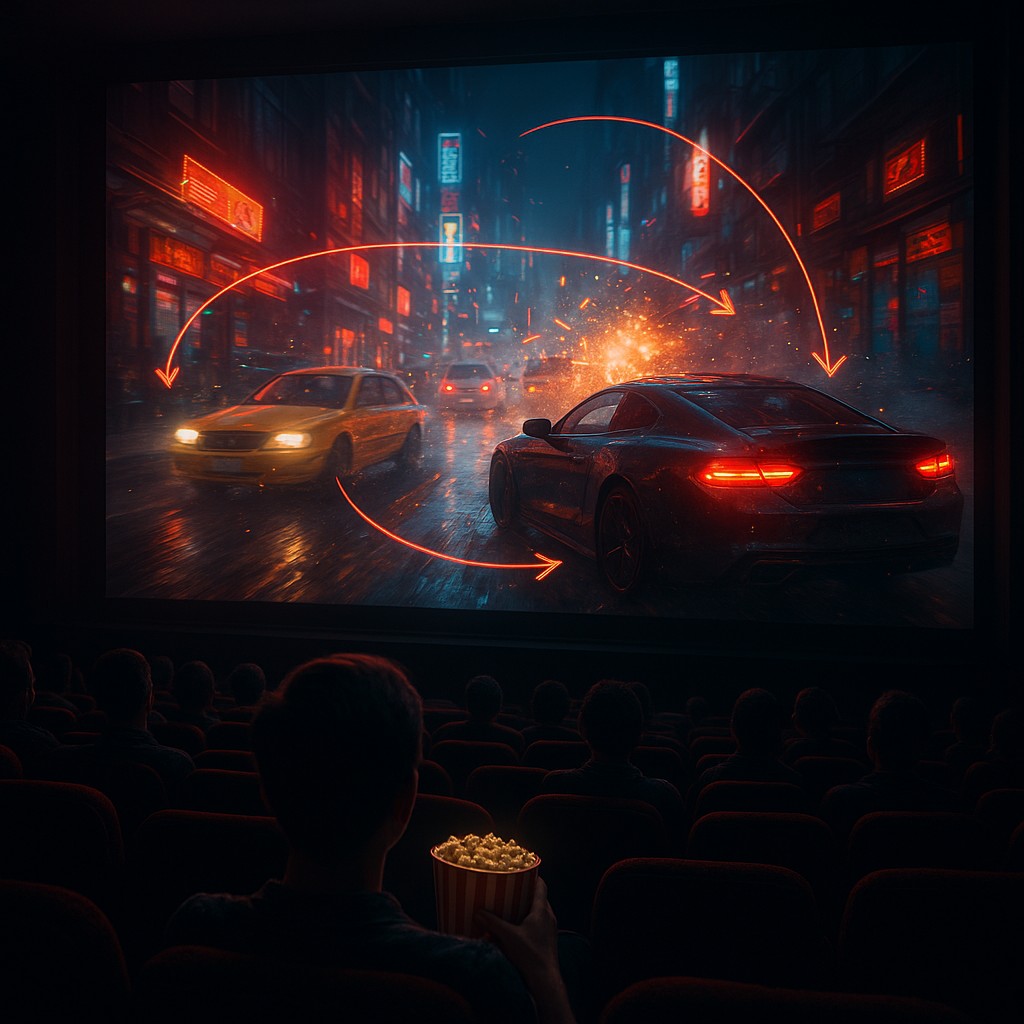
Imagine sitting in a dark theater with a bag of popcorn, watching a high-speed chase through neon-lit city streets. Cars weave through traffic, glass shatters, and the camera cuts from the driver’s focused eyes to screeching tires every split second. Even though you are seeing dozens of different angles stitched together in a frantic rhythm, you never lose the thread of the story. You know exactly where the villain is, how close the hero’s bumper is to the wall, and where the next explosion will hit. Your brain processes this chaotic mix of visual data as one smooth, continuous event rather than a series of choppy photos.
This seamless experience isn't just a byproduct of high-tech cameras or pricey special effects. It is the result of a clever psychological tool called eye-trace. Film editors act like puppeteers for your eyes, using the screen’s layout to pull your gaze exactly where they want it to go. When an editor gets eye-trace right, they are working in harmony with how our bodies handle motion and focus. When they fail, you get that dizzy, nauseating feeling often found in "shaky cam" movies, where it is impossible to tell who is hitting whom or which way a car is turning. Understanding eye-trace is the key to moving past simply watching a movie and beginning to see the hidden structure of visual storytelling.
The Cognitive Glue of Motion Pictures
To understand eye-trace, we first have to look at how the human eye actually works. We like to think our vision is a steady, high-definition live stream, but the reality is much more twitchy. Our eyes move in quick jumps called saccades. Our brains effectively "shut off" the feed during these jumps to keep us from seeing a blurry mess. However, when we focus on a specific object, our eyes want to stay locked on those coordinates. Editors take advantage of this by making sure the most important part of "Shot B" appears in the exact same spot on the screen where your eyes were resting at the end of "Shot A."
If a hero fires a gun in the top right corner of the screen, your eyes naturally fly there. If the next shot shows the target falling in the bottom left corner, your brain has to perform a physical "handshake" between your eye muscles and your visual center to find the new subject. This takes only milliseconds, but in a fast-paced action scene, those moments add up to mental burnout. By aligning these focal points, the editor lets your brain stay "in the zone," processing the story instead of hunting for the characters. It is the difference between a smooth highway and a road full of potholes; the destination is the same, but one leaves you exhausted while the other feels effortless.
Geometric Harmony and the Rule of Six
Legendary film editor Walter Murch, the man who shaped the flow of Apocalypse Now and The Godfather, explained the importance of eye-trace in his famous book, In the Blink of an Eye. He developed the "Rule of Six," a ranking of what makes a good cut. Many people assume the most important part of a transition is technical consistency, like making sure a character is holding a coffee cup in the same hand from shot to shot. In reality, Murch places eye-trace much higher on the list than literal logic.
His ranking suggests that as long as the emotion and the rhythm are right, and the eye-trace is handled with care, a viewer will ignore a character’s shirt changing color or a wall clock jumping forward three hours. This is because eye-trace provides the "spatial logic" of the scene. If the editor keeps the geometry of where you are looking consistent, the brain accepts the scene as a single reality. We are biologically wired to follow the path of least resistance. A well-placed eye-trace acts as a gentle nudge in the right direction, turning 24 still frames per second into a living experience that mimics how we see the world when we move our heads.
Managing the Viewer's Visual Budget
Every cut in a movie carries a "mental cost." When the scene switches, your brain has to re-orient itself to a new setting, new lighting, and new character positions. Editors treat their audience as having a limited "visual budget" for each scene. If you spend that budget making the viewer work to find the subject of a shot, they will have less energy left to feel the emotion of the acting or follow a complex plot. Eye-trace acts as a management system, saving the viewer's focus for what truly matters.
| Technique |
Goal |
Viewer Experience |
| Match-on-Action |
Align movement across a cut |
The transition feels invisible and full of energy. |
| Center-Framing |
Keep the subject in the middle |
Provides maximum clarity, often used in fast action. |
| Leading Lines |
Use shapes to point to the next focus |
Creates a sense of anticipation and flow. |
| Contrast Pull |
Use light or color to grab the eye |
Forces the eye to a specific spot instantly. |
By using the methods in the table above, editors create a "pathway" for the eyes. In a scene where two people are talking, if Actor A is looking toward the right side of the frame, the editor will often place Actor B on the left side in the next shot. This creates a psychological "line" that the eye follows across the cut. If both actors were on the same side of the screen, the viewer's eyes would have to jump back and forth awkwardly, creating a "cross-eyed" feeling that pulls them out of the story. This mapping is the invisible thread that holds a movie together.
Common Misconceptions About Fast Cutting
A common myth among moviegoers is that "fast editing" is naturally bad or confusing. People often point to modern blockbusters and complain that shots are too short to understand. However, the problem usually isn't the speed of the cut; it is a failure of eye-trace. A series of half-second shots can be perfectly clear if the editor keeps the focal point of every shot in the exact center of the frame. This is a technique famously used in Mad Max: Fury Road. Director George Miller and editor Margaret Sixel made sure the "crosshairs" of the viewer's vision almost never had to move.
When the subject is always in the center, the brain can process images incredibly fast because the "search time" is zero. You aren't scanning the frame; you are simply taking in the center. Conversely, a scene with long, slow shots can feel confusing if the camera pans wildly and the subjects are scattered at the edges of the frame without a clear relationship to one another. Placement is the true king of clarity. If you understand where the viewer is looking, you can cut as fast as you want, and they will still follow the rhythm of the story like a heartbeat.
The Invisible Architecture of the Screen
As digital media shifts toward shorter formats like social media reels and vertical videos, eye-trace has become even more important. In a vertical video, the screen is narrow, meaning the eyes have less horizontal ground to cover, but vertical eye-trace becomes vital. If a creator puts a text bubble at the top of the screen and then transitions to a subject at the very bottom, they risk losing the viewer’s attention. The most successful viral editors have an intuitive grasp of where the thumb rests and where the eye naturally falls. They keep the core information in a "hot zone" that requires the least physical effort to track.
This concept also applies to video games and virtual reality (VR). In VR, "eye-trace" becomes "head-trace." Designers use light, sound, and movement to pull the player’s entire head toward the next goal. If they teleport a player to a new spot without a visual anchor, it causes motion sickness because the brain cannot make sense of the sudden change. Whether it is a multi-million-dollar action movie or a fifteen-second clip on a phone, the principle is the same: you must respect the physical journey of the viewer's gaze.
The next time you are swept up in a great movie, try to catch the editor in the act. Look for where your eyes land at the very first frame of a new shot. You will likely find that you were already looking there before the cut even happened. This realization doesn't ruin the magic; it improves it. It reveals the incredible precision required to make art feel natural. By mastering the geometry of the gaze, editors don't just show us a story; they lead us through it, ensuring that even in the most chaotic moments, we never truly lose our way. This silent conversation between the screen and the eye is what transforms a series of pictures into a pulse-pounding cinematic experience.